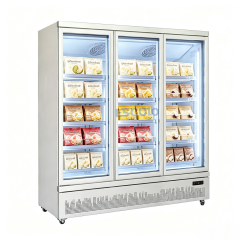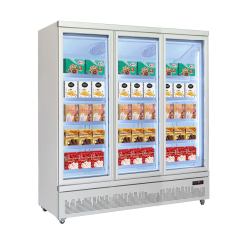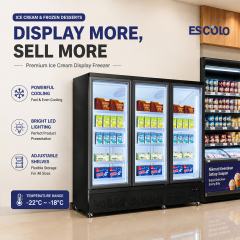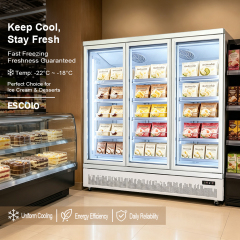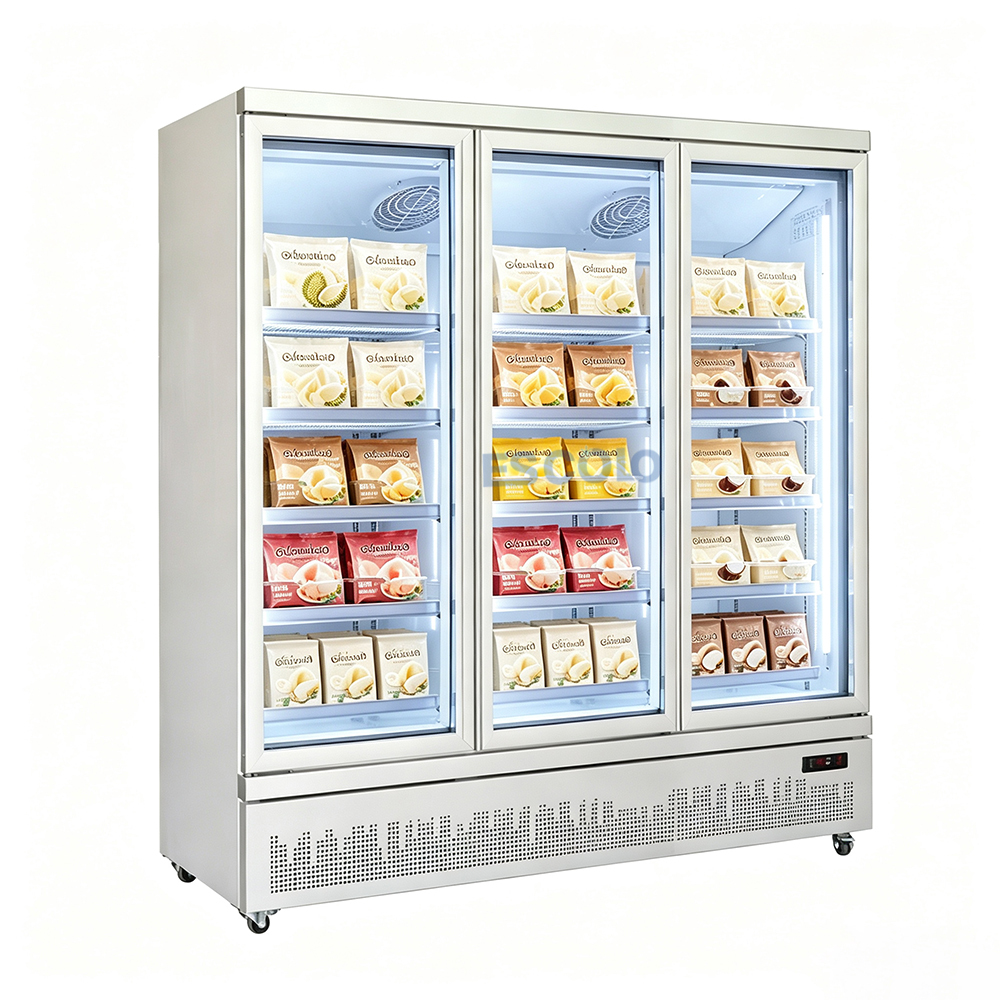
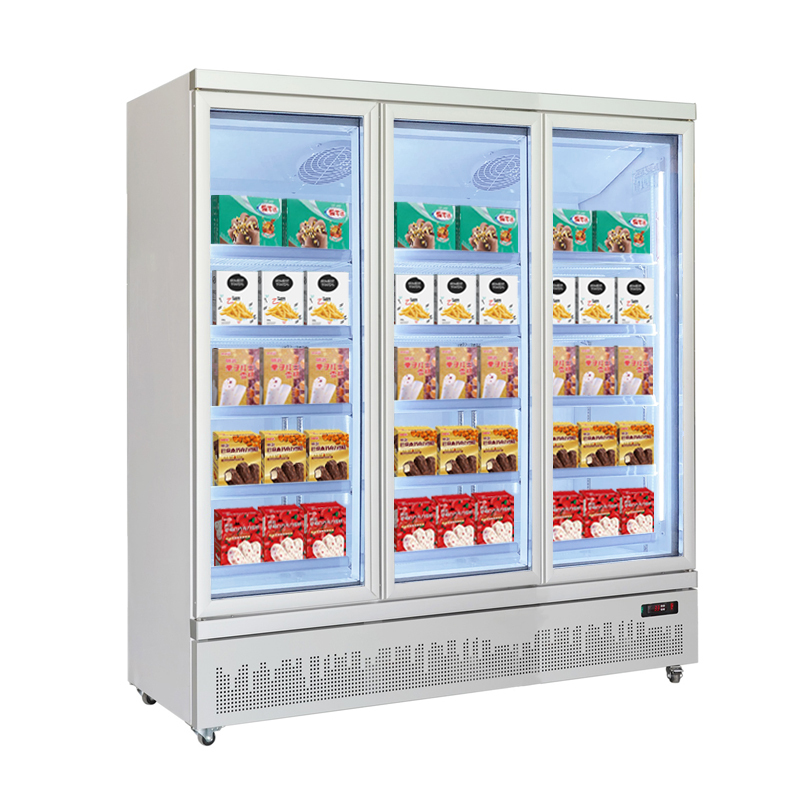
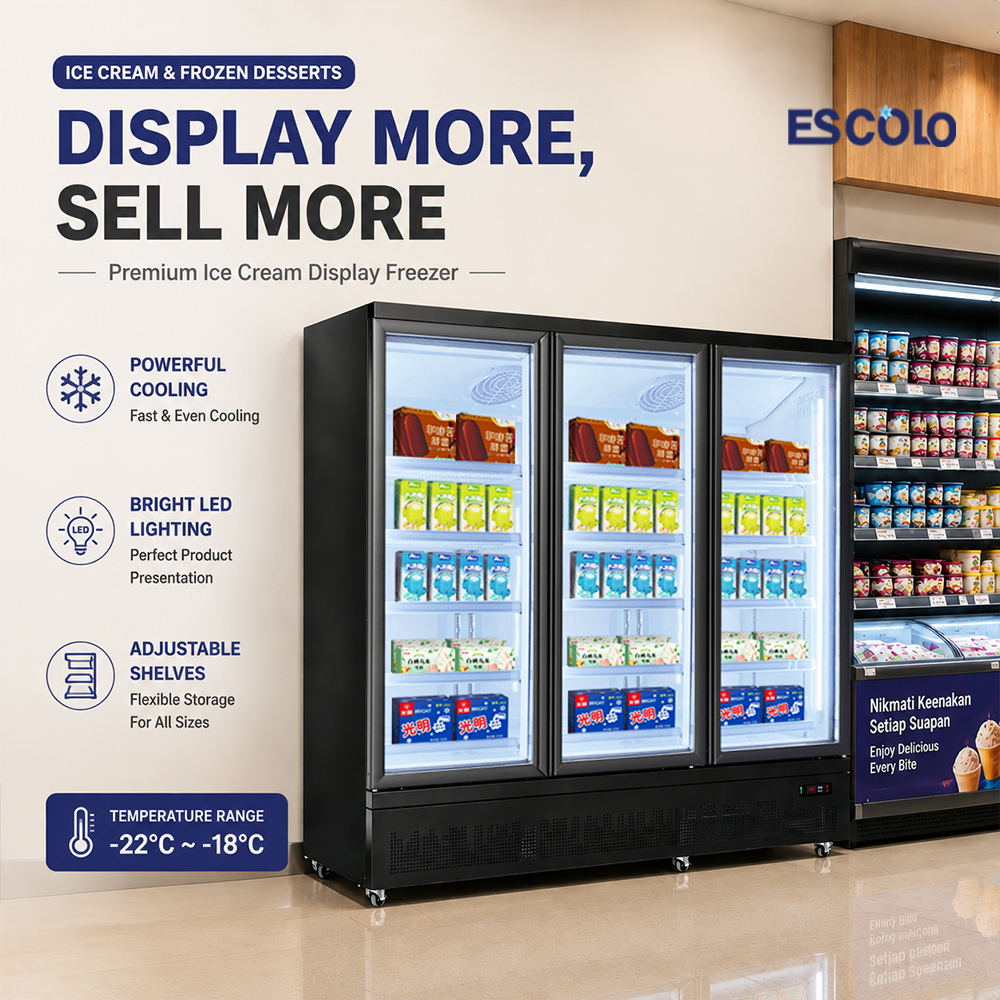
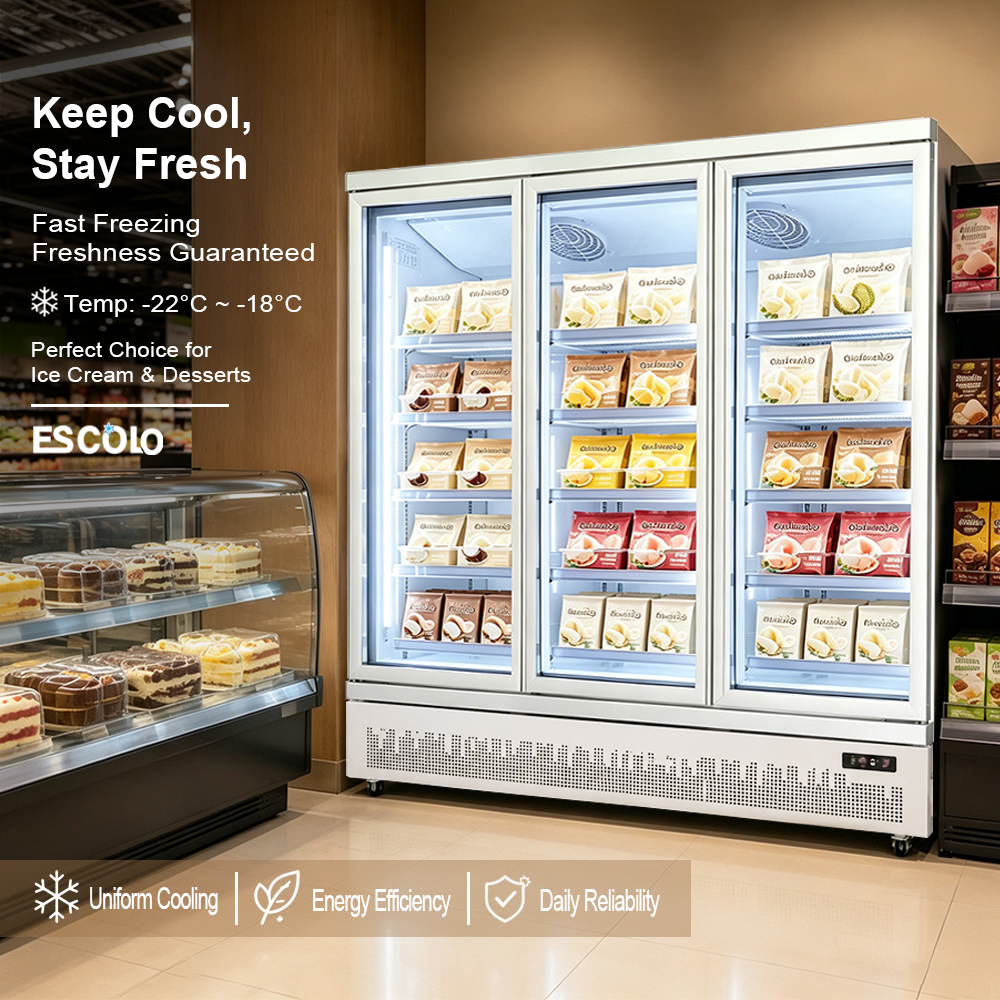
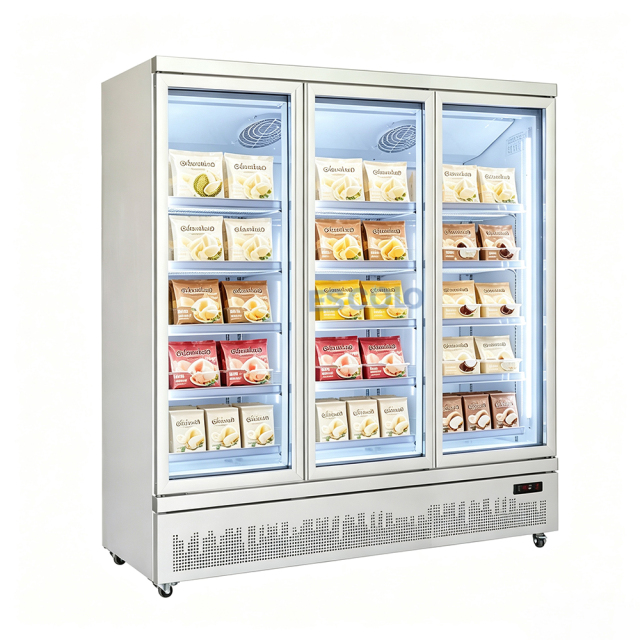
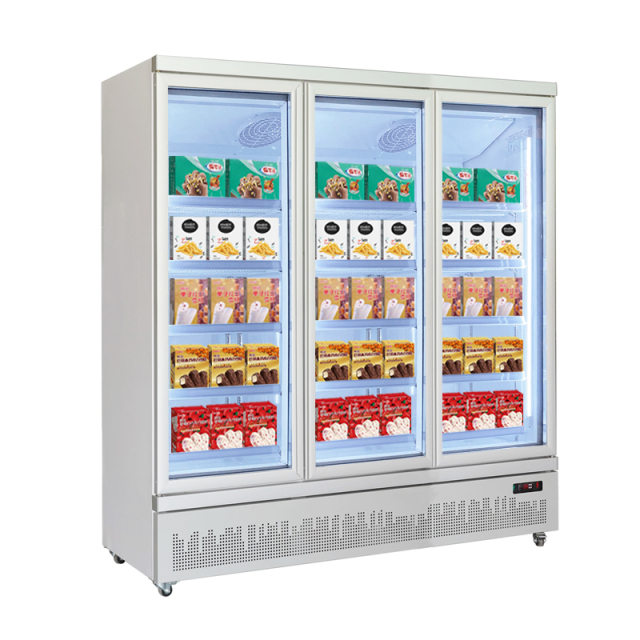
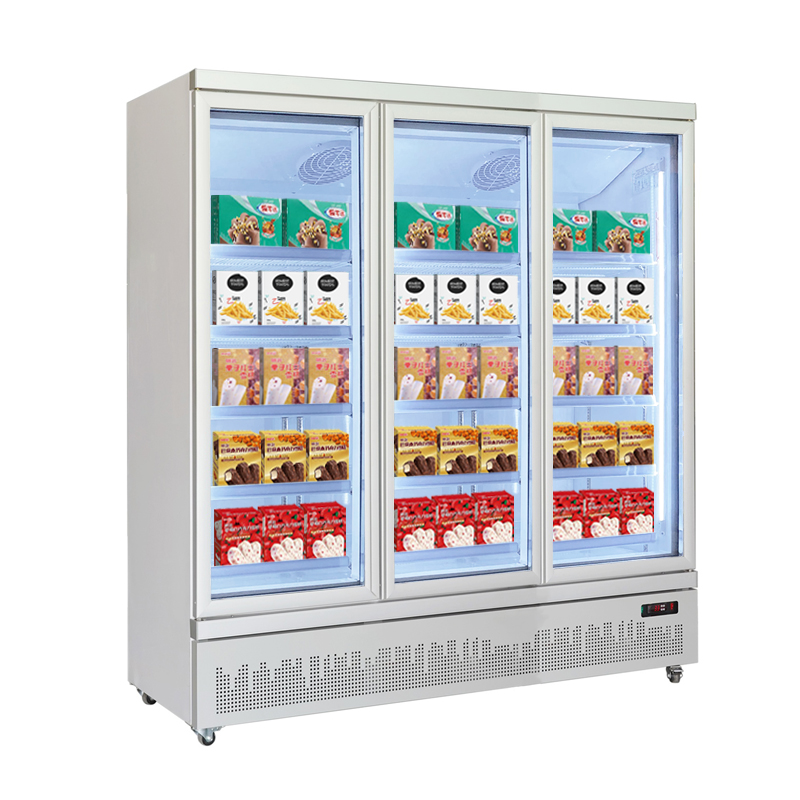
Frozen aisles are hard on a display cabinet. Doors open and close all day, trolleys pass within centimetres of the glass, and shoppers expect to read a label without hunting for it. The ESCOLO ESD-B1880-3M-F is arranged around those three jobs: a listed capacity of 1800L, three heated hollow glass doors across the front and a full column of shelves behind each one. It is an upright display freezer for frozen food, a triple door stand up refrigerator built for commercial display rather than back-room storage.
The cabinet suits supermarkets, frozen food operators and larger convenience stores that want frozen stock visible from the aisle. Packaged ice cream, frozen desserts, snacks, vegetables, ready meals and seafood all sit inside the working range of -22 °C to -18 °C. Where a store is moving a frozen section out of chest freezers, this commercial glass door freezer replaces them: customers browse at eye level instead of reaching down into a well, and staff restock from the front of the cabinet.
Refrigeration sits at the bottom of the unit. A bottom mount freezer for supermarket aisles keeps the compressor, condenser and fan low, which leaves the full height of the interior free for display and puts the serviceable parts within reach of a technician without dismantling the display. Inside, vertical LED lighting and PVC shelves with price-tag strips carry the stock.
Day to day, staff work one door at a time — open a section, fill it, close it, and the other two stay sealed. A digital panel keeps the set temperature visible, automatic defrost handles frost on the evaporator, and a self-evaporating water tray takes the melt water away.
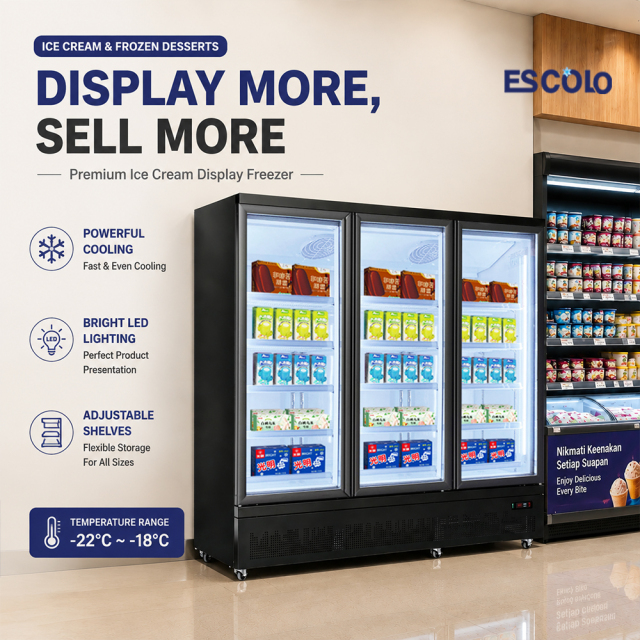
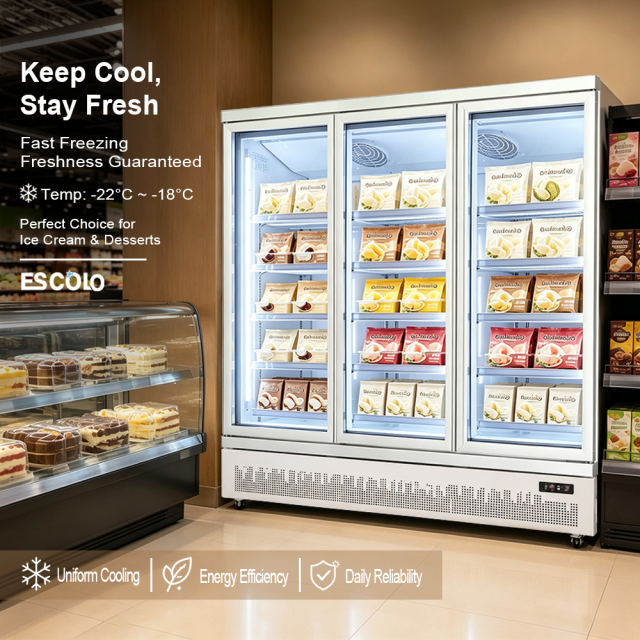
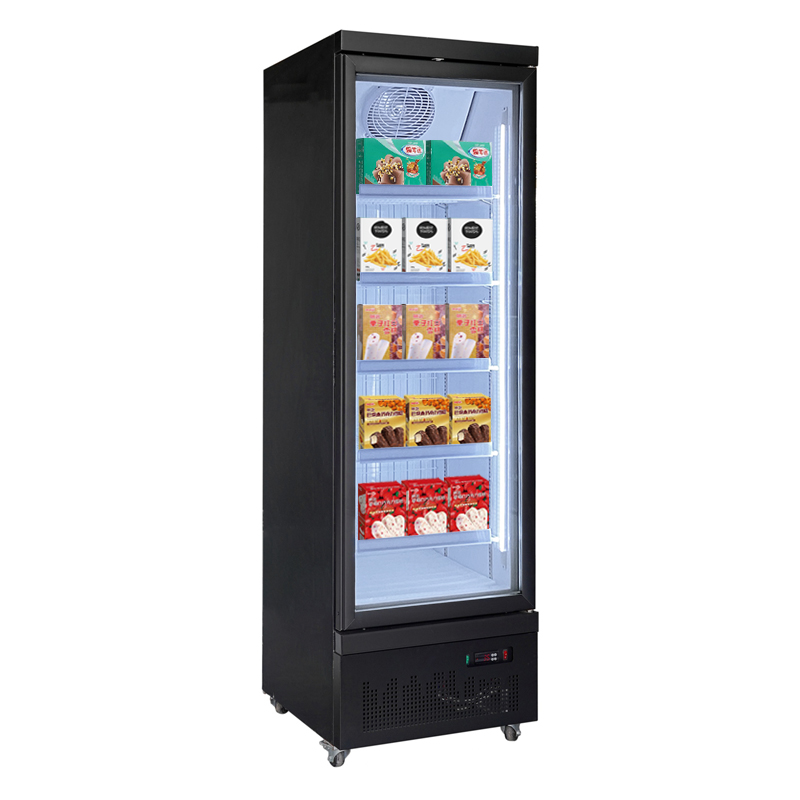
Photographs of the cabinet and of the other door counts in the same family show the door layout, the shelf positions and the interior lighting, which is useful when you are matching a cabinet to an existing frozen run.
Distributors planning an 1800L commercial fridge wholesale programme for a chain can lay out a frozen aisle around this three-door cabinet and its two-door and four-door siblings without changing the operating logic between stores.
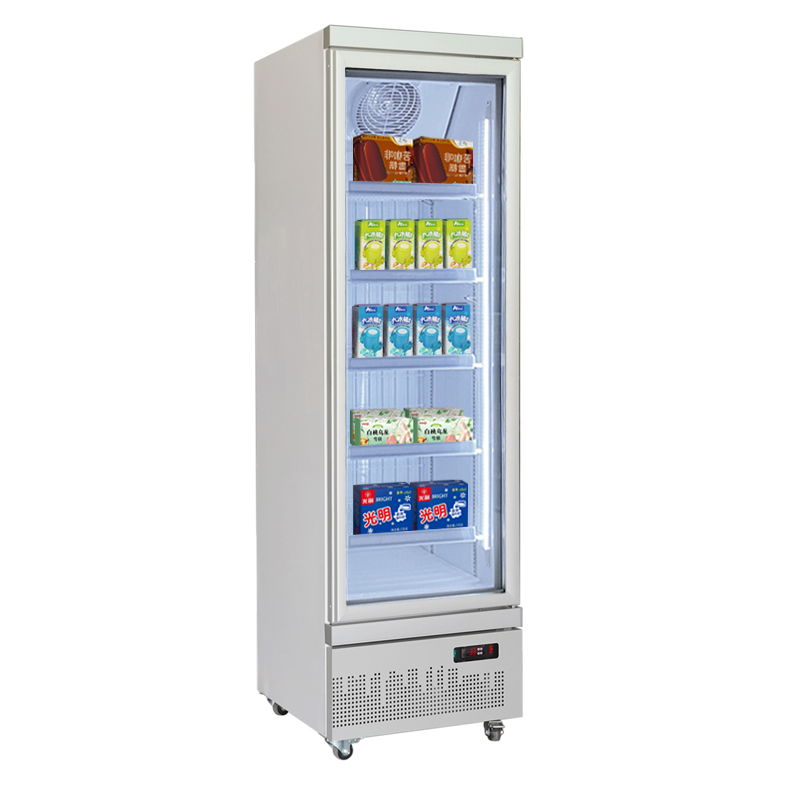
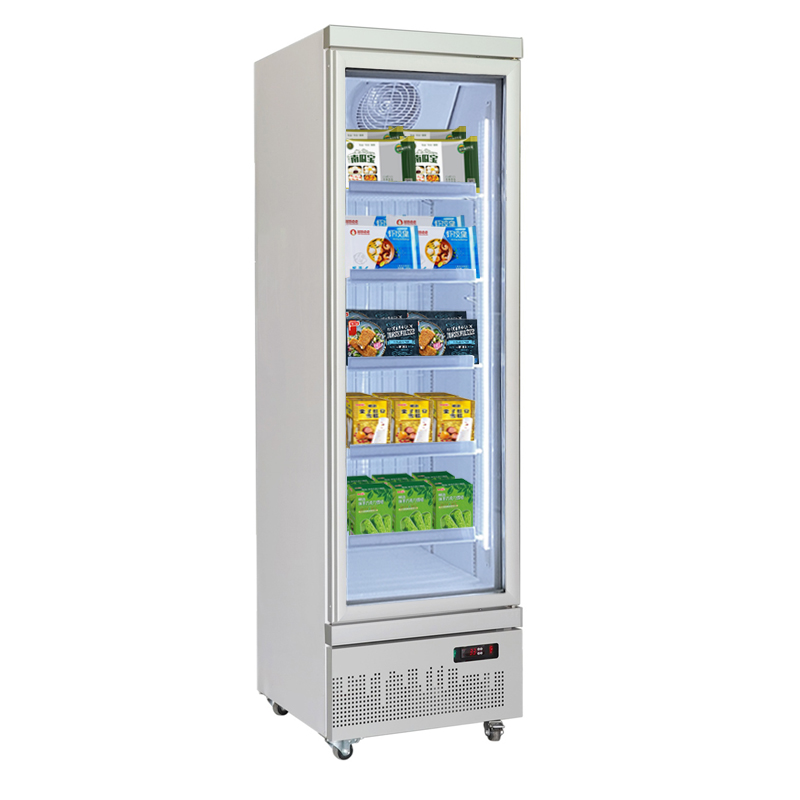
Every model in the series is an upright display freezer for frozen food working to the same -22 °C to -18 °C range; the table runs from the 500L single-door up to the 2000L four-door, with the 1800L three-door ESD-B1880-3M-F covered on this product.
| Model | Doors | Dimensions (W × D × H) | Listed capacity | Operating temperature | 20GP / 40HQ |
|---|---|---|---|---|---|
| ESD-B620-1M-F | 1 | 635 × 710 × 2030 mm | 500L | -22 °C to -18 °C | 24 / 51 |
| ESD-B700-1M-F | 1 | 700 × 660 × 2005 mm | 700L | -22 °C to -18 °C | 24 / 51 |
| ESD-B800-1M-F | 1 | 800 × 750 × 2030 mm | 800L | -22 °C to -18 °C | 21 / 42 |
| ESD-B1250-2M-F | 2 | 1253 × 710 × 2030 mm | 1200L | -22 °C to -18 °C | 12 / 27 |
| ESD-B1880-3M-F | 3 | 1880 × 710 × 2030 mm | 1800L | -22 °C to -18 °C | 9 / 18 |
| ESD-B2500-4M-F | 4 | 2508 × 710 × 2030 mm | 2000L | -22 °C to -18 °C | 6 / 12 |
The three-door layout is the part of this upright display freezer for frozen food that changes how a frozen section is run. Each door covers its own column of shelves, so the cabinet width divides into three self-contained bays rather than one long open span.
That matters most when a range has to be split. A supermarket can give ice cream one door, frozen desserts a second and savoury frozen food a third, then repeat the same logic on every shelf within each door. A convenience store with a shorter range can work the doors differently — own-brand on one side, branded lines in the middle, promotional packs on the right — and change the split when a promotion starts without emptying the whole cabinet.
For customers the result is navigation. Instead of scanning a wall of mixed packaging, they learn where their category lives and go straight to it. For staff it means a restock can be planned door by door: pick the section that has sold down, open it, work it, close it, and leave the other two sealed and cold.
Door swing needs planning before the cabinet is positioned. The three doors are hinged and open outward, so the aisle in front has to carry both customer traffic and a person standing at an open door. Check the run against your aisle width, and against any adjacent cabinet, counter or promotional stand.
Cold-air loss behaves differently from a single-door cabinet too. Opening one section of a three door freezer with heated glass doors leaves the other two closed, which is why the format holds up in frozen aisles where doors are in near-constant use. Fan circulation and the defrost cycle do the recovery work; loading discipline does the rest.
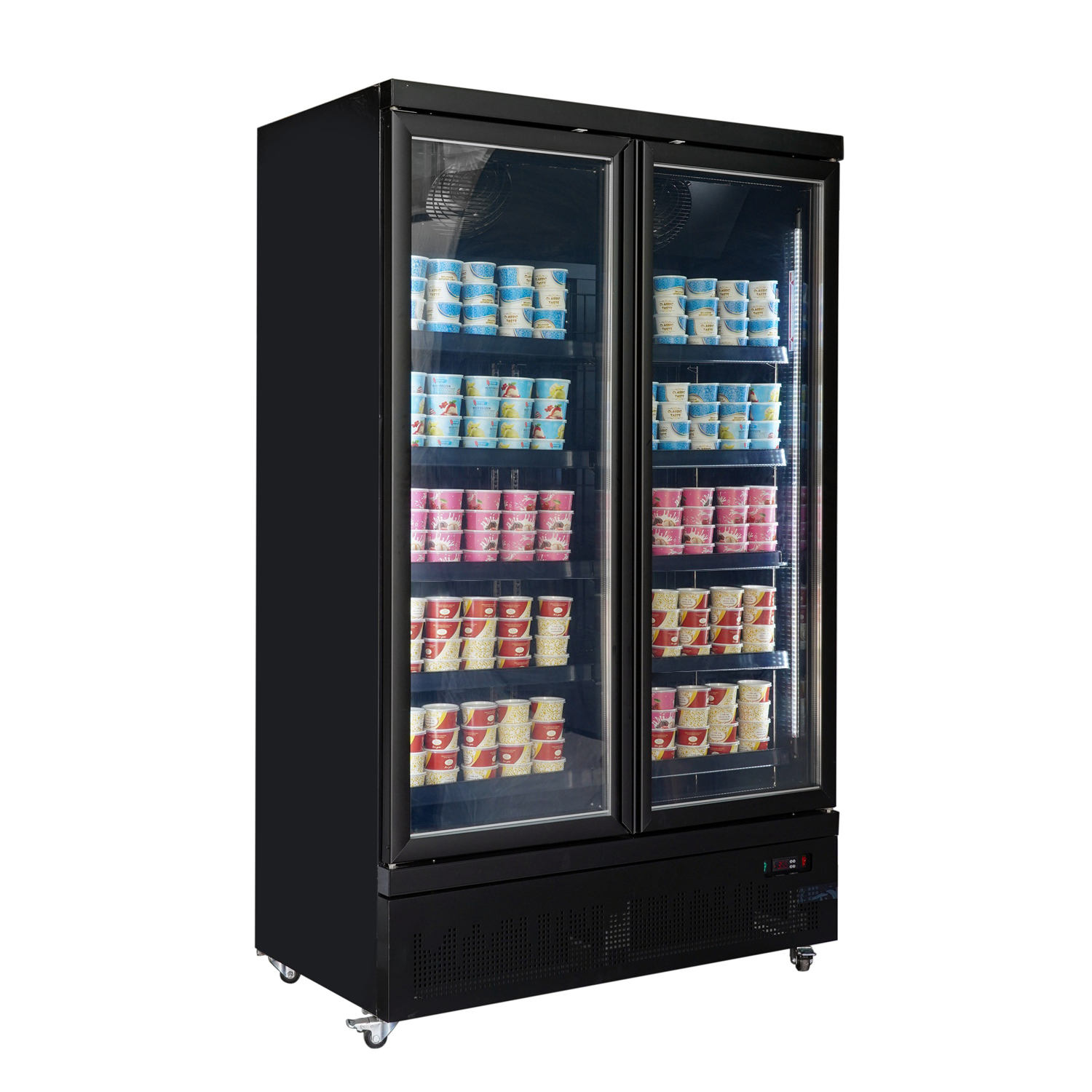
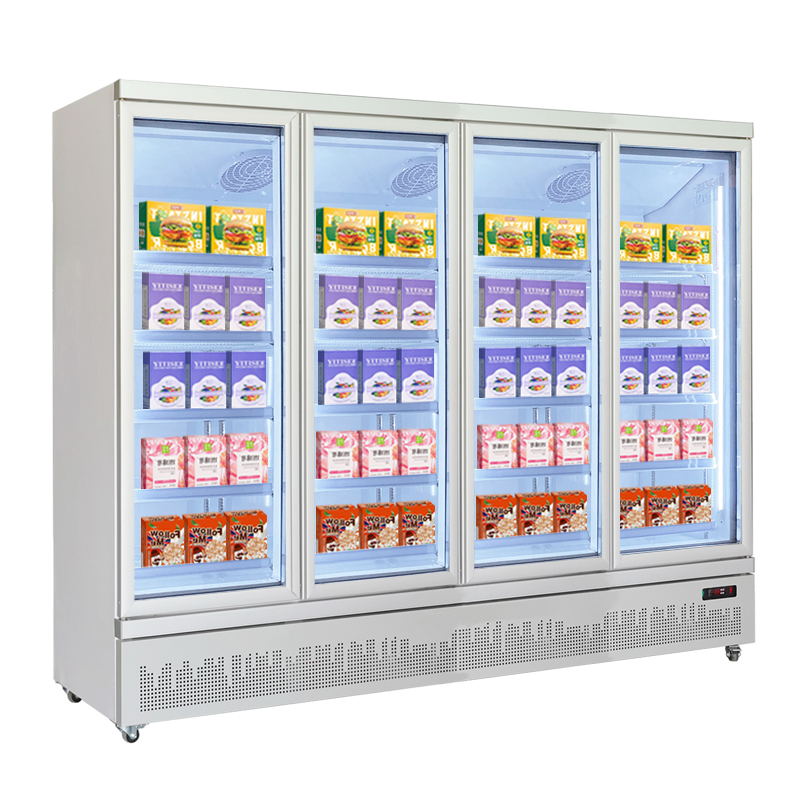
Heated hollow glass is what keeps a frozen cabinet readable in a warm, busy store. A hollow glass door is two panes with a sealed cavity between them, and a heating element in that assembly lifts the glass temperature just enough to keep condensation from settling on the surface.
Fogging is not a cosmetic problem. A misted door hides the label, and a shopper who cannot read a label either opens the door or walks away. On a three door freezer with heated glass doors, the heating is there so that browsing happens through the glass rather than through an open door, which is also the cheaper way to run a freezer.
The doors are framed in aluminium. The frame holds the glazing in a rigid surround, carries the load at the hinge points and gives the door a straight edge that seats against the cabinet gasket. Aluminium also keeps the door light enough for a customer to open one-handed while holding a basket.
How clear the glass stays depends on the store rather than on the door alone: humidity, footfall, how close the cabinet sits to an entrance or a baking area, and whether the gasket is sealing properly all play a part. Expect easier conditions in a climate-controlled supermarket and harder ones in a humid convenience store with constant traffic.
Cleaning the glass and frame is a routine job, not a technical one — a soft cloth, a mild detergent, no abrasive pad. Check the door gasket and the hinge fixings on the same walk-round as the shelves, and report a door that no longer closes flush.
Before the layout is fixed, confirm door opening clearance and the exact door configuration with our team, particularly if the cabinet will sit at the end of a run, against a wall or beside a return.
One detail worth knowing: the door cavity is sealed, so the assembly should never be drilled, fitted with third-party signage or have anything screwed into the frame.
Cooling in this cabinet is by air. A fan draws cold air across the fin-type evaporator and pushes it through the interior, so all three doors work with the same air temperature instead of a cold patch at one end and a warm one at the other.
Air cooling also means airflow is something the store controls. A shelf loaded right to the front edge, a pallet parked against the return grille or a cabinet pushed tight into a corner will each interrupt the pattern. Leave a hand's width behind and above the stock, and keep the grille clear.
Automatic defrost handles the frost that builds on the evaporator while the cabinet runs. The controller takes the system through a defrost cycle, drains the melt water and returns to normal cooling, so nobody has to empty the cabinet and scrape it by hand.
That melt water goes to a self-evaporating tray at the base of the unit. Rather than a drip tray that has to be emptied, the water is evaporated off using the warmth around the compressor area. The tray still belongs on the maintenance rota — check it and the drain line for debris and stray packaging when the cabinet is cleaned.
Because the refrigeration pack sits at the bottom, the machine is also easier to reach. A technician can get to the condenser, the fan and the tray from the front of the unit, and the condenser coil can be brushed or vacuumed during a routine service visit — worth scheduling in a store where flour, dust or cardboard fibres hang in the air.
If the cabinet ever stops holding temperature, check the simple things first: a door left ajar, a gasket held open by a crate flap, a blocked grille, or a defrost cycle in progress. Note the panel reading before calling for service, because it tells the technician which way to look.
Lighting inside a frozen cabinet has two jobs: make the pack readable and make the category look worth buying. Vertical LED strips run the height of each door section, so light reaches the top shelf and the bottom shelf with the same intensity instead of pooling in the middle.
That matters more than it sounds. Frozen packaging is often glossy, printed in pale colours and stacked behind glass that reflects the store's own ceiling lights. A lit interior gives the customer a clean read of the front of the pack, which is where flavour, size and price live.
The shelves themselves are PVC. Each shelf carries a price-tag strip along its front edge, so pricing sits directly under the product it belongs to and can be changed when a promotion starts or ends without reprinting labels for the whole cabinet. PVC also wipes clean and does not rust in a cold, damp interior.
Shelf quantity and adjustment are worth fixing before you order. Deep tubs, tall ready-meal boxes and flat snack bags all need different spacing, and the number of shelf positions you want depends on the mix you carry. Tell us the pack sizes you plan to display and we will confirm the shelf configuration that suits them.
The practical rule inside the cabinet is the same as outside it: leave a gap at the back and do not stack above the shelf line. Light reaches the pack, air reaches the pack, and the customer sees the front of the pack instead of the crushed side of a box that has been pushed to the back.
Orders are quoted against your destination, quantity and configuration. The commercial glass door freezer range starts at 1 container, and the series table shows how each door count packs for a 20GP or 40HQ shipment — worth sharing with your freight forwarder early so the container plan matches the order.
When you request a quotation, the details that speed it up are the destination country and port, the quantity required, the application (supermarket frozen aisle, convenience store or distribution), the electrical requirement for that market, and any branding, packaging or finish requests. Add the store's installation dimensions if the cabinet has to fit an existing recess, and the pack sizes you intend to display if you want the shelf configuration confirmed at the same time.
Customisation for distributors and chain store groups is handled project by project. Ask our team which logo, finish, packaging or structural options are available for this model and what the order conditions are; scope and schedule are confirmed in the quotation rather than assumed.
Before shipment we confirm the final technical datasheet, the approved order configuration, packaging details, shipping dimensions and the electrical specification for your market, so the documentation matches the exact model being loaded. Packed dimensions, gross weight and the confirmed loading quantity for your shipment come with the order confirmation, ready for freight booking.
After delivery, our After-Sales Support & Warranty arrangement covers the cabinet. Ask your sales contact for the current terms that apply in your market, and keep the serial details and the installation record together in the store's equipment file.
ESCOLO has manufactured commercial refrigeration equipment in Foshan, Guangdong since 2010, and the team now numbers more than 800 people. Fifteen-plus years in the trade, a network of 3,000+ qualified partner factories and an annual output of 200,000+ units let us run container-scale programmes and repeat orders for supermarket, convenience and foodservice buyers. OEM and ODM work is standard: size, colour, function and your own branding are set to the specification you send. Factory audit, pre-shipment inspection, consolidated shipping and after-sales support are handled in-house.
It is an upright glass door freezer for frozen food storage and display. Supermarkets, frozen food distributors and convenience stores use it to hold packaged frozen food at -22 °C to -18 °C while keeping the stock visible from the aisle. The three doors split a frozen range into sections, and it replaces chest freezers or closed storage where customers need to see the product before choosing. It is a display freezer, not a chest freezer and not an open ice cream dipping cabinet.
-22 °C to -18 °C. That is a storage range for packaged frozen food, so check the storage recommendation on each product line before you commit a range to the cabinet. Actual performance in store depends on the ambient temperature, how often the doors open and how the cabinet is loaded.
Width, depth and height for every model in the family are set out in the specification table, measured as width × depth × height. On site, allow extra space for the doors to open, for the delivery route into the store, and for ventilation and service access around the unit.
The listed capacity is 1800L. Usable space depends on where you set the shelves and how bulky the packs are; deep tubs and tall boxes take more room than flat bags. Leave space behind and above the stock so air can circulate.
Yes, for packaged ice cream and frozen desserts that sit within -22 °C to -18 °C. It is an upright glass door cabinet rather than an open-top dipping display, so it suits pre-packed tubs, boxes and multipacks rather than scooping and serving.
The doors are heated hollow glass, and the heating is there to keep condensation from clouding the view. How clear the glass stays depends on store humidity, footfall, door discipline and the condition of the gaskets.
This is a bottom mount freezer for supermarket and convenience store layouts, with the refrigeration pack at the base of the cabinet. A fan draws cold air across the fin-type evaporator and circulates it through the interior, so all three sections work at the same air temperature. Keep the shelves and the return grille clear so the airflow can do its job.
No. Automatic defrost takes the evaporator through a defrost cycle and drains the melt water, so there is no manual scrape-and-empty routine. Staff should still inspect the interior, the drain line and the tray during routine cleaning.
It collects the water produced during defrost and evaporates it off using the warmth around the compressor area, so there is no drip tray to empty. Check it for debris and packaging scrap when you clean the cabinet.
The shelves are PVC with price-tag strips along the front edge. Quantity and spacing are worth agreeing before you order — tell us the tubs, boxes and bags you plan to display and we will confirm the shelf configuration that fits them.
The electrical specification is set for the destination market. Voltage, frequency, rated current, power consumption and plug type are confirmed on the datasheet for your country, so ask us for that data before the order is placed and check it against the store's supply and socket.
Yes, where the frozen range justifies a three-door cabinet of this size. Measure the floor area, the aisle width for door swing and the ventilation available before you commit. A triple door stand up refrigerator takes more aisle than a single-door cabinet, and smaller stores often step down to the two-door 1200L or single-door models in the same family.