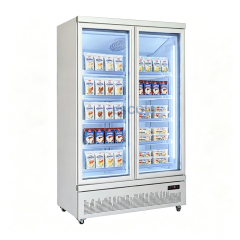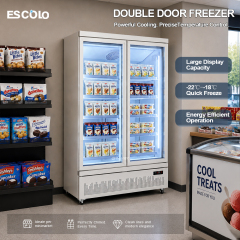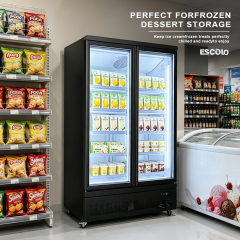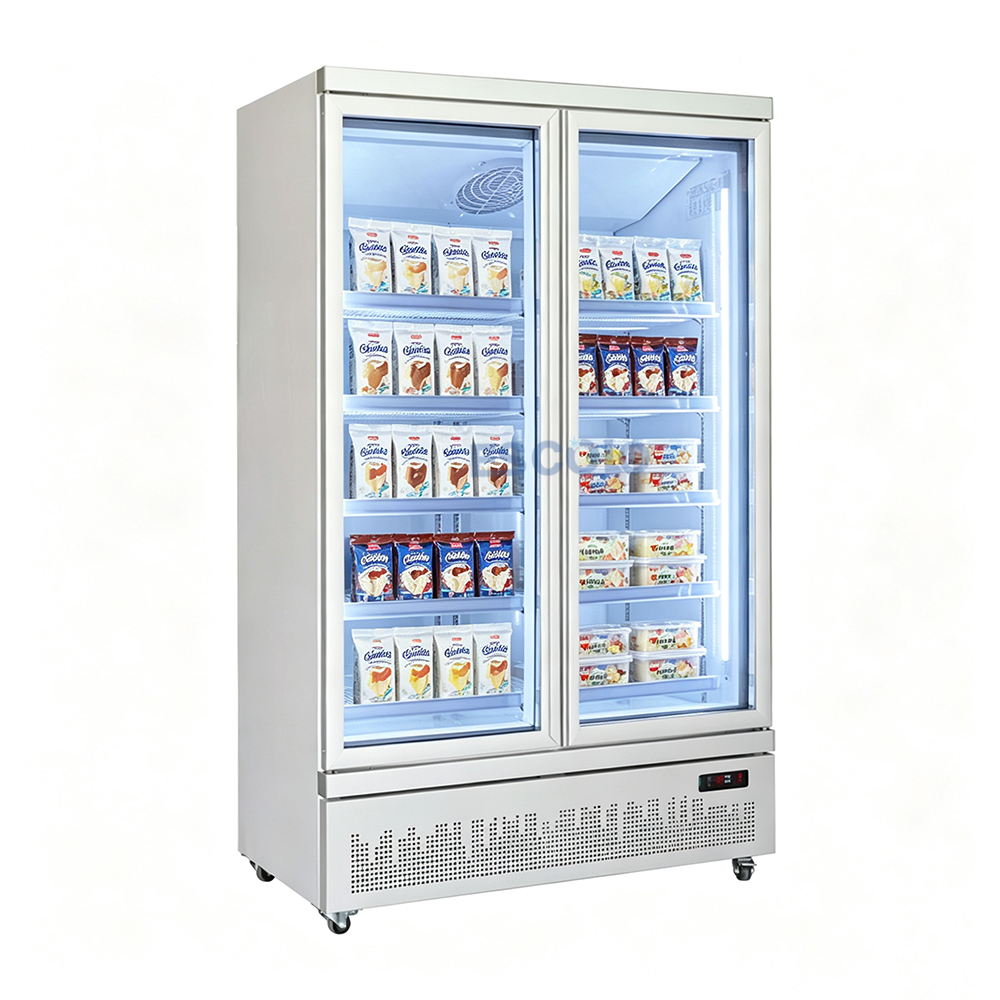
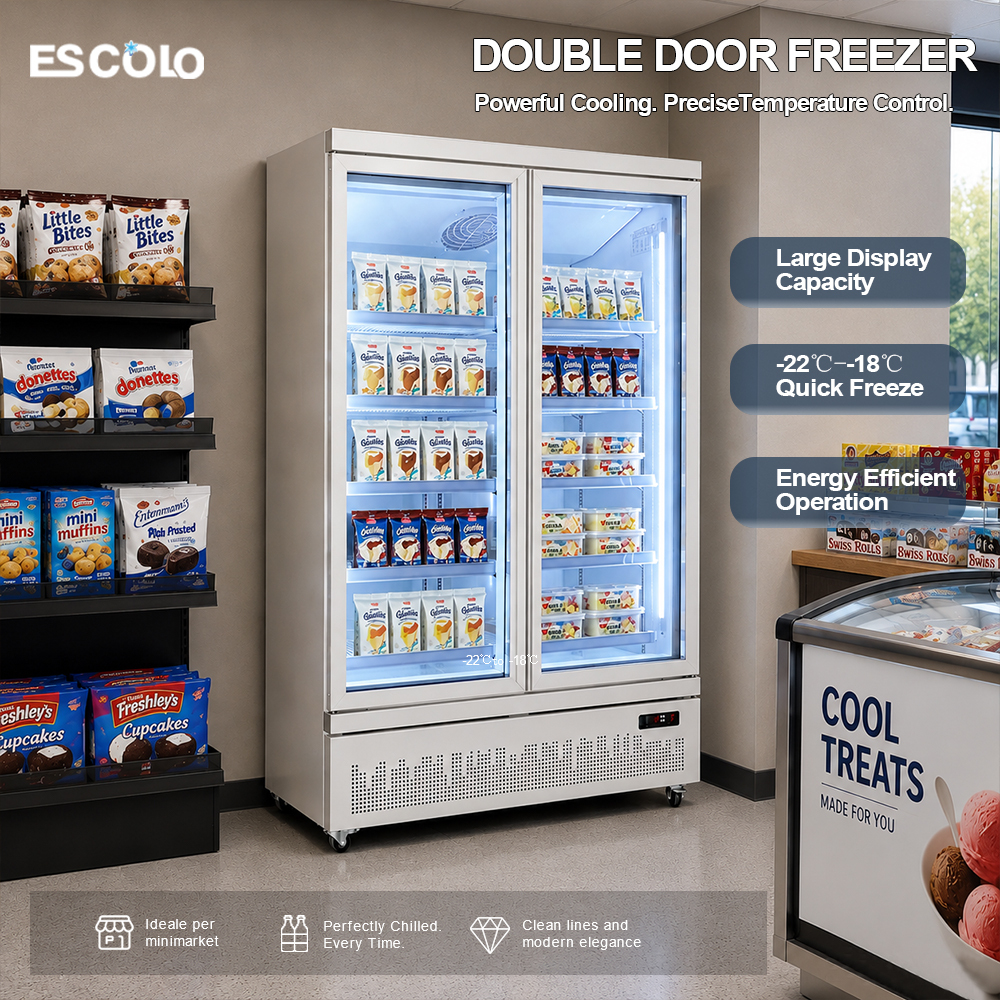
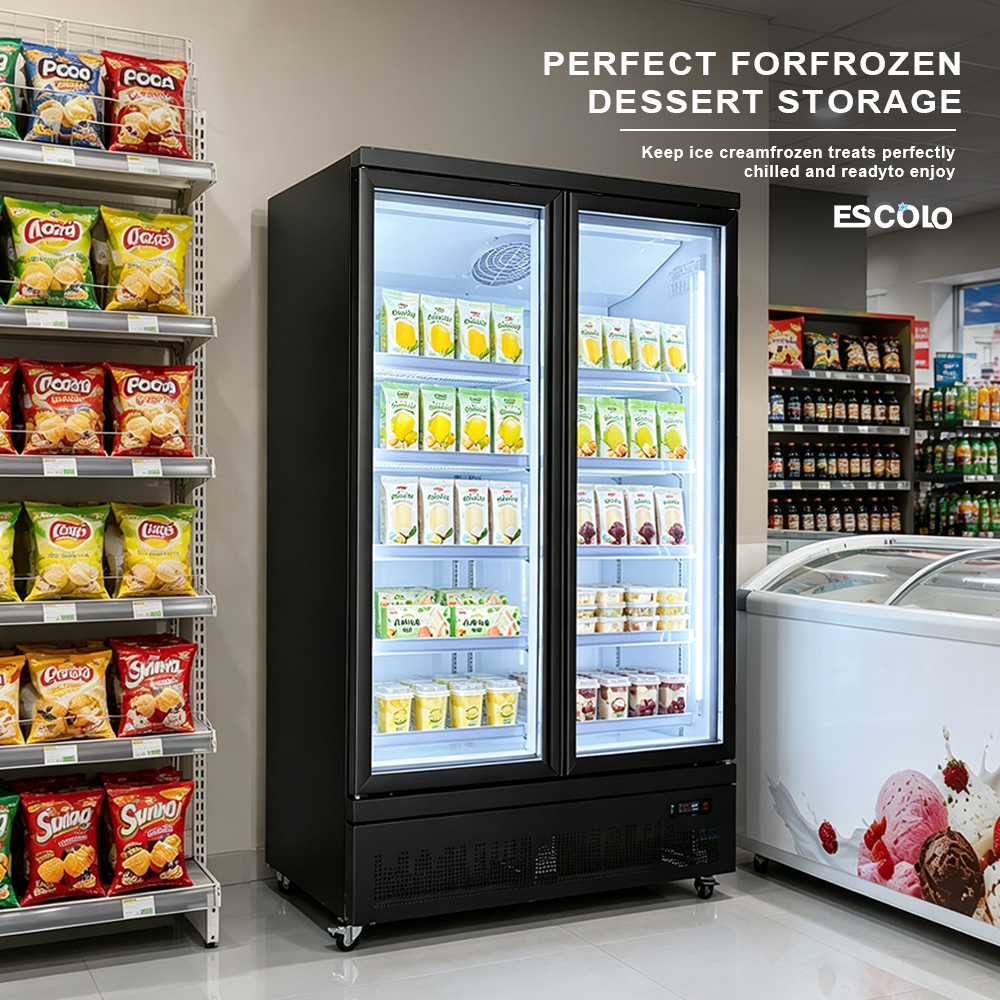
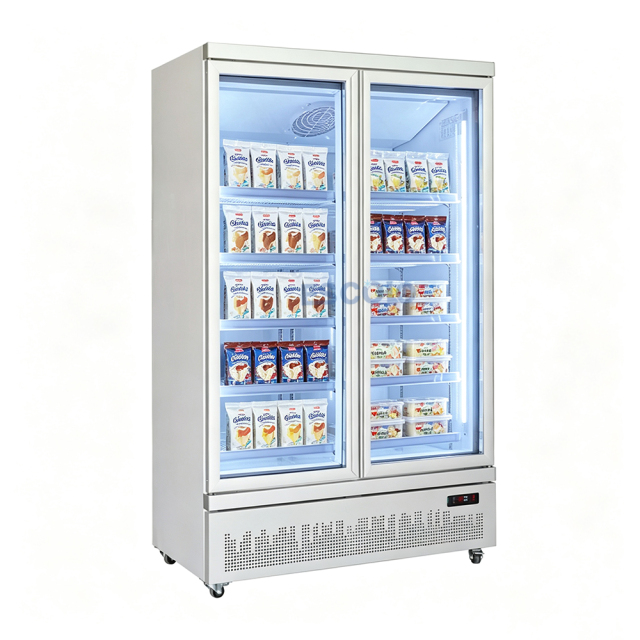
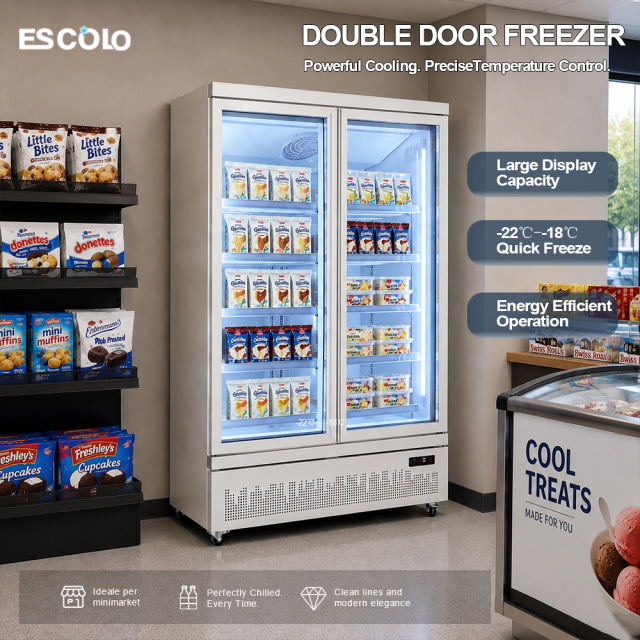
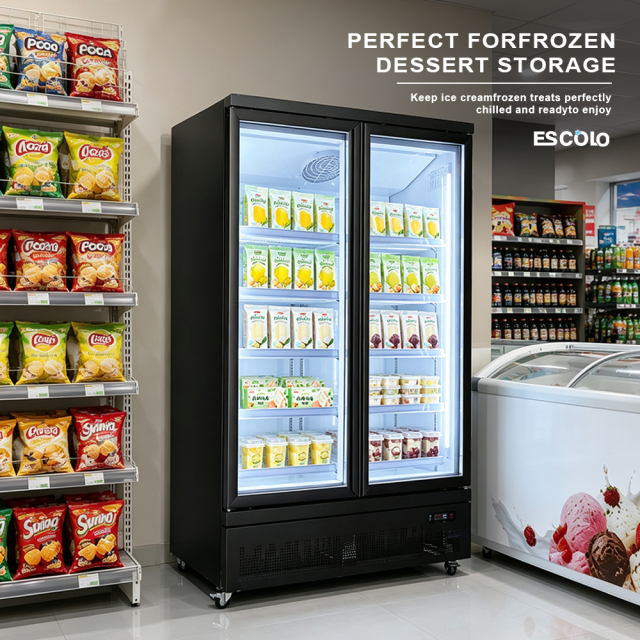
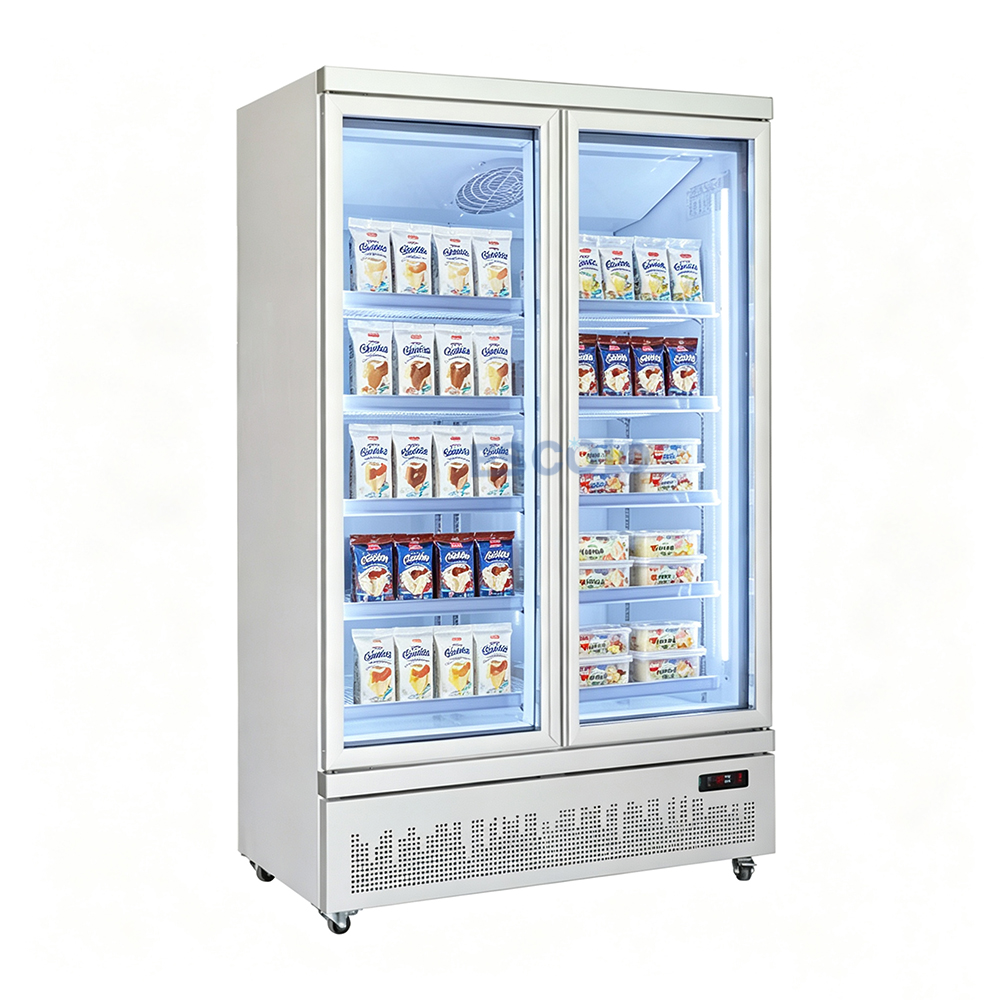
The ESD-B1250-2M-F is a two-door upright freezer engineered to merchandise frozen food rather than simply store it. Both doors are full-height glass, so the whole shelf is readable from the aisle, and the cabinet maintains frozen temperature while customers open and close it through operating hours.
It replaces two things at once: the closed chest freezer that hides stock at the bottom, and the back-store shelf that keeps available stock out of sight. When the cabinet itself is the display, the stock on the floor is the stock available to customers, and frozen food can be merchandised the way chilled drinks or bakery goods already are. That is what makes a glass door display freezer useful in a frozen section — the customer can price, compare and choose without staff assistance.
The two-door layout sits between a single-door cabinet and a long three- or four-door run. A single door rarely covers a full frozen category, and a four-door wall needs the length of a supermarket aisle. With two doors, each category can have a door of its own without committing the floor space of a bigger cabinet.
For a commercial upright freezer in grocery and food-service environments, that middle size is often the practical choice: it can be specified for a new store, used to replace an ageing unit, or added to a frozen section that has outgrown its current display. It is also the size most often specified as a second or third unit, once a store has demonstrated category demand.
| Parameter | Specification |
|---|---|
| Model | ESD-B1250-2M-F |
| Cabinet temperature | -22 °C to -18 °C |
| Temperature control | Digital thermostat with LED display |
| Cooling system | Fan cooling, no frost |
| Defrosting | Auto defrost |
| Compressor | Bottom mounted |
| Evaporator | Skin type evaporator |
| Condenser | Inside condenser with fan, hot air blowing to avoid fog on the glass |
| Glass door | Double-glazed tempered glass front with ordinary glass inner pane, all-glass door, self-closing |
| Interior light | Yes, LED |
| Key / lock | Yes |
| Shelves | 5 pc PVC-coated heavy-duty shelves per door |
| Wheels | 4 universal wheels, 2 with brake; 6 universal wheels, 2 with brake on the larger cabinets |
| Lightbox | No |
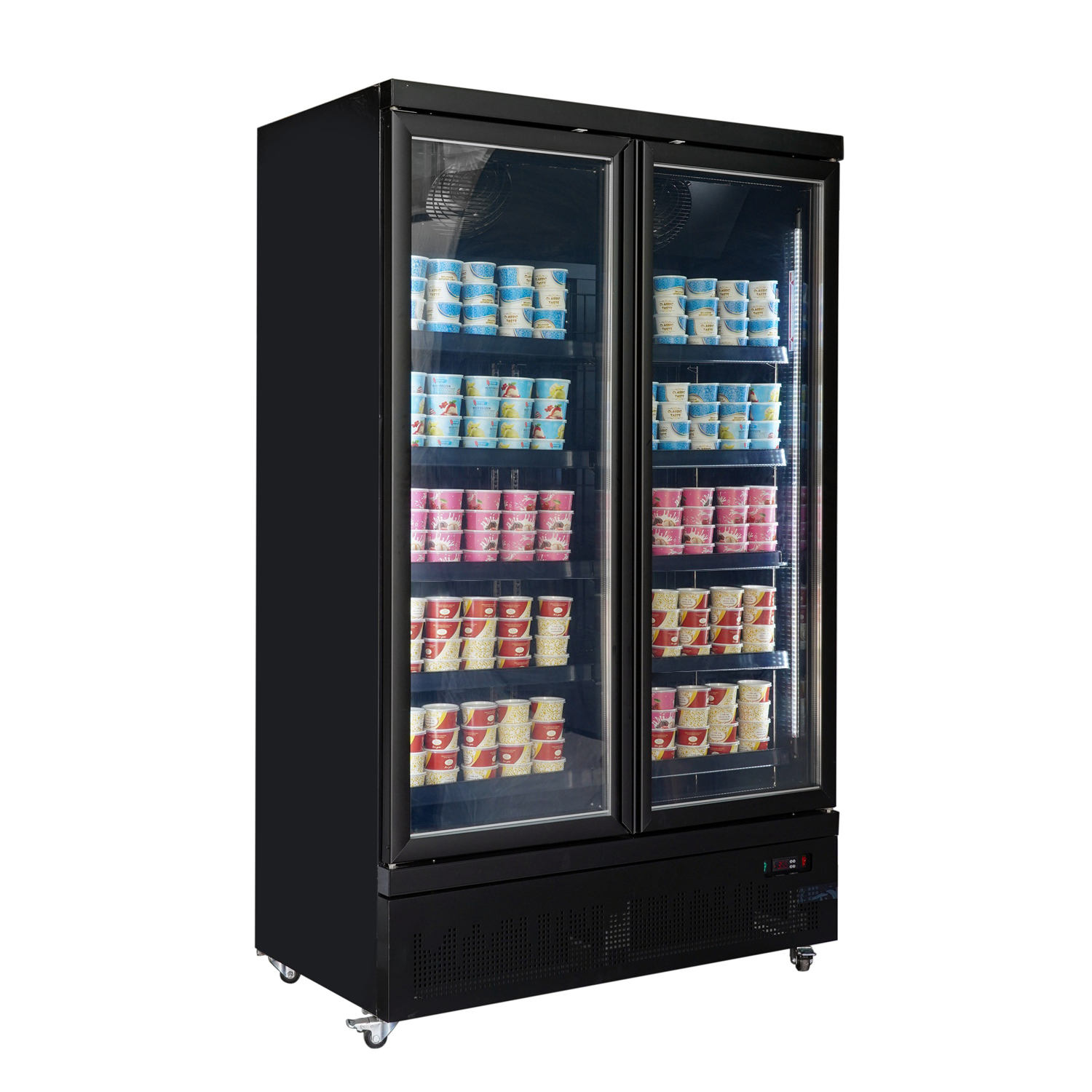
The refrigeration sits in a compartment at the base of the cabinet: compressor, condenser and fan together, with the evaporator working inside the food space above. On a commercial upright freezer that arrangement is worth understanding before the store layout is fixed, because it decides where the cabinet can stand and how quickly it can be serviced.
Because the machinery is below rather than above, the full height of the cabinet is shelf. Nothing is boxed off at the top for a plant room, so the interior loads from the bottom shelf to the top one, and the door glass runs the full height of the display.
Service access is the practical gain of an upright freezer display cabinet. A technician reaches the condensing unit from the front of the base without unloading stock or pulling the cabinet away from the wall — which matters when a store cannot afford to empty a freezer during trading hours. The same access makes a routine condenser check a five-minute job rather than a service call.
The base also needs air. The condenser fan draws through the compartment and rejects heat at floor level, so keep the grille clear of cartons, shrink wrap and cleaning equipment, and leave the clearance the cabinet needs when the store plan is drawn. Cabinets that run warm are very often cabinets whose base has been boxed in. If your layout genuinely needs the machinery above the cabinet, tell us before the order is fixed and we will point you to the models in the range built that way.
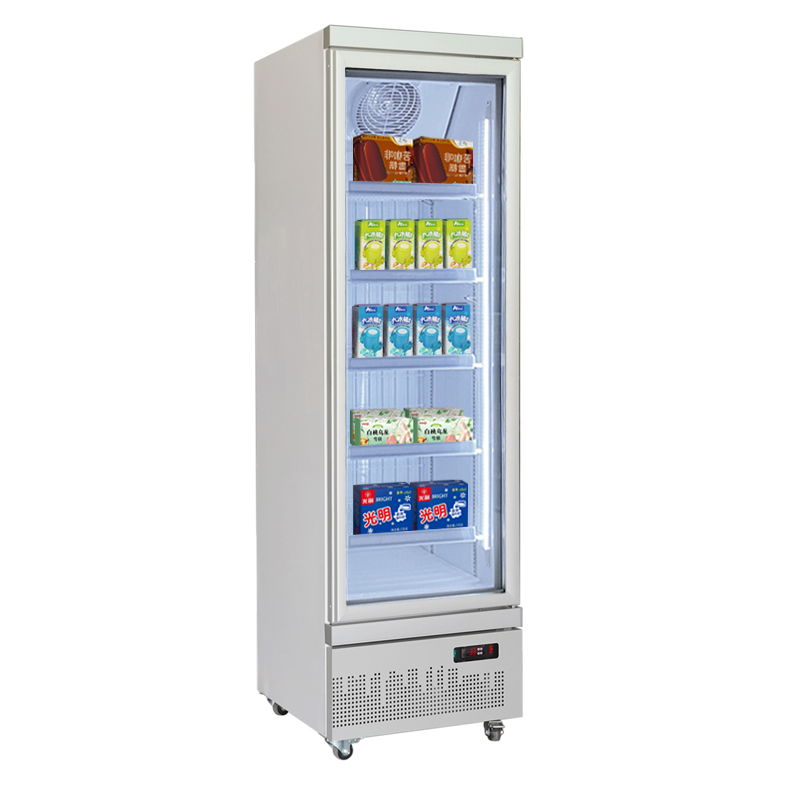
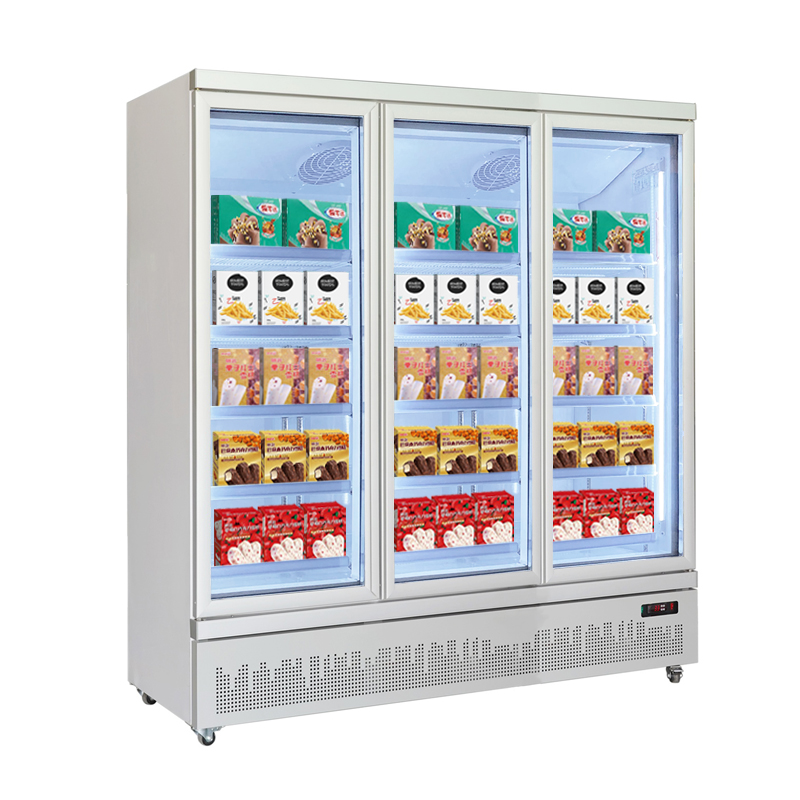
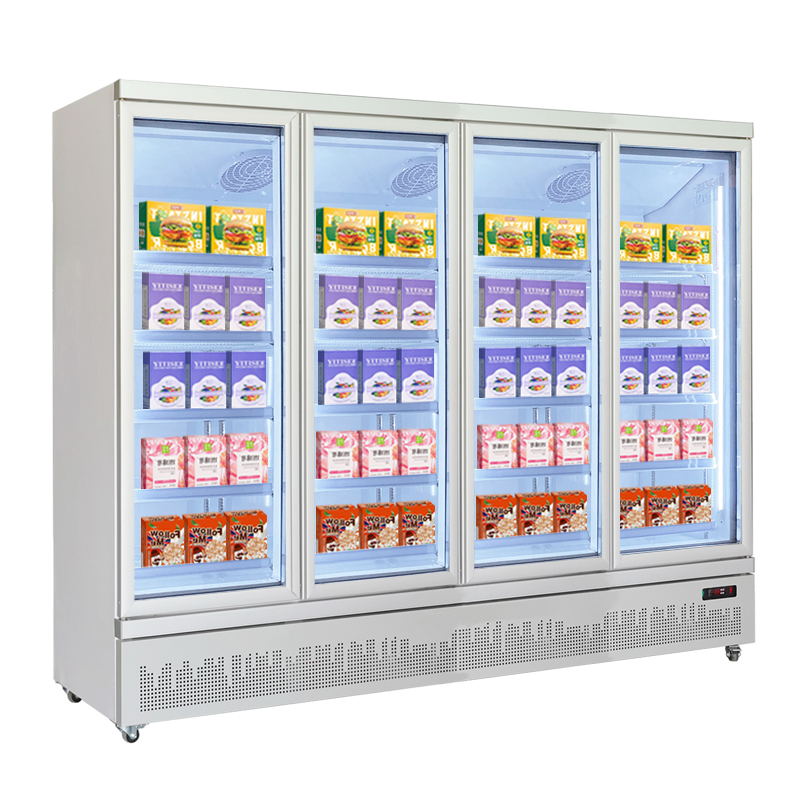
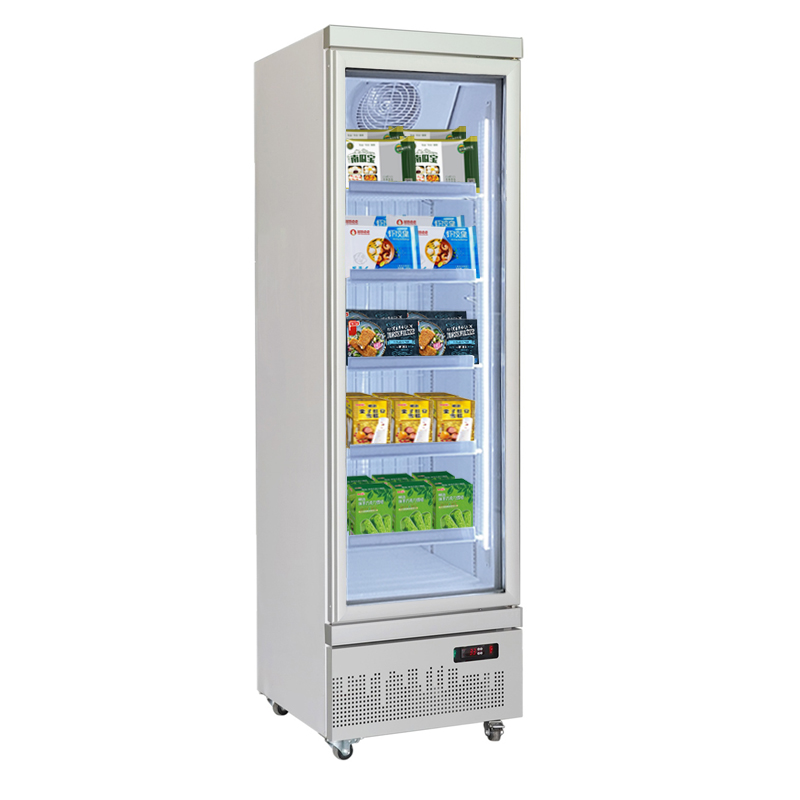
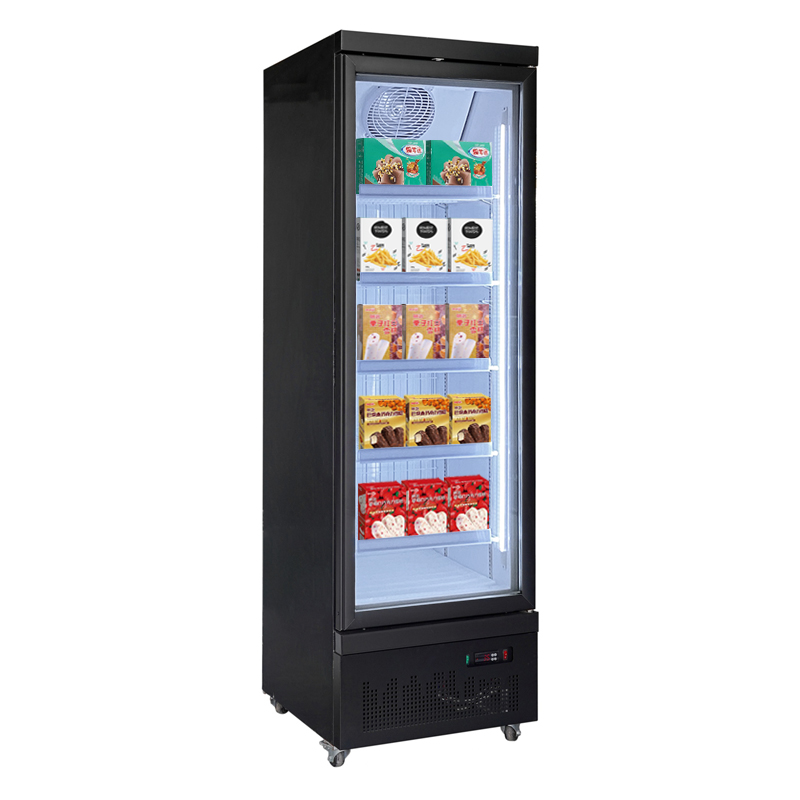
Every upright freezer display cabinet in this series stands 2,030 mm tall, so a run of mixed sizes reads as one line along the aisle. The 800 L single-door cabinet measures 800 × 750 × 2,030 mm and loads 21 units per 20GP and 42 per 40HQ. This two-door model measures 1,253 × 710 × 2,030 mm, carries 1,200 L gross and loads 12 / 27. The three-door cabinet is 1,880 × 710 × 2,030 mm at 1,800 L with 9 / 18, and the four-door runs to 2,508 × 710 × 2,030 mm at 2,000 L with 6 / 12. The gross weights listed for the four are 120 kg, 100 kg, 200 kg and 300 kg in that order, and two smaller single-door cabinets at 620 L and 700 L complete the same family.
Choosing between them is mostly a question of how much frozen run a store has and how many categories it needs to separate. A single door suits a small shop's ice cream and desserts; two doors cover a full category split; three and four doors are for supermarket aisles where the frozen wall is a destination in itself. Because the cabinets are built in our own glass door freezer factory, mixed containers are routine — single-door units for small sites and three- or four-door cabinets for supermarkets can travel in the same shipment. Measure the run, check the loading figures against your forwarder's container plan, and settle the cabinet mix before the order is fixed.
Supermarkets. In a supermarket the cabinet usually joins a frozen wall rather than standing alone. Used as a commercial freezer for grocery stores and store chains run in series, it can carry a category per door, with the price-tag strips doing work that printed signage used to do, and two or three cabinets side by side give a frozen aisle a consistent face.
Convenience stores. Space is the constraint here, and a two-door cabinet is often the largest frozen unit a small store can justify. As a glass door display freezer for a grab-and-go format, it is well-suited to ice cream, frozen desserts and a short frozen meal range that a customer can spot from the counter.
Restaurants. Kitchens use the cabinet for frozen seafood, meat, prepared components and desserts, with staff opening doors during prep rather than shoppers browsing. Position it so the door swing clears the pass, and label shelves by service station rather than by brand.
Cafés. Frozen desserts, ice cream tubs and frozen drink bases sit well here, and the glass front turns storage into a menu signal for customers seated nearby.
Bakeries. Frozen dough, pastry and dessert components need separating from finished product. Give each its own shelf so nothing heavy is stacked on a delicate item, and keep wrapping intact so nothing frosts over.
Beverage shops. Frozen drink concentrates, ice cream and slush bases are the usual stock. Near the counter the cabinet works as an impulse display rather than as back-store storage.
| Item | Detail |
|---|---|
| Minimum order quantity | 1 container for this glass door freezer line |
| Voltage | 220-240 V / 50 Hz (60 Hz available) or 110 V / 60 Hz |
| Certificates | CE, CB, RoHS, ETL, ISO 9001 |
| Colour | White or black |
| Loading quantity | 12 units per 20GP; 27 per 40HQ |
| Packing | Export packing agreed against your shipping route |
| After-sales | After-Sales Support & Warranty |
| Documents | Model specification sheet and loading plan on request |
Running cost on a display freezer is decided less by the compressor label than by how hard the cabinet has to work through a trading day. Four things set that load: how much cold air leaves the cabinet each time a door opens, how evenly the cold air is spread once the door closes, how much frost is allowed to build on the evaporator, and how much heat the cabinet's own lighting puts back into the food space. Each of those is a design decision, and each one is addressed here.
Where the power goes. Fan cooling pushes cold air to every shelf rather than letting it settle in layers, so the thermostat reads a representative temperature instead of the warmest corner, and there are fewer long pull-down cycles after a busy hour. Automatic defrost clears the evaporator on a cycle rather than leaving frost to insulate the coil — a frosted coil is one of the quietest ways a commercial freezer starts costing more to run. LED lighting is fitted inside rather than incandescent strips, so the shelves are bright without the lamp itself adding heat that the refrigeration then has to remove. The self-evaporating tray takes away the manual defrost and tray-emptying routine that, when it is skipped, is usually where an efficiency problem begins.
The heated door, honestly. The door heater does draw power, and it is worth being clear about why it is there: without it, a full-glass door in a warm, humid store fogs over and shoppers open the cabinet to see what is inside. The heater keeps the pane clear, warm air from the condenser fan is blown across the glass as a second measure, and the self-closing doors shut behind the shopper. The saving is not in the heater itself but in fewer door openings, less cold air lost to browsing and fewer staff wipes through the day.
What the operator controls. Two cabinets of the same model can run at noticeably different costs. Set the thermostat to the band your stock actually needs rather than the coldest setting it will accept. Keep the base grille and condenser clear — dust and shrink wrap on the coil make the compressor run longer for the same result. Check gaskets and door alignment so the doors seal. Site the cabinet away from direct sun, doorways and oven exhaust; ambient heat is a load the cabinet cannot shed, and placement costs nothing to change at the planning stage.
Over a multi-year service life. The compressor and the condenser fan work hardest of all, and both sit in the bottom compartment where a technician reaches them from the front without unloading stock. Routine condenser cleaning and a gasket check a couple of times a year are the maintenance that keeps consumption near where it started instead of drifting up with age. If you need figures for a business case, ask us for the rated power of the model you are specifying and run it against your own tariff and trading hours — the honest number for your store depends on those, not on a claim printed on a specification sheet.
Cafes increasingly offer frozen desserts, ice cream products and packaged beverages alongside their drinks menu, so the display needs to work as hard as the counter does. A glass door display lets a cafe combine storage with attractive product presentation, keeping stock visible and neatly arranged instead of tucked away out of sight. LED lighting helps create a cleaner, brighter and more professional customer-facing display area, so guests can see exactly what is on offer before they order.
ESCOLO has manufactured commercial refrigeration equipment in Foshan, Guangdong since 2010, and the team now numbers more than 800 people. Fifteen-plus years in the trade, a network of 3,000+ qualified partner factories and an annual output of 200,000+ units let us run container-scale programmes and repeat orders for supermarket, convenience and foodservice buyers. OEM and ODM work is standard: size, colour, function and your own branding are set to the specification you send. Factory audit, pre-shipment inspection, consolidated shipping and after-sales support are handled in-house.
Packaged frozen food, ice cream and frozen desserts, frozen vegetables, seafood, meat, frozen snacks, ready-to-cook meals and frozen drinks all sit comfortably within the cabinet's frozen band. Most stores split it by category rather than by brand — one door for ice cream and desserts, the other for meal packs and vegetables — so shoppers know where to look. This is a freezer rather than a chiller, so keep chilled and ambient goods out of it, and check that your tallest packs fit the shelf spacing you set.
Cold glass in a warm, humid sales floor collects condensation, and a fogged door hides the product the cabinet exists to show. A heated glass door freezer lifts the outer pane above the point where moisture condenses, and warm air from the condenser fan is directed across the glass as a second measure. The result is a clear pane through the trading day with far fewer wipes, and shoppers who can identify a product without opening the door.
This commercial upright freezer runs a deep-frozen band suitable for long-term storage of packaged frozen food, set and read from the digital thermostat and LED display on the front panel. Fan cooling keeps air moving to every shelf, so the top shelf is not warmer than the bottom one, and automatic defrost cycles the cabinet instead of letting frost build on the evaporator. Expect the reading to lift slightly every time a door opens during peak trading; the cabinet pulls it back once the door closes.
That is the job it was designed for. As a commercial freezer for supermarket and grocery environments, it is normally installed in the frozen aisle where customers serve themselves, with each door given to a category so shoppers can reach ice cream, vegetables or ready meals without opening the wrong door. Vertical lighting keeps the shelves readable from the aisle, and the price-tag strips let the store run a promotion without new signage. Stores running a long frozen wall usually place two or three cabinets side by side rather than relying on one unit.
It can, provided the store has room for the footprint and for the aisle in front of it. In a convenience store this glass door display freezer usually carries the high-margin lines — ice cream, frozen desserts and a short frozen meal range — positioned where a customer can see them from the counter. Two doors give a small store a full frozen section without the length a three- or four-door cabinet needs; where the space is tighter still, the single-door models in the same series do the same job on a smaller footprint.
Less than older freezers demanded. Automatic defrost and a self-evaporating water tray remove the two chores operators most often forget, so there is no manual defrost cycle and no tray to empty. Day to day, wipe the glass and door gaskets, keep product away from the air outlets and check that the doors close squarely. Every few weeks, clear dust and packaging away from the condenser compartment at the base — a blocked condenser is the most common reason a working freezer starts running warm. Clean the interior section by section so the other door keeps trading.
Efficiency here comes from how the cabinet is built rather than from a headline figure: fan cooling spreads cold air evenly so the thermostat is not fighting warm pockets, automatic defrost keeps the evaporator surface working, self-closing doors limit the cold air that escapes on a busy floor, and LED lighting adds brightness without adding heat inside the cabinet. The biggest factor in running cost is how the unit is used — a clean condenser, unblocked air outlets and doors that close properly matter more than any single component.