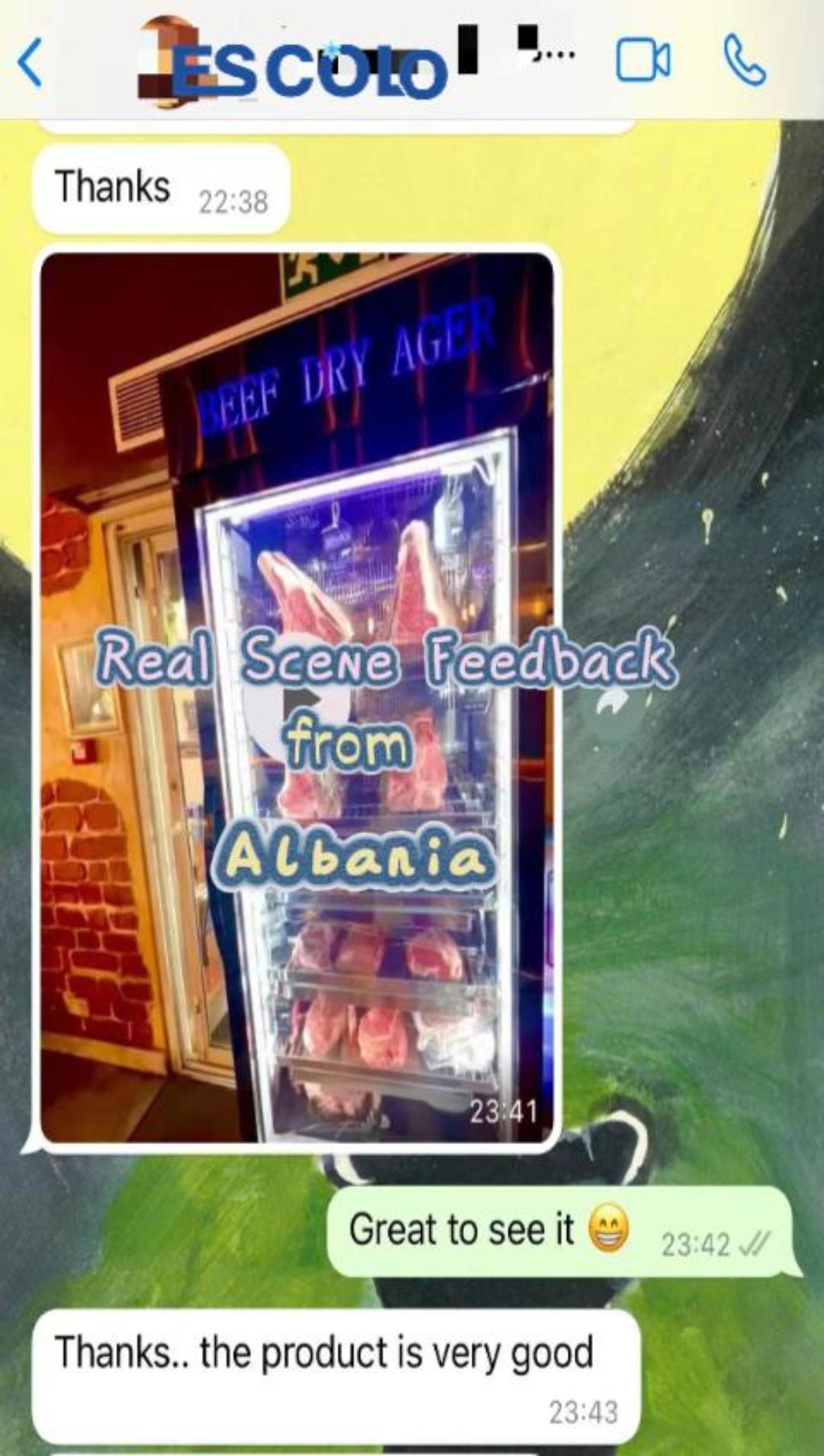
This Beef Display Cabinet with internal purple lighting is perfect for supermarkets, butcher shops, and hotels. Made of stainless steel inside and out, with 5 shelves per door, digital humidity-controlled temperature, fan cooling with auto defrost, heated self-closing glass doors, self-evaporating condensation, LED lighting, and powered by SECOP compressors with copper pipe condensers and eco-friendly R290 gas, it offers reliable performance and visually appealing meat display.




Dry aging is a waiting game, and this cabinet exists to make the wait pay. It is a purpose-built beef dry aging fridge: a stainless steel, glass-fronted chamber that holds whole primals and sub-primals at aging conditions while the crust forms behind the glass. Steakhouses, butcher shops and hotel grills use it as a working chamber and as a piece of theatre — guests see the programme, and the programme sells the steak.
Most kitchens start out aging in a walk-in corner or a converted display fridge. Both work until you want consistency. A walk-in moves air for the whole room, so conditions at the door are not what they are at the back. A converted display fridge has no humidity control at all, so the surface dries faster than you can plan for, and you end up trimming away the result. This cabinet puts the entire environment — refrigeration, moisture management, air circulation and light — inside one sealed footprint that you set from a single panel.
Inside, it is stainless: the body, the liner and the trays that carry the meat. That is deliberate. An aging chamber is a moist, salty environment, and the cabinet has to be wiped down between programmes without corroding. It is also why we build it as a stainless steel dry ager cabinet for steakhouse front-of-house use as readily as for the back corridor — the finish stands being seen.
One detail shapes the whole design. The compressor sits on top of the cabinet rather than underneath, which keeps the machine compartment away from mop water, dropped product and the kick space where people stand, and puts the service points at a height a technician can reach without lying on the floor. It also leaves the base of the cabinet clean-lined for the dining room.
Dry aging is controlled dehydration. Over the weeks a primal spends in the chamber, moisture leaves the surface, enzymes break down connective tissue and the flavour concentrates. What the cabinet controls is the rate. Run it too dry and the surface case-hardens, trapping moisture inside; run it too wet and the crust never forms and the surface stays tacky.
That is why the moisture setting deserves as much attention as the temperature setting, and why both are set from the same panel here. Air has to keep moving past the meat, or moisture pools on one face of a primal and that face ages differently from the others. It also has to move evenly from the top shelf to the bottom — the usual reason a batch ages unevenly, and the reason a chamber packed shoulder to shoulder never gives a predictable result.
The working window runs from a light chill at the cold end to a cool larder at the warm end, so the same cabinet can hold a long, slow programme or a shorter rest before service. Pick the programme your kitchen needs and then leave the setting alone: every adjustment restarts the moisture balance at the surface and adds days to the result.
Treat the record as part of the process. Note the date and the weight going in, weigh the same piece again near the end, and keep the note against its shelf. Over a few programmes that log tells you more about how the chamber is running than any single reading on the display.
| Model | ESK-680A | ESK-1220A | ESK-1860A |
|---|---|---|---|
| Doors | 1 | 2 | 3 |
| Unit size (mm) | 680*680*2130 | 680*680*2130 | 680*680*2130 |
| Temperature | -5 to +10 °C | -5 to +10 °C | -5 to +10 °C |
| Capacity (L) | 500 | 1000 | 1500 |
| Loading (20GP/40HQ) | 21/45 | 11/24 | 10/15 |

Door count is really a question of how you work, not how much floor you have. The single-door cabinet suits a steakhouse or a hotel grill running one programme at a time, with the aging on show where guests pass it. The two-door is the usual butcher-shop choice: one side for beef going out this month, the other for a longer programme, and staff can work one side while the other stays shut. The three-door is for volume — a wholesaler, a large steakhouse group or a butcher with a wholesale counter — where several ages need their own space and their own door.
Width is the constraint to check first. Confirm the exact cabinet width for the door count you are specifying against your plan before the unit is built into a counter run or a wall recess; send us the layout and we will confirm the figure for your chosen model. Door swing matters as much as width. These are hinged, self-closing doors, so each one needs clearance to open and a member of staff standing in front of it. In a tight back-of-house corner, a narrower cabinet with fewer doors usually beats a wide one squeezed against a wall.
We build all three door counts on the same line. As a commercial dry ager fridge factory we can assemble a mixed container — a single-door unit for a front counter plus larger cabinets for a central aging room — and ship it as one consignment, which is how most distributors and multi-site groups start.
ESCOLO has manufactured commercial refrigeration equipment in Foshan, Guangdong since 2010, and the team now numbers more than 800 people. Fifteen-plus years in the trade, a network of 3,000+ qualified partner factories and an annual output of 200,000+ units let us run container-scale programmes and repeat orders for supermarket, convenience and foodservice buyers. OEM and ODM work is standard: size, colour, function and your own branding are set to the specification you send. Factory audit, pre-shipment inspection, consolidated shipping and after-sales support are handled in-house.
It sets how fast the surface dries. Too dry and the outside case-hardens while the centre stays wet; too wet and the crust never forms and the surface stays tacky. The controller on this cabinet manages temperature and moisture from one panel, so you set a programme and the chamber holds it instead of you adjusting a fridge by feel. Change one variable at a time and give the chamber a few days to settle.
Treat the dry aging cabinet as a set of zones rather than one space. Put the primals you plan to sell first on the middle levels where access is easiest, spread the batch so air can move around every piece, and leave the top and bottom levels for the pieces going longer. Each door has five stainless shelves with trays, so a piece can be turned or weighed without lifting it off a bare shelf. A date-and-weight note per shelf lets you run several ages side by side without mixing them up.
It is a display light, not a processing one. The violet cast deepens the red in the meat and throws the dry crust into relief, which is why the cabinet reads so clearly from across a dining room. It also lets staff and guests see the product without opening a door and disturbing the chamber's conditions.
The door is heated, so the pane stays clear when the dining room is warm and humid and the chamber is cold. The self-closing action helps at the source as well: a glass front that clouds is nearly always a door that has been left standing open through a busy service.
No. A fresh meat counter is built to hold cut product at serving freshness for a day or two. A beef dry aging fridge is built to hold whole primals for weeks while moisture, air movement and a steady chill do the work. The build looks similar — stainless, glass, fan cooling — but the job, the control range and the way you load it are different.
Three things: the cabinet width for the door count you want, the door swing and the standing space in front of it, and the electrical supply at the site. Send us your layout and the site voltage, and we will confirm the footprint, the clearances and the electrical details for the model you are specifying before it goes into production.
Beef primals are what most of our buyers run in it, and the chamber is set up for that. Because it holds a chill-to-cool window with moisture control, some operators also run lamb and whole-muscle charcuterie projects in it. Tell us what you plan to age and we will confirm whether the programme fits before you commit.