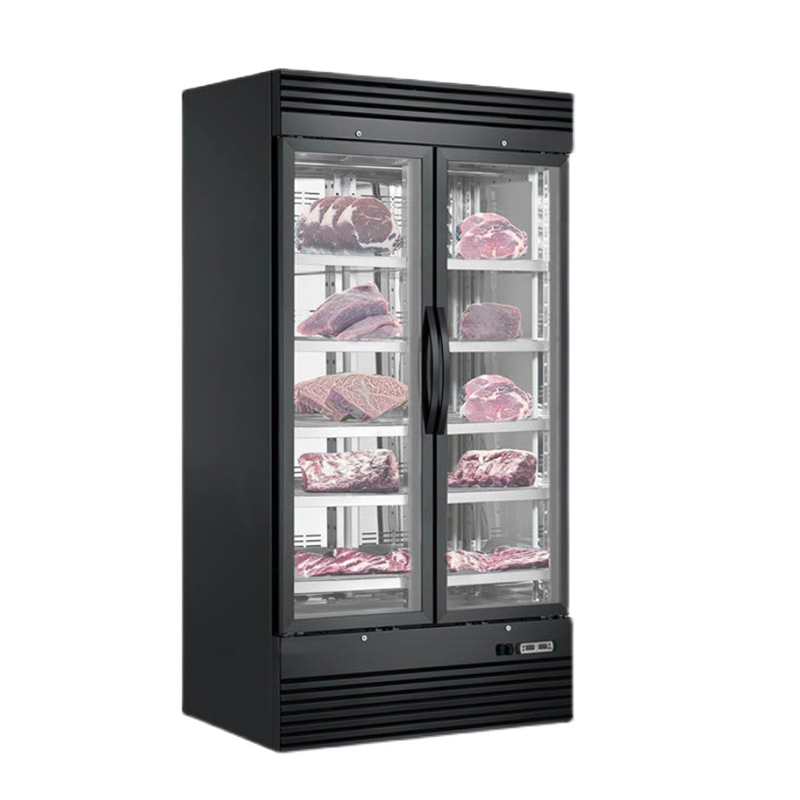
Product Overview
Dry ageing is a waiting game played with temperature, humidity and air. Beef rested in a chilled, slowly moving atmosphere gives up moisture, firms into a dark crust and develops a longer, nuttier flavour underneath. Hold those conditions steady for weeks and the cut changes; let them drift and the same cut dries unevenly or turns. As a dry ager cabinet manufacturer, we build this 2 door beef dry ager to hold those conditions steady, with the added advantage that every stage is visible through the front glass.
It is aimed at people who sell dry-aged beef rather than simply store it: butchers running a dedicated ageing programme, steakhouses that list cuts by days aged, hotel and club kitchens curing in house, and specialty meat suppliers who want customers to watch the process. Because the cabinet reads as a display piece as much as a refrigeration unit, it usually ends up where guests and customers pass it rather than in a back room.
The cabinet shown here is the two-door build. The same design is made as a single-door cabinet for a short ageing list and a three-door cabinet for volume, so a shop can begin with the footprint its counter can carry and add capacity later. Built as a professional dry aging cabinet for butcher shop and steakhouse use, it keeps the working parts simple: one controller for the climate, one glass front for the display, and stainless steel everywhere the meat and the moisture reach.
Standard Features
- Stainless steel interior and exterior: on a professional dry aging cabinet for butcher shop use, the walls, base and frames are stainless rather than painted, so brine, blood and daily wipe-downs leave no rust blooms or chipped edges along the tray line.
- Stainless steel shelves with tray: every cut sits on a tray that slides onto a stainless shelf, so drips are caught below the meat instead of running down the cabinet, and a finished cut can be lifted out in one movement.
- Digital controller with humidity control: temperature and moisture are set from one panel — how much water the air holds matters as much as how cold it is, and this is the dial you adjust as a programme develops.
- Fan cooling with auto defrost: air moves continuously through the cabinet so every shelf sits in the same conditions, and the defrost cycle runs on its own instead of waiting for someone to notice ice on the evaporator.
- Heated, self-closing glass door: the heater keeps the glass clear when the shop is warm and humid, and the door swings shut behind staff, so a busy service never leaves the cabinet standing open.
- Self-evaporation of condensation water: moisture pulled out of the air is evaporated inside the unit, so there is no drain line to run and no tray to empty at close.
- LED interior light: the cabinet is lit along its full height, so the crust and colour of the beef read clearly from outside without adding meaningful heat to the load.
- Secop compressor: a branded compressor specified for continuous commercial duty rather than intermittent household use, which is what a cabinet running week after week actually needs.
- Copper pipe condenser and evaporator: copper tube heat exchangers stand up to a damp, salty cabinet far better than aluminium and keep heat transfer consistent over years of service.
Specifications
| Model | ESK-680B | ESK-1220B | ESK-1860B |
|---|
| Door | 1 | 2 | 3 |
| Unit size (mm) | 680*760*1980 | 1220 × 760 × 1980 | 1860 × 760 × 1980 |
| Temperature | -5 ~ +10 °C | -5 ~ +10 °C | -5 ~ +10 °C |
| Capacity (L) | 500 | 1000 | 1500 |
| Loading (20GP/40HQ) | 21/45 | 11/24 | 10/15 |
Operating the Aging Cabinet
- Let the cabinet settle after delivery. Stand it in its final position, take the packing off, and leave it upright at room temperature for a few hours before switching on — a cabinet that has travelled on its side needs that time before the compressor runs.
- Run it empty first. Close the door and let the cabinet pull down to your working setting with nothing inside, so the first cuts go into a stable environment instead of one that is still chasing temperature.
- Set temperature and humidity to suit your programme. On a professional dry aging cabinet for butcher shop use, one controller sets both; start where your house style calls for and fine-tune as you see how the crust forms on your beef.
- Load with space between the cuts. Air has to reach every surface — a shelf packed shoulder to shoulder ages unevenly, and pieces at the back lag behind the ones at the front.
- Keep every cut on its tray. The trays catch the drips, protect the shelf underneath and let staff move a piece without handling the meat.
- Look in daily, adjust weekly. A glance at the controller, the glass and the crust tells you most of what you need; small corrections early are cheaper than a rescue later.
- Trim and rest before it is offered to customers. Take the cut out when the crust and firmness match your menu, trim the surface, and let it rest before slicing.
Applications
- Steakhouse with a short dry-aged list: a single-door cabinet standing where guests pass keeps a few cuts on show without eating into kitchen floor, and the move up to the two-door build comes when the list covers more than a couple of primals at a time.
- Butcher counter selling dry-aged beef by the cut: the two-door cabinet gives several cuts their own shelf space, and the glass front lets a customer point at the piece they want. The cabinet is on show all day, so the stainless finish, the lighting and the way the door closes matter as much as the cooling.
- Hotel, club or members' restaurant curing in house: placed where the kitchen can reach it but guests can still see it, the cabinet gives the brigade its own ageing supply without tying up walk-in space.
- Specialty meat supplier or farm shop: the cabinet becomes part of the shop's story — customers watch a cut change over the weeks and staff can talk through exactly what they are looking at.
- Distributor or fit-out contractor working across several sites: as a dry ager cabinet manufacturer, we keep one design in three widths, so specification, spare planning and staff training stay consistent from one store to the next.
- Restaurant group rolling out a signature aged steak: a single build standard means the ageing programme behaves the same way in every kitchen that runs it.
Care and Cleaning
- Clear the cabinet and switch it off before a deep clean. Lift the trays and shelves out and wash them separately in warm, soapy water.
- Wipe the stainless steel with a soft cloth and a mild detergent, then rinse and dry. Work from the top down so nothing you have already cleaned gets splashed again.
- Keep chlorinated and abrasive cleaners away from stainless steel. Bleach-based products and scouring pads dull the surface and can leave it open to corrosion in a damp cabinet.
- Clean the glass on both faces with a standard glass cleaner and a microfibre cloth. With the door open, check the frame and the gasket for dried drips and wipe them away.
- Let everything air dry before the cabinet goes back together, then close the door and let it recover to temperature before reloading.
- Check that the door lines up and closes cleanly against the frame. If it hangs or needs a push, ask your sales contact about adjustment before the next ageing run.
- Never steam clean or pressure wash the cabinet. Water driven into the door frame and control panel does far more damage than any spill.
Ordering and Delivery
Cabinets are built to the configuration you choose, so the first conversation covers three things: how many doors you need, the voltage and plug standard your market uses, and how the cabinet will be packed for shipment. As a dry ager cabinet manufacturer we build to order rather than ship from stock, which means the order quantity, the mix of models and the delivery date are agreed with your sales contact before production is scheduled.
Voltage and market requirements
Tell your sales contact the voltage, frequency and plug standard used in your market and we will confirm the version that matches your order.
Packing and loading
Cabinets travel in export packing suited to container freight, and mixed orders across the range can be consolidated. Confirm the packing and shipping arrangement that suits your route with your sales contact.
After-Sales Support & Warranty
The terms that apply after delivery are confirmed for your market. Ask your sales contact for the current documentation and for the spare-part arrangement in your region.
Fresh Meat Display Pairing
- The cabinet is an ageing space, not a fresh meat counter. Its working range of -5 to +10 °C and humidity control are set to dry and mature beef over weeks; it is not intended to hold fresh cuts at normal display temperatures through a trading day.
- If you sell fresh beef as well as dry-aged beef, keep a separate fresh meat display. A fresh meat cooler in our range holds 0–5 °C with its own fan cooling, stainless steel interior and LED lighting, keeping everyday cuts cold, bright and ready to sell without opening the ageing cabinet.
- Place the two cabinets as a pair at the counter: the fresh display for same-day cutlets, mince, roasts and service cuts; the 2 door beef dry ager for primals on their ageing programme behind or beside it. Customers see the difference between today's meat and aged beef, and staff do not mix stock.
- Use separate trays and tools. A tray that has held fresh cuts should not go into the ageing cabinet without washing, and aged cuts should be trimmed on a clean board before they meet the fresh display.
- Do not try to speed up ageing by turning the dry ager into a fresh chiller. Raising the setting and loading it with fresh cuts defeats the humidity control, crowds the airflow and can leave you with meat that is neither properly aged nor properly displayed.
- For a small shop with a short fresh range, the single-door dry aging cabinet plus a compact fresh meat cooler can take less counter length than one wide combination unit, and each can be replaced on its own schedule.
- When planning a new counter, tell your sales contact the width you can give to each function. The 2 door beef dry ager is 1220 mm wide, so the fresh display and the ageing cabinet need to be measured as two footprints, not one.
- If you only sell dry-aged beef and hold no fresh cuts, a separate fresh meat display may not be necessary; the dry ager can stand as your main beef showcase. Confirm the mix with your sales contact before the counter layout is fixed.
Scale & Supply Capability
ESCOLO has manufactured commercial refrigeration equipment in Foshan, Guangdong since 2010, and the team now numbers more than 800 people. Fifteen-plus years in the trade, a network of 3,000+ qualified partner factories and an annual output of 200,000+ units let us run container-scale programmes and repeat orders for supermarket, convenience and foodservice buyers. OEM and ODM work is standard: size, colour, function and your own branding are set to the specification you send. Factory audit, pre-shipment inspection, consolidated shipping and after-sales support are handled in-house.
FAQ
Why does dry-aged beef need its own cabinet instead of space in the walk-in?
A walk-in is built to hold a lot of food cold, not to keep a small volume of beef in slowly moving air for weeks. Dry ageing needs a steady temperature, controlled humidity and constant airflow around every cut, and it needs that environment kept away from other products, whose smells the beef will pick up. A cabinet built for this does exactly that, and it makes the process visible — which is much of the reason customers order dry-aged beef in the first place.
Do the cuts hang from hooks or sit on shelves?
They sit on trays on stainless steel shelves. Each shelf carries a tray that catches drips and keeps the meat clear of the shelf surface, and staff can slide a whole tray out when a cut is ready rather than reaching in for it. Hooks and rails are not part of this cabinet, so there is nothing extra to buy before the first ageing run.
Will the glass fog up when the shop is warm?
The door is heated, so the inner face stays above the point where room humidity condenses on it. The door also closes itself behind staff, which keeps most of the moist room air out to begin with. In a hot, steamy room, keep the cabinet away from ovens and fryers, and the glass stays clear through service.
Can we use the same cabinet for fresh cuts as well as ageing beef?
It is set up for ageing, which means holding a climate rather than simply keeping meat cold. For everyday fresh display at normal chilling temperatures, our fresh meat cooler is the cabinet you want, and plenty of shops run both side by side. Tell your sales contact how you plan to use the space and we will point you at the right combination.
How much room does the cabinet need around it?
Leave clear space in front for the door to swing fully and for a member of staff to lift a tray out, plus a gap at the sides and back so the refrigeration system can breathe. Measure the doorway and any turn on the route into the shop before delivery day — a cabinet that will not go through the door is the most common installation problem there is.
Is the two-door build too big for a small shop?
It depends on how much beef you intend to hold and how much counter space you can give up. A short ageing list in a tight shop usually starts with the single-door cabinet. A 2 door beef dry ager suits a butcher or steakhouse keeping several cuts on the go at once, and the three-door version is for volume. All three share the same build and controls, so moving up later is a question of floor space rather than retraining.