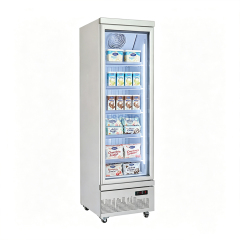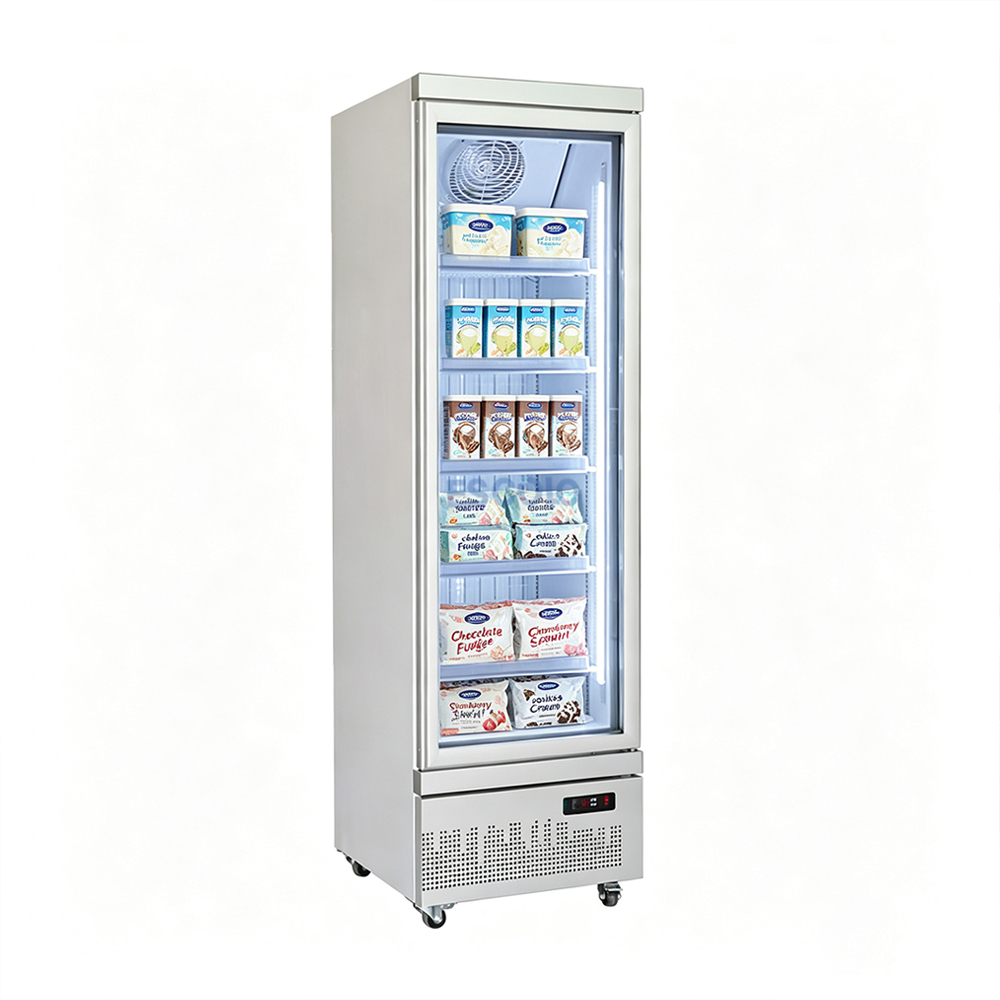
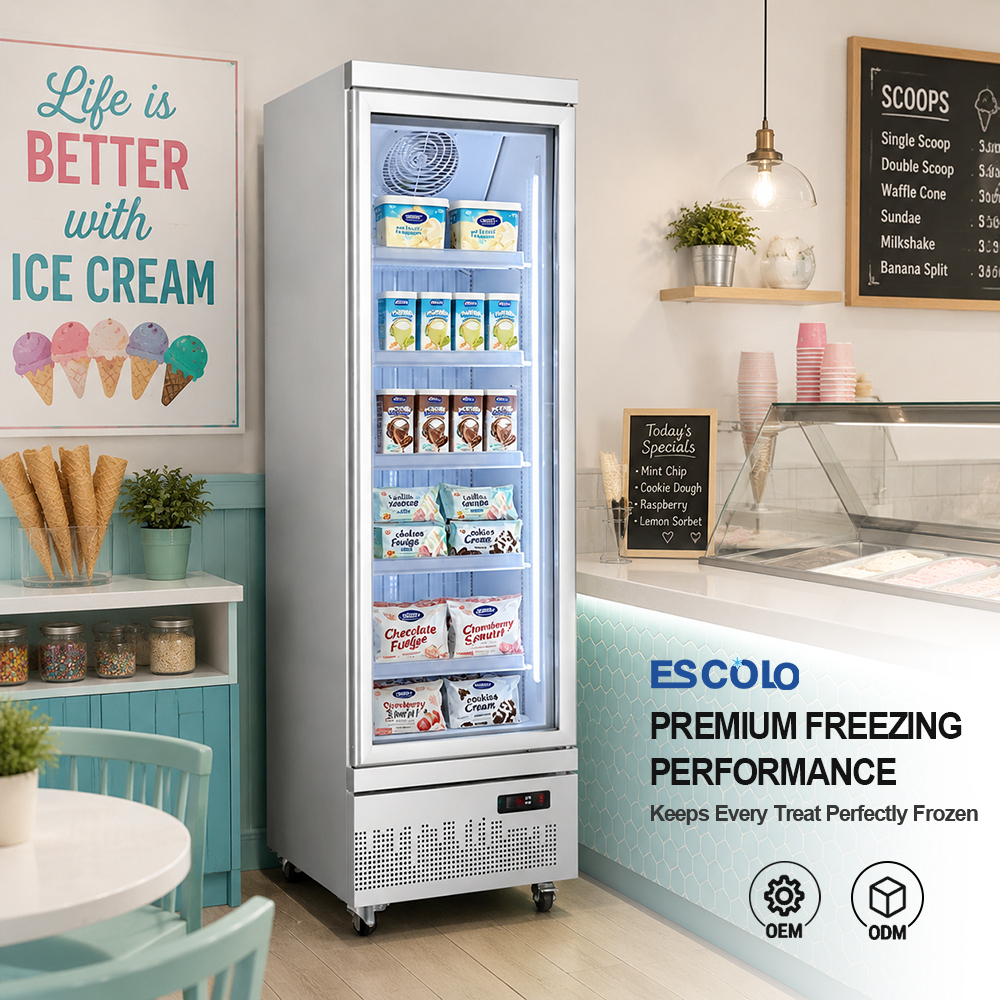
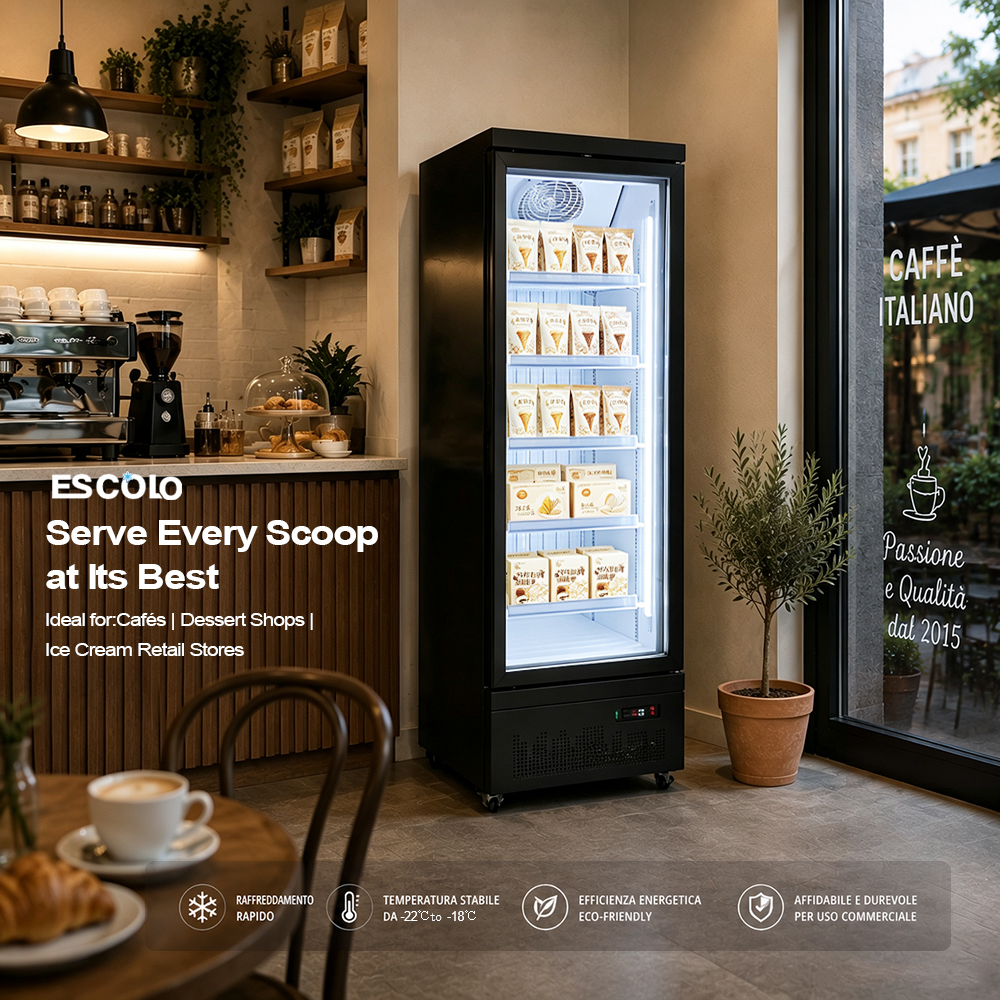
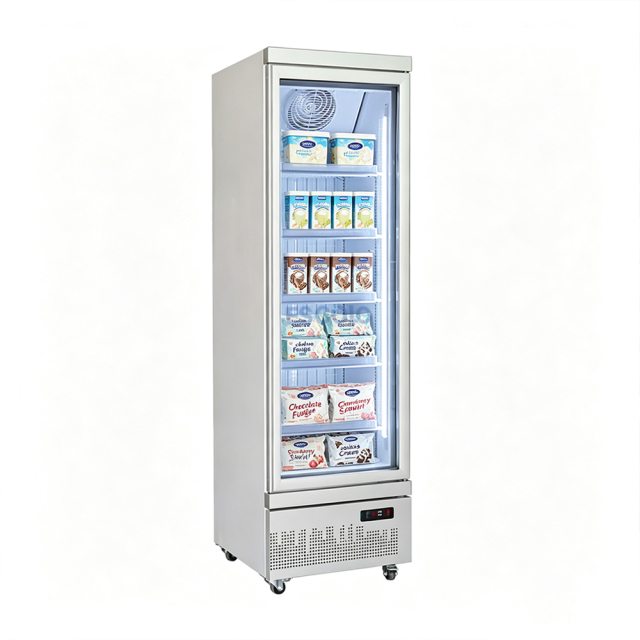
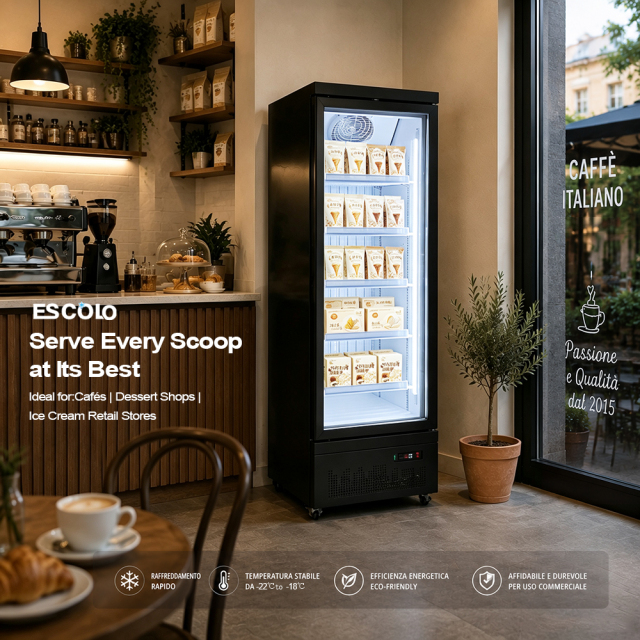
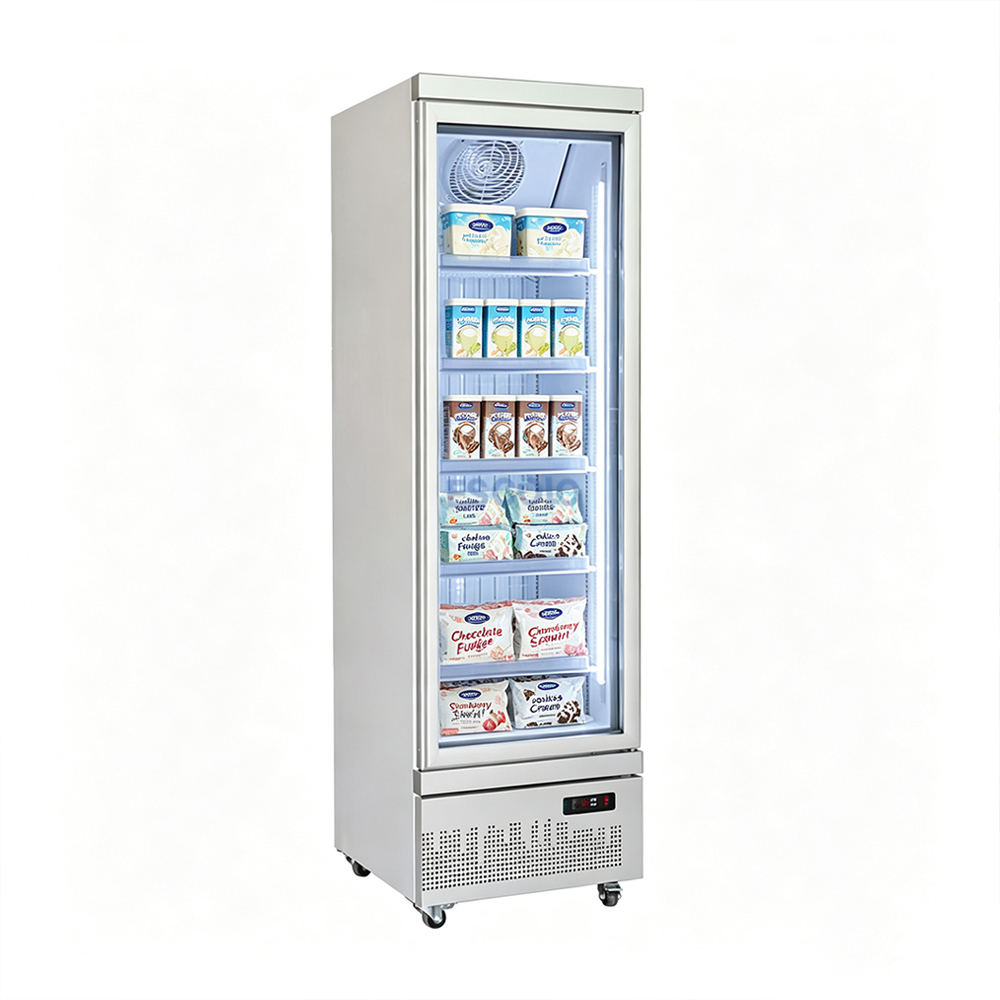
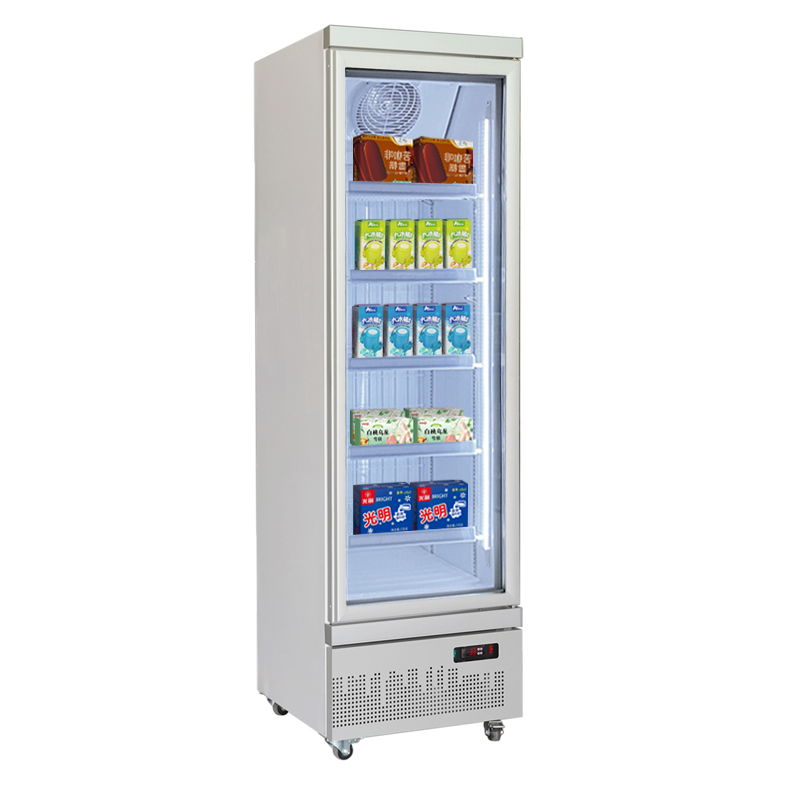
ESCOLO builds the ESD-B series as an upright freezer cabinet for grocery stores that want frozen stock out in the open rather than buried in a chest. The single-door cabinet — the 800 L ESD-B800-1M-F — measures 800 mm wide, 750 mm deep and 2030 mm tall, so it stands against a wall or at an aisle end and puts ice cream, frozen meals, seafood and frozen desserts at eye level.
The door is heated hollow glass set in an aluminum frame. Products rest on five PVC-coated shelves with price tag strips, and vertical LED lighting runs the full height of the interior, so a shopper can read pack sizes and prices from a few metres away without opening the door.
Inside, the cabinet runs from -22 °C to -18 °C on fan cooling with automatic defrost. The refrigeration pack sits at the bottom: the heavy components stay at floor level, which steadies a tall cabinet that is opened all day, and the compressor, condenser and fan are reached through a front panel rather than by pulling the cabinet out. Warm air from the condenser is directed across the glass to help keep it clear.
As a commercial glass freezer supplier, ESCOLO supplies this large commercial glass door freezer either as a single unit for a convenience store, forecourt or café, or as part of a mixed container for distributors fitting out several sites. The same series continues in 1200 L, 1800 L and 2000 L multi-door cabinets, so a frozen run can grow without changing the way it looks to shoppers or the way staff work it.
| Model | ESD-B800-1M-F, 800 L single door; 620 L and 700 L single-door versions also listed |
|---|---|
| Temperature range | -22 °C to -18 °C |
| Door type | Heated hollow glass door with aluminum frame; no lightbox |
| Cooling system | Fan cooling system, no frost |
| Compressor | Bottom mounted |
| Evaporator and condenser | Skin-type evaporator; inside condenser with fan, warm air blown across the glass to prevent fogging |
| Defrost | Automatic defrost with self-evaporating water tray |
| Temperature control | Digital thermostat with LED display |
| Interior light | Yes, vertical LED |
| Key and lock | Yes |
| Shelving | 5 PVC-coated shelves per door with price tag strips, heavy duty |
| Wheels and feet | 4 universal wheels, 2 with brake; 6 universal wheels, 2 with brake on larger cabinets |
| Cabinet material | Painted steel interior and exterior |
| Application | Supermarkets, convenience stores, beverage display, shopping malls, restaurants, specialty stores |
Six cabinet widths are built on the same platform, and the door count is really a decision about how much frozen range you want in one place. The single-door models open the series: 620 L, 700 L and 800 L versions, with the 800 L cabinet measuring 800 × 750 × 2030 mm. That size suits a corner shop, a forecourt, a café or a single aisle end where one door's worth of frozen stock is enough.
Step up and the cabinet widens rather than deepens. The two-door ESD-B1250-2M-F is 1253 × 710 × 2030 mm and holds 1200 L; the three-door ESD-B1880-3M-F is 1880 × 710 × 2030 mm at 1800 L; the four-door ESD-B2500-4M-F is 2508 × 710 × 2030 mm at 2000 L. Depth stays between 710 mm and 750 mm across the range, which matters when you are planning an aisle: the cabinets run along the wall instead of pushing into the walkway.
Container planning follows the same logic. A 20GP/40HQ takes 21/42 of the 800 L cabinets, 12/27 of the 1200 L, 9/18 of the 1800 L and 6/12 of the 2000 L, so a distributor can build one load of single-door units for small accounts alongside wider cabinets for supermarkets.
For an upright freezer cabinet for grocery aisles, the single-door version is often the first unit bought and the one that gets added to as the frozen range grows. If your plan needs a different width or door split, the series is built to be adapted — settle the combination with us before the order is fixed.
The working range is -22 °C to -18 °C, and where you sit inside it depends on what you sell. Ice cream, frozen desserts and anything that must stay hard travel most reliably at the colder end; frozen meat, seafood, vegetables and ready meals hold comfortably through the middle of the range; frozen beverages and ice-based products sit anywhere inside it. The set point is changed on the digital thermostat and shown on the LED display, so a manager can check it from the aisle without opening the door.
Fan cooling keeps air moving through the cabinet instead of letting cold settle at the bottom, which is what allows five shelf levels to run at a similar temperature. Automatic defrost deals with the ice that builds on the evaporator during normal running; the melt water drains to a tray at the base and evaporates there, so there is no bucket to empty and no manual scraping.
What the cabinet cannot do is compensate for hot air. Site it away from direct sun, oven lines and unventilated corners, and leave clearance at the base so the condenser can breathe. During a rush, every door opening lets a slug of warm air in; fan cooling pulls the temperature back afterwards, but recovery is quicker when staff close the door behind them. If your store runs hot for most of the year, tell our team the ambient conditions when you order.
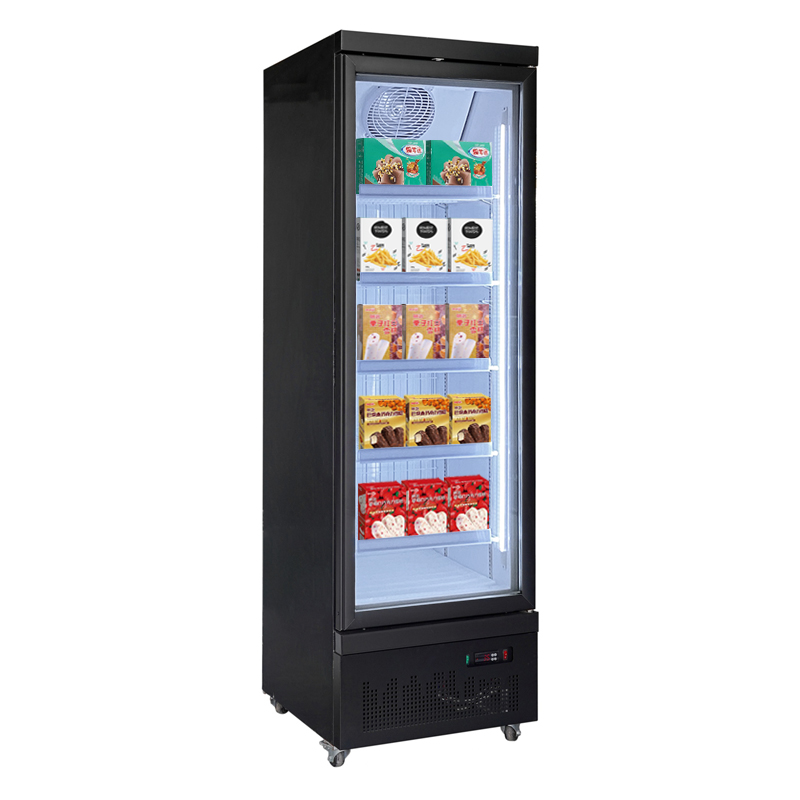
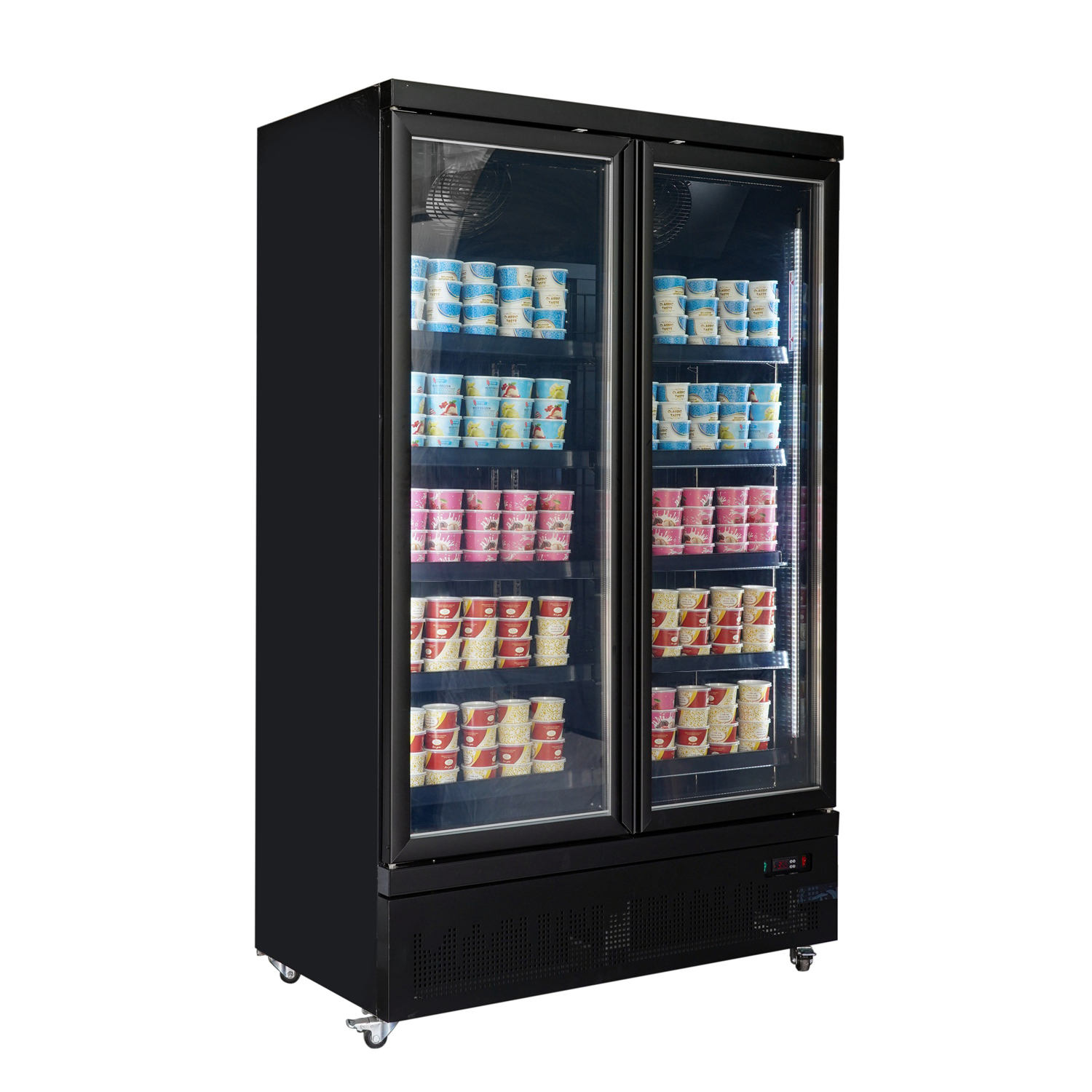
Vertical LED strips run down the door posts and light the cabinet from front to back, which is the arrangement that suits a tall frozen display. Each of the five shelf levels gets similar brightness, so the top shelf is not lit while the bottom sits in shadow. Because LED light carries very little heat, the lighting does not fight the refrigeration — the cabinet is not working to remove heat it created itself.
For merchandising, the effect is practical rather than decorative. Frozen packaging is often dark or heavily printed and frosts over quickly when the door is open; even cool white light keeps brand colours and pack fronts readable, and the price tag strips on the shelf edges stay legible at a glance. Vertical light also draws the eye down the cabinet from a distance, which is why the format earns its place at an aisle end.
The strips are a sealed, low-maintenance part of the cabinet, with no tubes to change on a routine basis. Keep the diffusers wiped as part of normal cleaning so brightness does not drop off, and check at handover that the interior light is working — a dark frozen cabinet loses most of its selling value.
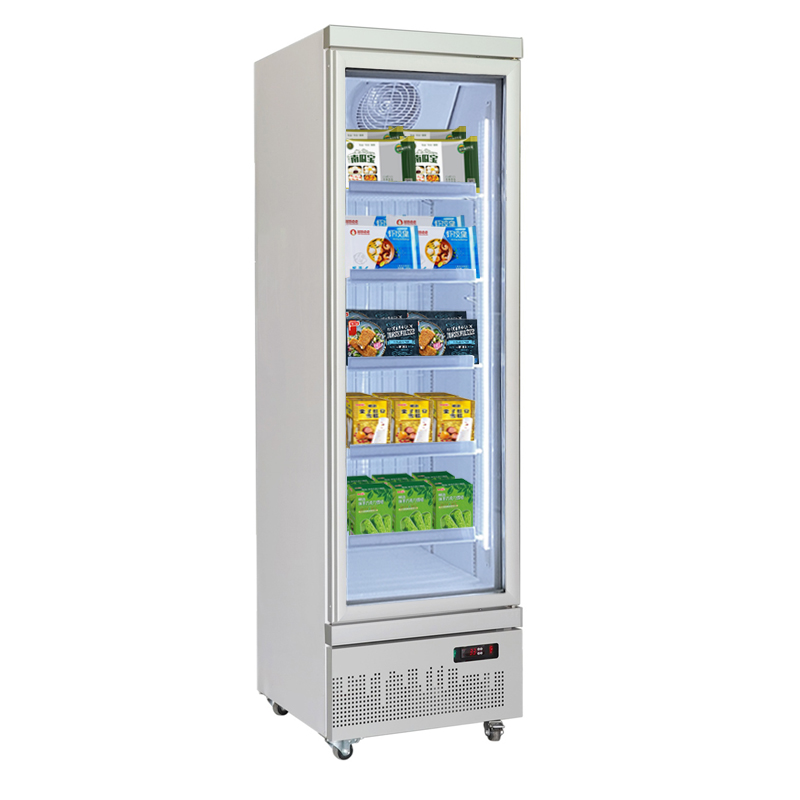
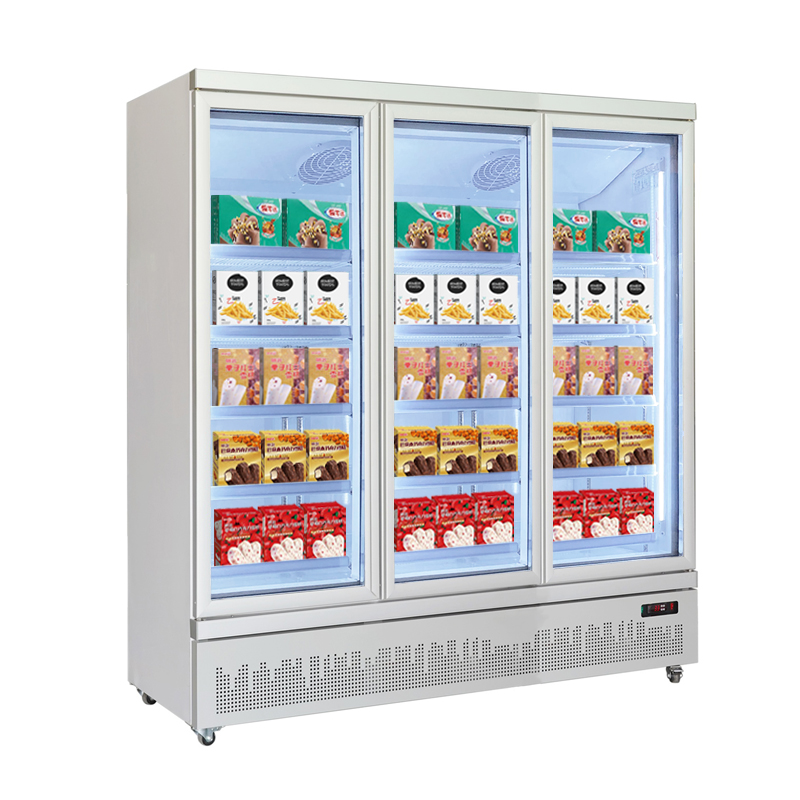
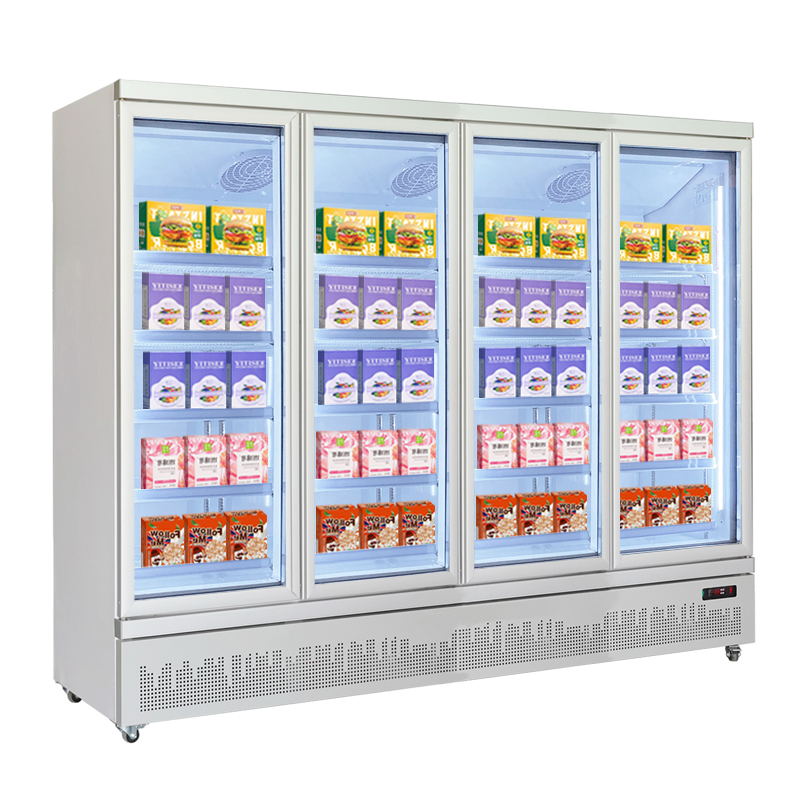
Standard cabinets ship in white or black. Beyond that, the factory works to a brand: cabinet colour matched on the coating line, logo and decals applied to the door or top panel, packaging printed with your own artwork, and the electrical configuration set for the market you sell into. Shelf count, door split and cabinet width can be adjusted within the series, and the compressor and refrigerant specification is confirmed per order.
This is the part of the programme most importers care about, because a container of unbranded cabinets is hard to sell twice. As a commercial glass freezer supplier, ESCOLO works from drawings and specifications rather than a single catalogue page, so a model can carry your name rather than ours if that is how your market buys.
Two practical notes. Colour should be approved against a physical panel sample before a production run, because screen references and paint batches do not always agree. And any change to width, door count or electrics changes the production plan, so settle the specification before the order is released rather than during production. Bring your destination market's voltage, frequency and plug standard to that conversation — refrigerant and compressor options are confirmed at the same point.
Orders for this glass door freezer line start at one container, and the load can mix cabinet widths from the series — single-door units for small accounts alongside 1200 L, 1800 L or 2000 L cabinets for larger sites. Standard models generally move through production faster than OEM and ODM projects, which need colour, artwork and specification approval first. Confirm the current lead time with your sales contact before you book a store opening or a handover date, since timing depends on quantity, customization and destination.
Electrical configuration, cabinet colour, branding and packaging are all settled before production, so bring your market's voltage and plug standard into that conversation early. Payment terms, shipping terms and destination port are agreed per order — ask for them in writing with the quotation. If you want to inspect the build before committing to a full load, ask your sales contact about sample availability and the current arrangements.
Every cabinet is backed by ESCOLO's After-Sales Support & Warranty. Ask your sales contact for the terms that apply in your market, and for spare-part availability on castors, door gaskets, shelves and controllers, so a single damaged part does not take a cabinet out of service.
The cabinet is built with painted steel for both the exterior and interior, giving it a strong structure suited to commercial environments. That durable construction allows the freezer to stand up to the frequent opening and closing that comes with daily use in convenience stores, supermarkets and food service businesses.
ESCOLO has manufactured commercial refrigeration equipment in Foshan, Guangdong since 2010, and the team now numbers more than 800 people. Fifteen-plus years in the trade, a network of 3,000+ qualified partner factories and an annual output of 200,000+ units let us run container-scale programmes and repeat orders for supermarket, convenience and foodservice buyers. OEM and ODM work is standard: size, colour, function and your own branding are set to the specification you send. Factory audit, pre-shipment inspection, consolidated shipping and after-sales support are handled in-house.
It is a frozen display cabinet for commercial sales floors: ice cream and frozen desserts, frozen meals and vegetables, seafood, frozen beverages and other packaged frozen lines. Because the door is glass and the shelves carry price tags, it is bought for selling from rather than for back-room storage, and it most often goes at an aisle end, beside a checkout, or on a frozen run where a chest freezer would be too deep.
The cabinet is set within -22 °C to -18 °C and holds there under normal trading. The colder end suits ice cream and desserts that need a firm freeze, while most other frozen lines sit comfortably mid-range. The set point moves on the digital thermostat and the LED display shows it without opening the door. During the automatic defrost cycle the controller briefly stops cooling and then returns to the set point, which is normal — load the cabinet with stock that is already frozen rather than warm.
Yes. The single-door version is the small-format member of the series: a corner shop, forecourt or convenience store can run one 800 L cabinet without giving up aisle width, and a supermarket can use it as a fill-in or aisle-end unit beside the wider 1200 L, 1800 L and 2000 L cabinets. The braked castors let staff pull it out for floor cleaning and lock it back for trading.
Cabinet colour (white and black are the standard options), logo and decal placement, printed packaging, the electrical configuration for your market, and the shelf and door layout within the series. Compressor and refrigerant specification is agreed per order. Approve the colour against a physical panel sample before production rather than from a screen reference.
Fan cooling with a skin-type evaporator and an inside condenser. A fan pushes air across the evaporator and through the cabinet so all five shelf levels sit at a similar temperature, and the condenser fan draws air in through the base. Because the condenser discharges warm air across the outside of the glass, the door has help staying clear in humid conditions.
The door is hollow glass with a heater in the cavity, which keeps the outer pane above the dew point in most store conditions, and warm condenser air adds another layer of protection. In very humid climates, or where the cabinet faces an open door, some condensation on the frame is normal. Keep the door closed when the store is quiet, and check the gasket is seating properly if fogging appears in patches rather than evenly.
An enclosed glass door cabinet keeps cold air where it belongs, while an open multideck relies on an air curtain and loses cold air continuously. Within this cabinet, LED lighting adds almost no heat, automatic defrost runs to a cycle rather than all the time, and the self-evaporating tray removes defrost water without a heater. The biggest variable is door discipline — a cabinet left open, or loaded with warm stock, will always cost more to run.
Painted steel for the interior and exterior panels, an aluminum frame around the heated hollow glass door, PVC-coated steel shelves with price tag strips, and a digital controller with an LED display. The painted finish is meant to be wiped down: use a soft cloth and a mild cleaner rather than abrasive pads on the panels, and a glass cleaner rather than a scraper on the door.
Yes. Voltage, frequency and plug standard are set for the destination market when the order is confirmed, and the compressor and refrigerant specification — R290 or R404A depending on the compressor chosen — is agreed at the same time. Give your sales contact the exact local standard before production, because changing electrics after the cabinet is built is not a simple swap.
Chains buy it for consistency: the same door, shelf and lighting layout across every site means planograms and staff training carry over from store to store. Cabinets can carry group branding, be mixed with the wider models in one container, and be specified to a single electrical standard for the market. For a multi-site rollout, agree the specification once and hold it across the order.
Wipe the interior and glass as part of the normal cleaning routine, brush or vacuum the condenser at the base every few weeks (more often in a dusty or floury environment), check that the door gasket seals along its full length, and confirm defrost water is evaporating from the tray. Braked castors should be checked for wear if the cabinet is moved regularly. No manual defrosting is required.
Yes. Frozen beverages and ice-based desserts sit inside the -22 °C to -18 °C range without difficulty, and ice cream is the product that benefits most from the colder end of it. Pack height is what to plan: the five shelves are repositionable, so a mix of tubs, cartons and cups can be arranged without wasting a level.
A household freezer is built for a few openings a day. This large commercial glass door freezer is built for a shop: a heavier cabinet, commercial shelving that carries a full shelf of tubs, heated glass that stays clear, and a bottom-mounted pack a technician can reach from the front. It is also repairable in place — condenser, fan, controller and door parts are accessible without dismantling the store.
Anywhere the door can open fully and the cabinet is not fighting heat. Keep it out of direct sunlight, away from oven lines, hotplates and unventilated corners, and stand it on a level floor so the door hangs and seals correctly. If it sits at an aisle end, leave enough room for a shopper to step back with the door open — that clearance is worth measuring before you fix the layout.