

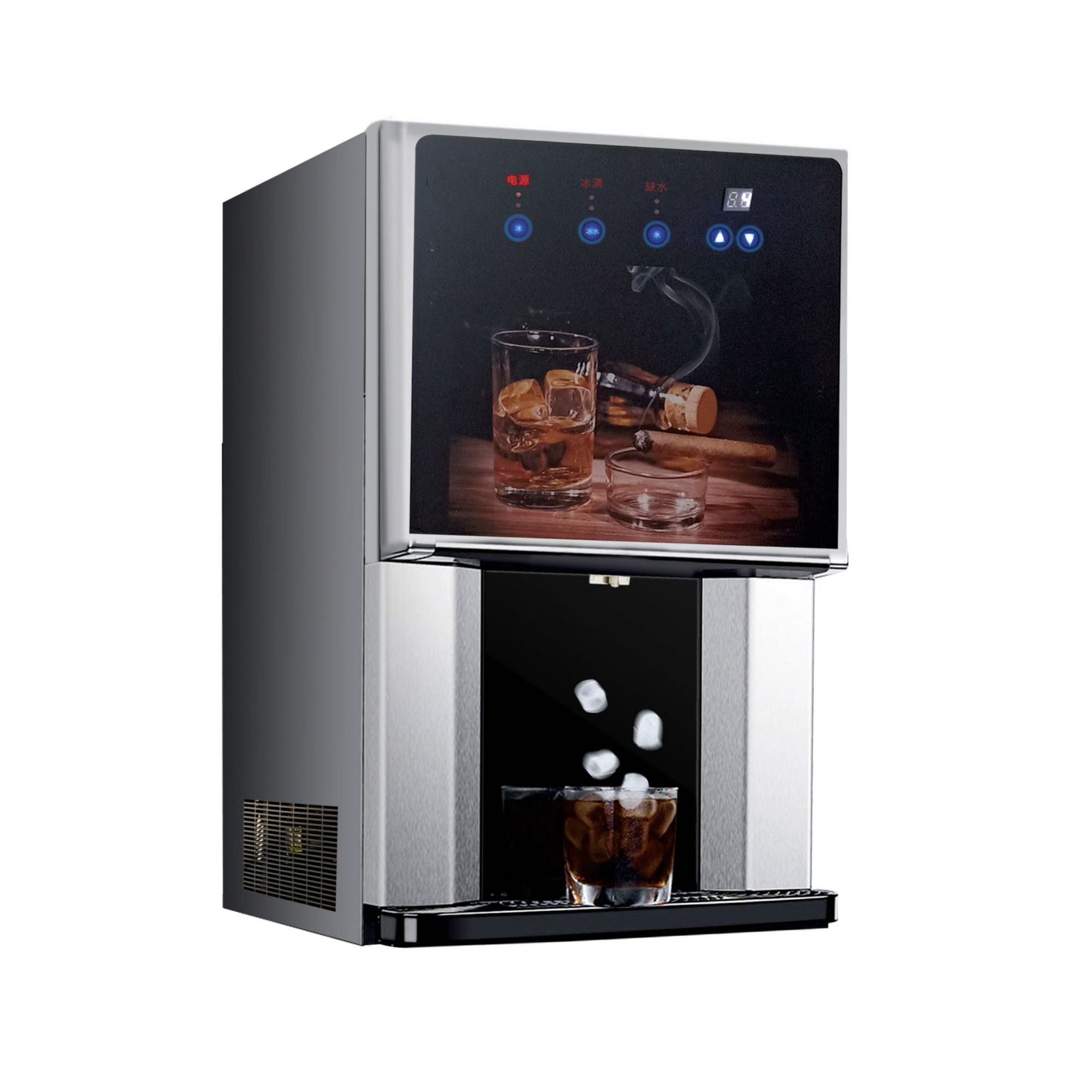
This is a countertop ice maker with storage bin and dispenser for the service side of a bar, restaurant or hotel kitchen. Ice is made on the machine's own cycle, held in the bin below it and drawn straight into a glass at the front — no scoop, no chest lid to lift, no bag of bought-in ice to break open in the middle of service.
The cabinet is a compact countertop unit, so this trapezoid ice maker takes a section of worktop or a low service shelf rather than a room of its own, and the dispensing point faces the person using it rather than the wall.
It is a high efficiency commercial ice maker in the practical sense: it produces and holds its own ice in one small footprint, and it is built to run through a long shift instead of being nursed between batches.
The venues that get the most from it share a rhythm. Drinks are poured all evening, iced coffee and soft drinks go out all day, or a hotel bar tops up continuously from breakfast onward. In each case ice is consumed steadily, and running out at nine at night is a real operational problem rather than an inconvenience.
It replaces two things at once — the chest freezer holding bagged ice and the separate scoop-and-tub arrangement beside it — and it takes the daily job of ordering, receiving and storing bought-in ice off the list entirely.
| Specification | Detail |
|---|---|
| Model | IM-110 |
| Cooling system | Fan Cooling |
| Ice form | Trapezoid ice |
| Ice production | 110kg |
| Dimensions | 438 × 630 × 733 mm |
| Power supply | 220 V / 850 W |
| Ice storage | Sealed storage bin |
| Ice dispensing | Adjustable dispensing time with auto stop |
| Control | One-button operation with digital display |
| Fault diagnosis | Alarm with error-code display |
| Ice-contact materials | Food-grade |
Trapezoid ice rather than cubes or flakes
This is a trapezoid ice maker, so each piece comes out small and tapered. They settle into a glass without leaving the large voids you get with blocky ice, and they hold their shape far longer than flake or crushed ice, which collapses into water the moment the drink is poured. For spirits, soft drinks, iced coffee and chilled display work, that is the difference between a drink that still looks right at the last mouthful and one that looks tired after five minutes.
Dispensing into the glass
The glass goes under the spout at the front of the machine and the portion is delivered from the control. Dispensing time is adjustable, so a house pour, a tall soft drink and a cocktail shaker can each be set to a repeatable amount, and the auto stop ends the portion without the operator counting seconds. The drip tray underneath catches the melt, so the counter stays dry through service.
The control panel
One button starts production, and the digital display shows where the machine is in its cycle. Indicator lights on the panel flag the three things an operator needs at a glance — power on, bin full, water supply low — so a bartender can read the state of the machine from a metre away instead of opening it up in the middle of a rush.
When something goes wrong
The machine reports the problem rather than simply stopping. A fault alarm sounds and an error code appears on the display, which means whoever takes the call — your maintenance technician or our support contact — starts from the actual cause instead of a description of the symptom. Buying from the commercial ice maker manufacturer keeps that path short: the same questions go to the people who built the unit, and replacement parts are ordered against the model on the plate.
| Equipment | Model |
| Ice maker, 30–120 kg / 24 h, cube ice | ESK series |
| Compact high-output ice maker | ICE-400AS / ICE-500AS |
| Ice storage freezer with digital temperature control | ESK-300S |
| High-capacity ice cube maker series, 130–1500 kg / 24 h | ESK-300 to ESK-3000 |
| Single door glass front beverage cooler | ES-B620-1M |
| Double glass door supermarket freezer | ESD-1330H |
| Upright glass showcase beverage cooler | ES-B1880-3M |
| Advanced upright freezer with R290 refrigerant | ES-D2500-4M-F |
| Black painted steel open chiller with self-closing glass door | BFLG1880-3M / BFLG1985-3M |
| Two-layer cake display fridge | ESK-1500B1 |
| Commercial ice cream freezer, rectangle or curved glass | ESK-QA120 / ESK-QA150 / ESK-QA180 |
ESCOLO has manufactured commercial refrigeration equipment in Foshan, Guangdong since 2010, and the team now numbers more than 800 people. Fifteen-plus years in the trade, a network of 3,000+ qualified partner factories and an annual output of 200,000+ units let us run container-scale programmes and repeat orders for supermarket, convenience and foodservice buyers. OEM and ODM work is standard: size, colour, function and your own branding are set to the specification you send. Factory audit, pre-shipment inspection, consolidated shipping and after-sales support are handled in-house.
For a single busy service point, yes. It is a fast ice production machine for restaurant service sized around one outlet: the bin carries ice between cycles while the machine keeps producing underneath. If you are fitting out several bars, a banquet kitchen or a site that goes through ice in bulk, the larger models in the range are the better match, and the capacity question is worth settling with your sales contact before you order.
The panel includes a water-low warning, so the machine monitors its own supply. Whether your unit is set up for a plumbed feed or another filling arrangement is confirmed with your sales contact when you order — tell them how the site is actually laid out. If it is plumbed in, fit an accessible shut-off valve, and consider a filter where the local water is hard.
The listed draw is 850 W. Because it is a high efficiency commercial ice maker rather than a small domestic unit, give it a dedicated circuit instead of sharing a socket run with other kitchen equipment — the compressor starts and stops all day, and a shared circuit is where nuisance trips come from. Confirm the plug and socket standard for your market before shipping.
It can sit on a counter or a low service shelf, but it has to breathe. Fan cooling needs clearance at the vents, and the dispense point and drip tray have to be reachable from the front, so a closed cabinet with a narrow opening is the wrong home for it. Measure the opening and the space you can leave around the vents before you commit to a built-in position.