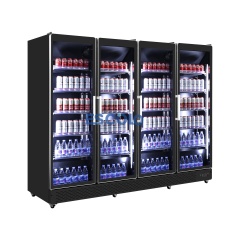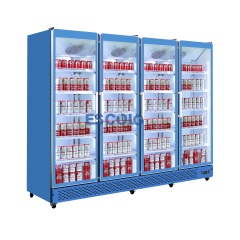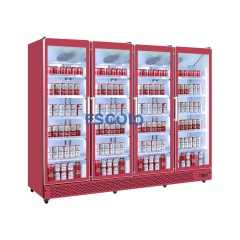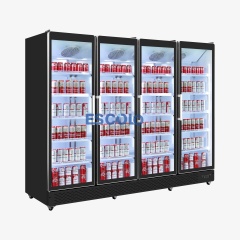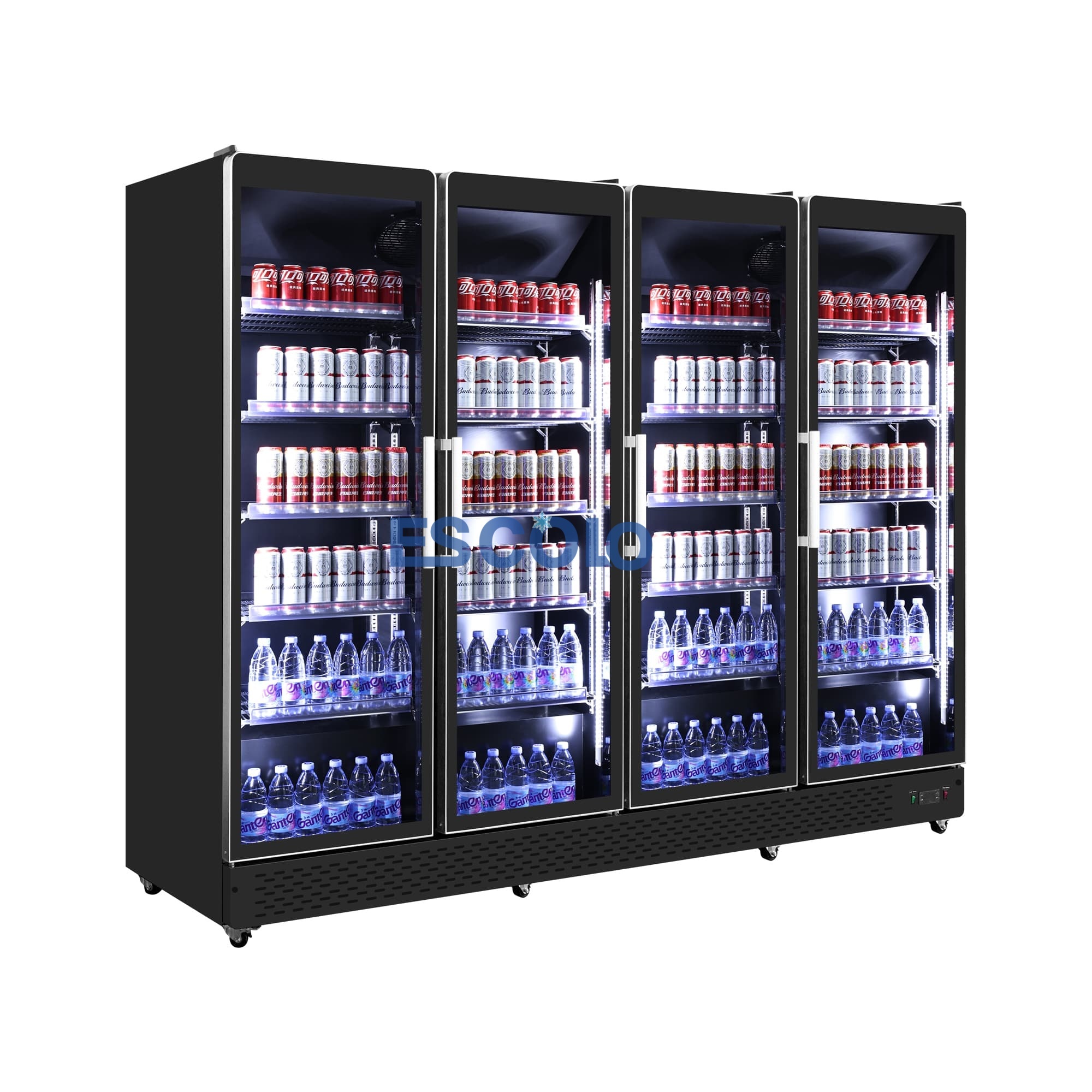
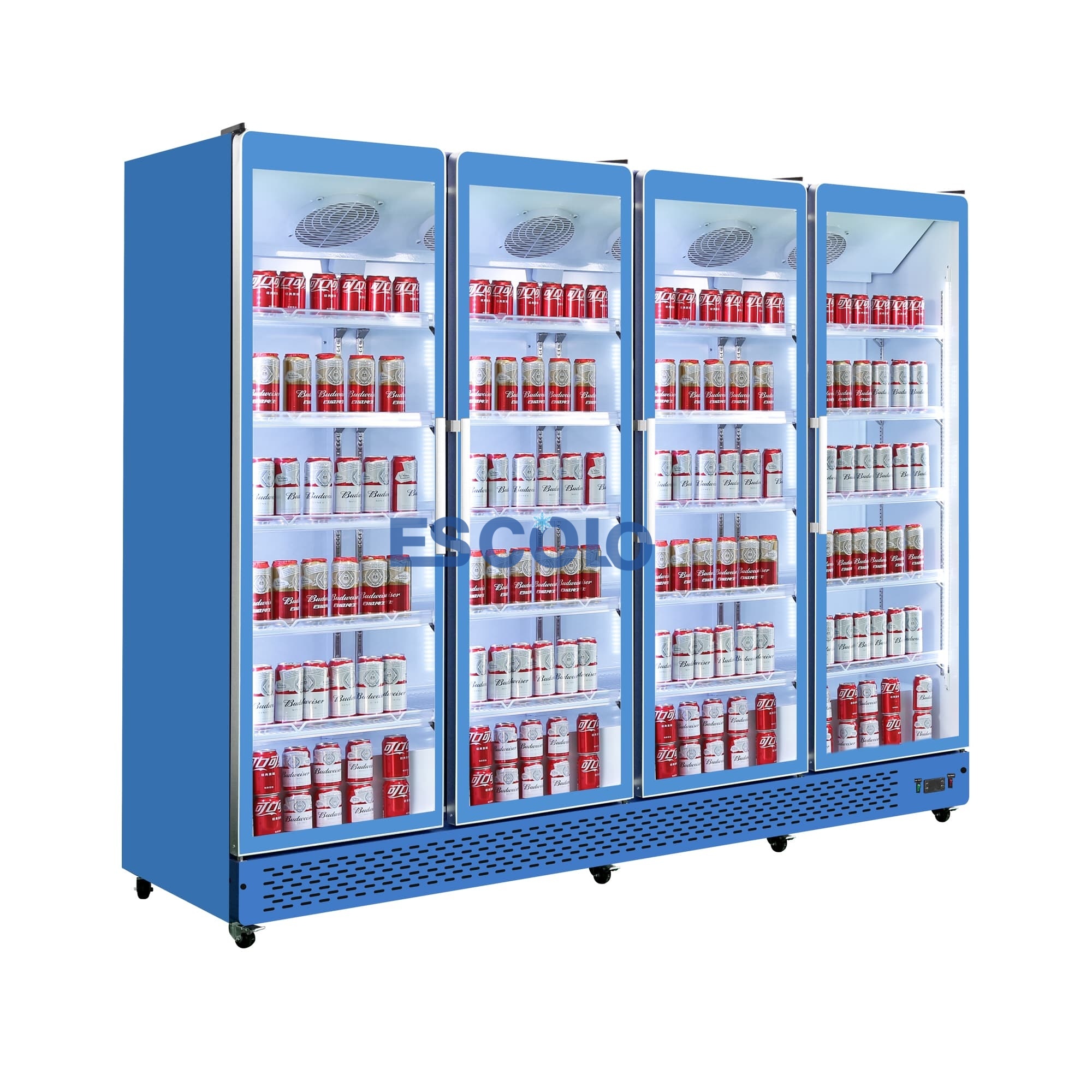
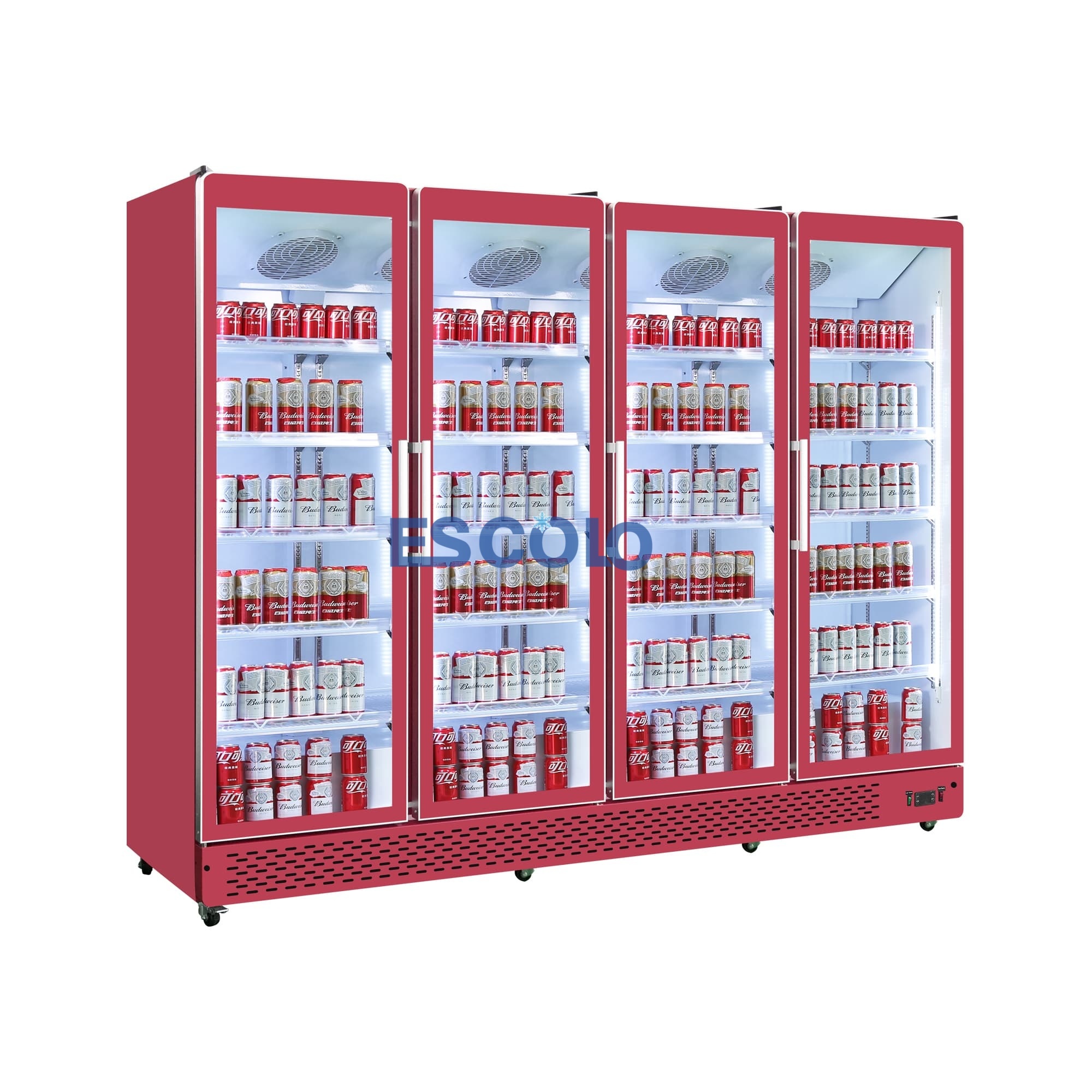
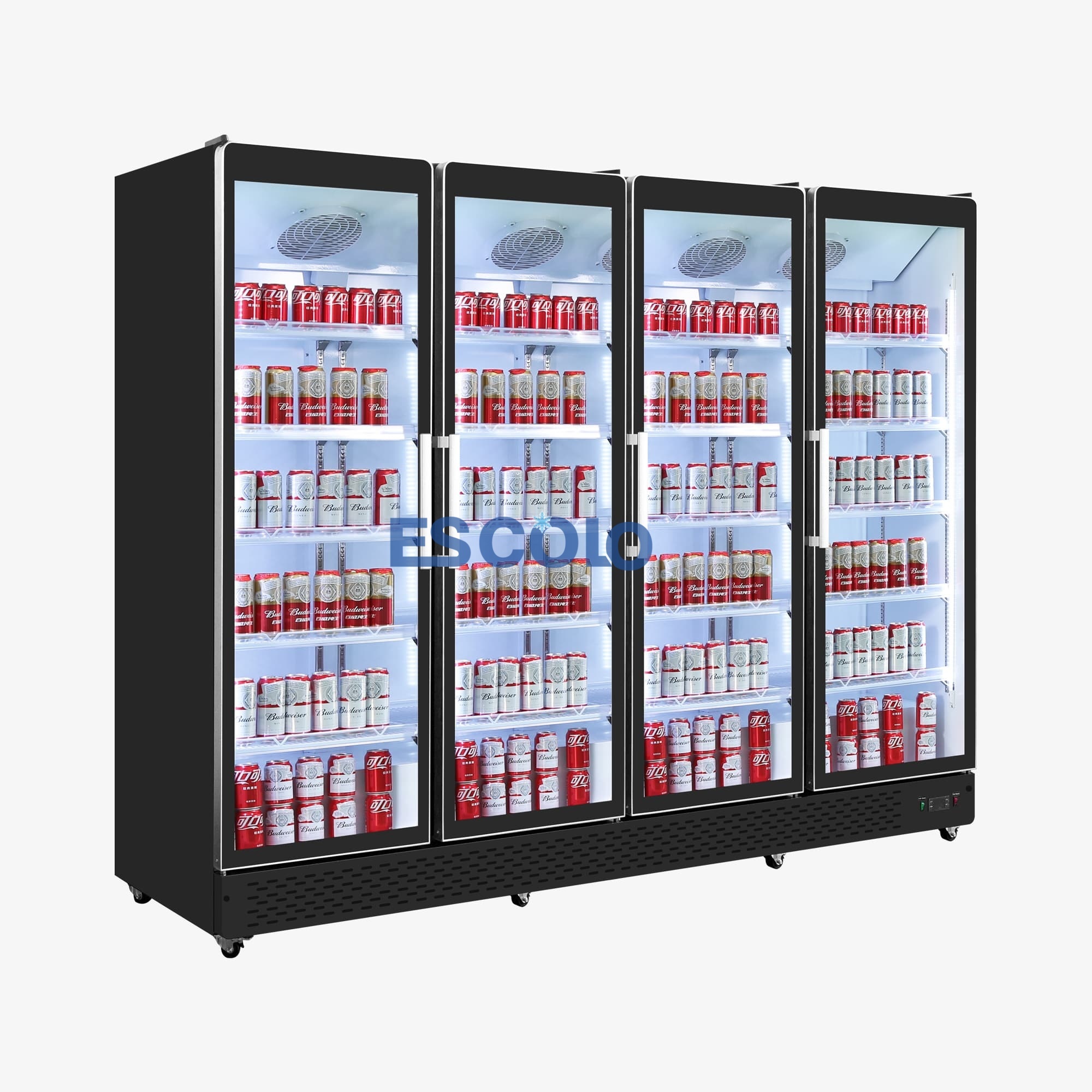
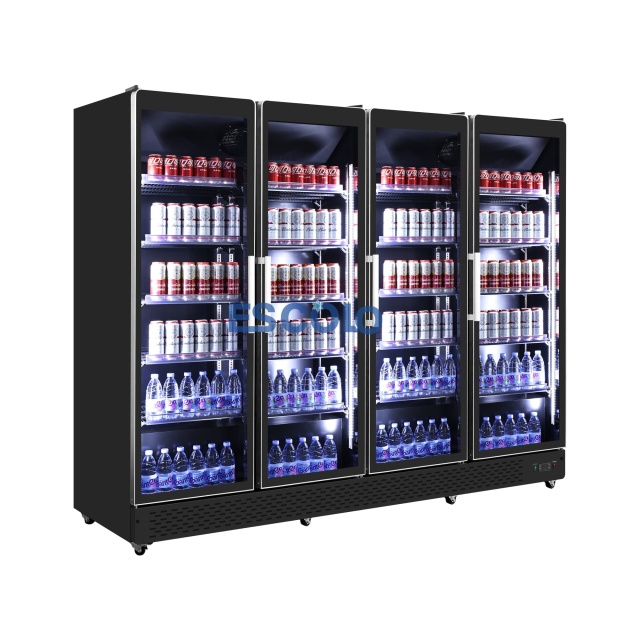
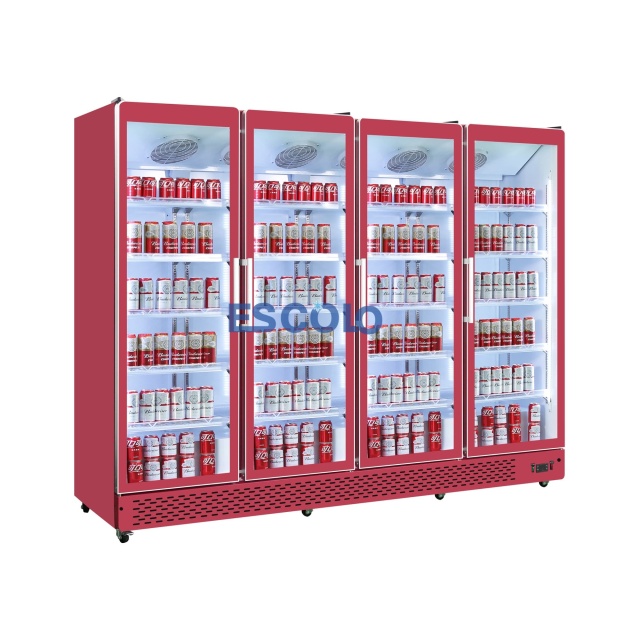
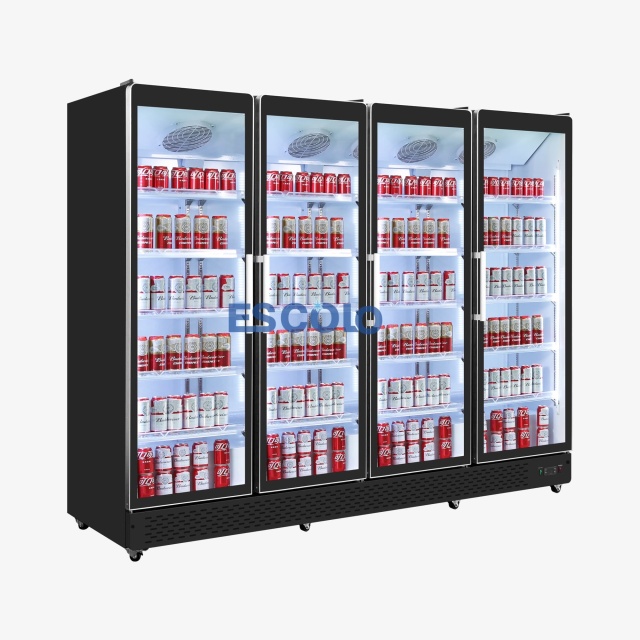
Built for the chilled aisle, this commercial full glass door display cooler presents a complete beverage, dairy or packaged-food range behind four full-height glazed doors and holds it at a steady chilled temperature. Everything about the layout is front-loading: staff stock and rotate from the aisle side, and shoppers read the shelves straight through the glass without waiting for someone to open a door for them.
The cabinet suits the places where a chilled wall has to work hard — supermarket beverage and dairy aisles, convenience and forecourt stores, a distributor's trade showroom, and the front-of-house counter in a hotel or restaurant. In each of those settings the same three things decide whether the equipment pays for itself: the range has to be visible from several metres away, the temperature has to survive a busy Saturday, and staff have to restock a door in a couple of minutes between customers.
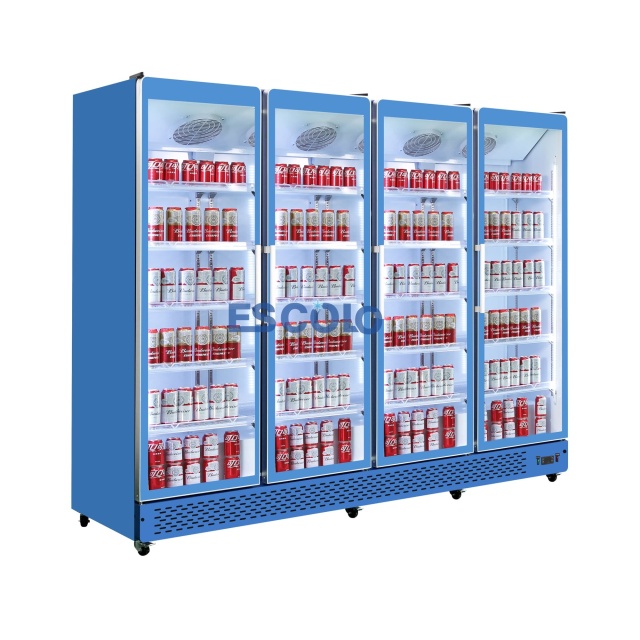
Because the series is offered in three cabinet widths, a store can fill the wall it planned instead of redesigning the aisle around whatever size happens to be available. The merchandising inside is deliberately plain — PVC-coated shelves, price-tag strips, dividers, clear glass and vertical lighting — so the packaging does the talking and the cabinet stays out of the way.
For anyone replacing a row of older closed cabinets or a mix of single-door units, the visible change is one continuous glass front with a common shelf rhythm running across the whole chilled set. Distributors use it as a single line that can serve supermarket, convenience and hospitality accounts from one stock item, which simplifies both the catalogue and the spare-parts list.
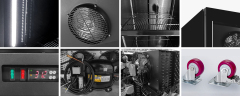
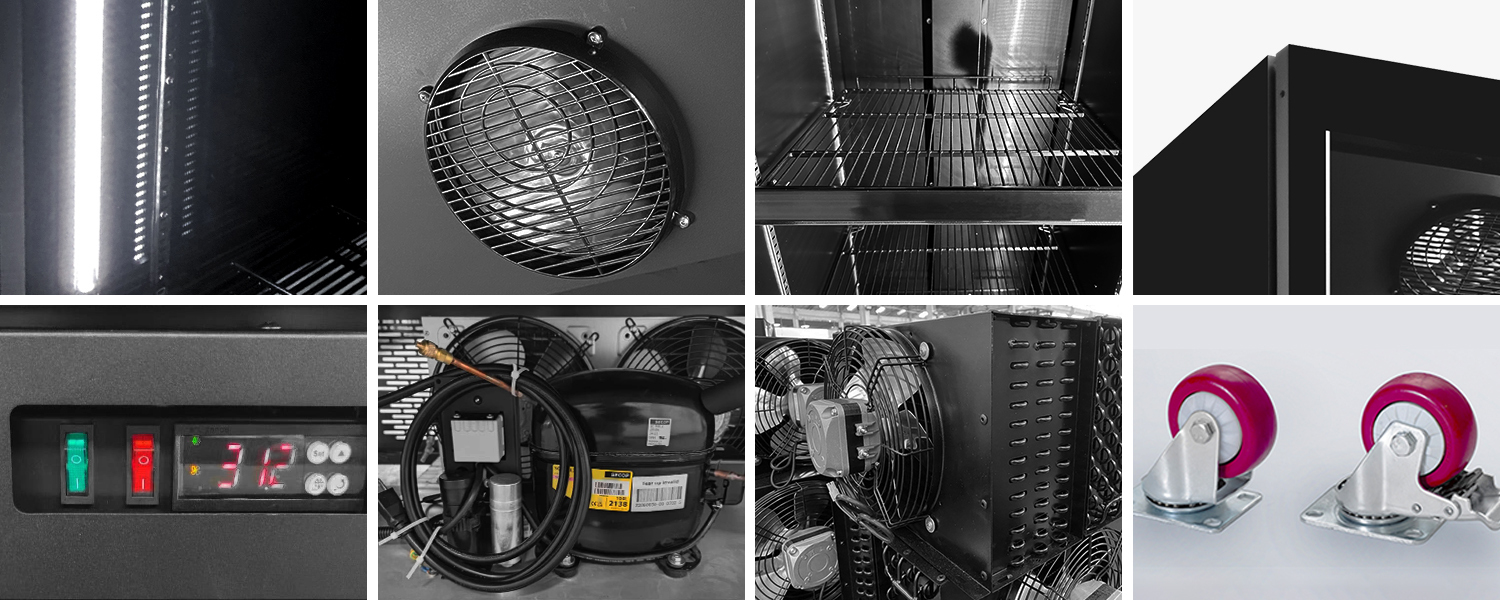
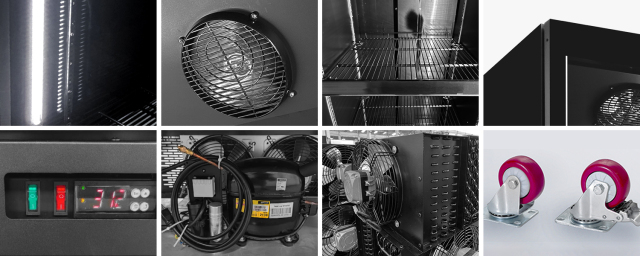
Cooling comes from two DONPER K480CU1 compressors running on 220 V / 50 Hz with R290 refrigerant. The R290*2 notation in the specification refers to the twin refrigerant circuits, one serving each pair of doors, so the cabinet is effectively two cooling systems sharing one frame.
R290 is a natural refrigerant with a very low global warming potential, and it lets each circuit pull its half of the cabinet down quickly and hold it there without the energy penalty of an older synthetic-refrigerant system. The cabinet uses a fan cooling system and is built as a no-frost cabinet: fans move cold air through the compartment rather than letting it settle in layers, so the top shelf and the bottom shelf sit in the same temperature band. The evaporator is a skin-type coil — a plate design that spreads cooling across the cabinet structure instead of concentrating it in a single cold blast at the back.
Glass clarity is where this cabinet differs from most heated-door merchandisers. The condenser is mounted inside the cabinet with its own fan, and that fan directs the warm discharge air across the inner face of the glass: hot air blowing to avoid fog on the glass, as the specification puts it. There is no heater element inside the door, so nothing in the glass is running against the refrigeration, and the pane stays readable in a humid store, near a shopfront, or on a wet afternoon when every customer brings the weather in with them.
The practical result is a front that can be browsed rather than peered through. Two circuits also mean that if one side develops a fault, the other half of the wall keeps its temperature while the engineer is called — the difference between moving a dozen lines and emptying four doors into a back-room chiller.
| Parameter | Specification |
|---|---|
| Door | 4 |
| Structure temperature | 0 °C to +10 °C |
| Glass door | Full glass door, front side tempered, self-closing |
| Lightbox | No |
| Interior light | Yes,5 LED energy-saving lamps |
| Key / lock | Yes |
| Temperature control | Digital thermostat with LED display |
| Defrosting | Auto defrost |
| Shelf | 5 pcs PVC-coated per door, heavy duty |
| Wheels / feet | 4 universal wheels, 2 with brake |
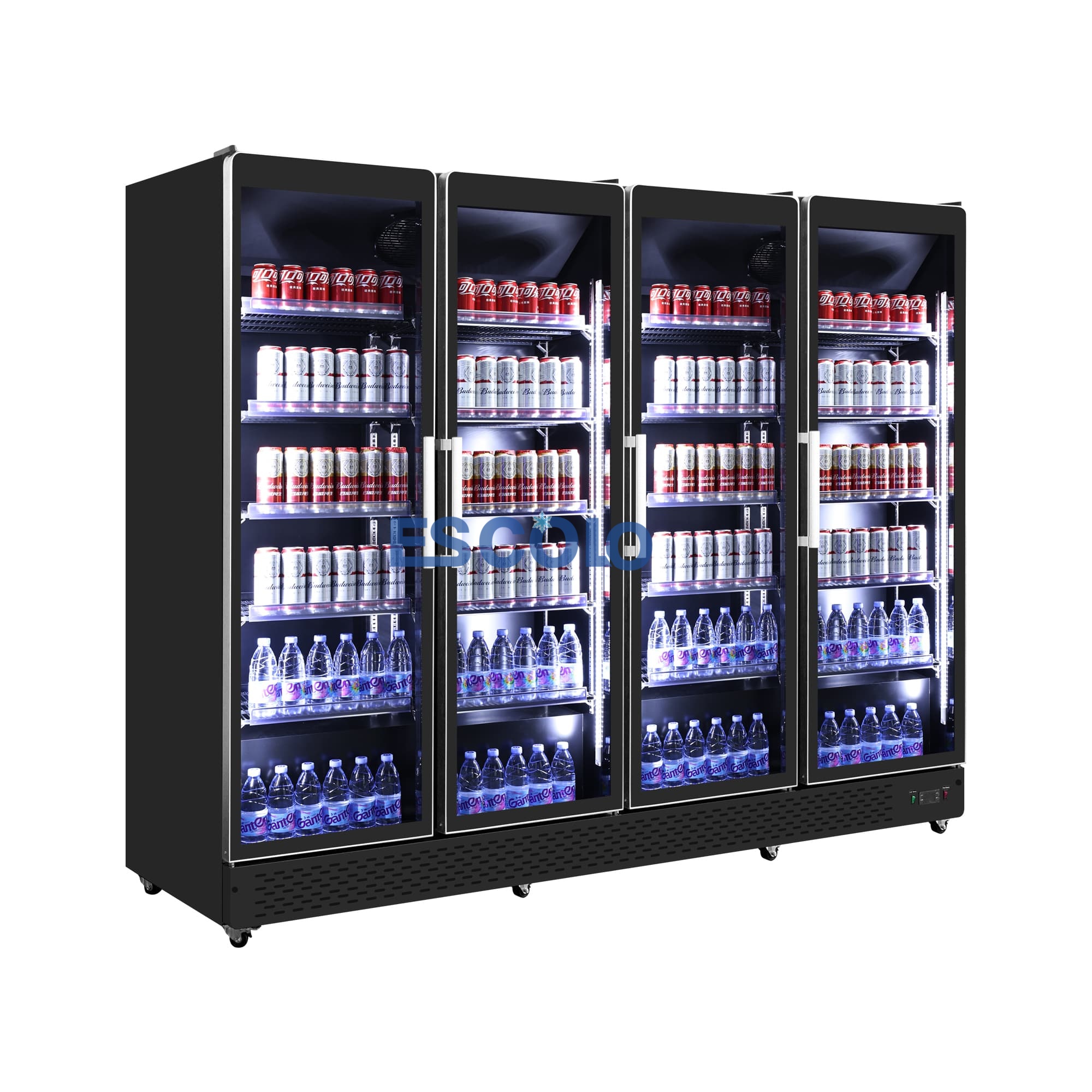
Shelving is where a four-door cabinet either works or turns into a jumble. Each door carries its own column of heavy-duty PVC-coated shelves, and every shelf takes a price-tag strip along the front edge plus adjustable dividers, so the facings plan survives the first restock instead of sliding into a heap by mid-morning.
Treat each door as a zone. A common arrangement is water and large-format bottles on the left door, carbonated soft drinks across the middle two, and dairy, juice or promotional lines on the right — roughly the order most shoppers walk the aisle, and an easy rhythm for one person to replenish. Dividers hold each block of facings upright, so a gap left by a sold-out line does not take the neighbouring brand down with it.
Shelf pitch adjusts, which matters once 330 ml cans share a door with 1.5 L bottles or multi-packs. Because the shelves are PVC-coated, they wipe clean, they do not rust at a chipped edge, and glass bottles do not scrape along bare metal. Keep the rear of each shelf clear so cold air can travel down the back of the cabinet, and put heavy multi-packs low rather than at eye level.
For a glass door merchandiser fridge in a commercial merchandising environment, the shelf edge is the merchandising surface. Price strips, dividers and consistent facings do more for sell-through than one extra row of stock jammed onto a shelf, and they make the difference between a wall that looks like a category and one that looks like a delivery.
The cabinet earns its space where chilled products are picked up on the way round rather than ordered in advance. Supermarket beverage and dairy aisles are the obvious home: the four-door frontage matches the length of a standard chilled run, and the doors let a category be shopped from both directions.
Convenience stores and forecourts often use a single cabinet as the entire cold-drinks offer, sited where the pick-up decision happens rather than at the back of the shop. Beverage distributors and importers put one in a showroom or trade counter loaded with the brands they carry, because a glass door merchandiser fridge for commercial display sells a range better than a price list does. Hotels, restaurants and catering kitchens use it front-of-house for bottled water, soft drinks, beer and dairy, which keeps service staff out of the walk-in chiller during service.
Foodservice customers also load it with packaged chilled food — sandwiches, salads, ready meals, desserts — where the rules are the same: the packaging has to be readable, the shelf has to take a multipack, and the range has to still look organised at seven o'clock on a Friday evening.
If your mix is mostly large-format bottles, plan the shelf pitch with us before the order is placed; if it is mostly cans and small cartons, the standard configuration works as supplied. Bright vertical LED lighting improves product visibility and helps merchandise stand out along the shelf.
Orders for this range start at 1 container, and the line sits within our glass door freezer and merchandiser programme. The three sizes can be planned together, and we will build the container arrangement against your planogram and destination port.
Customisation runs across the series: cabinet branding, logo placement, packaging and specification adjustments can be set to your market, which is how most of our distributor customers buy a commercial display cooler wholesale rather than off the shelf. If the branding has to match an existing store concept, send the artwork or a sample label with the enquiry.
Three things are worth settling before the order is confirmed: the voltage and plug standard for your market (the compressors are specified at 220 V / 50 Hz), the packaging and marking your warehouse or direct-to-store delivery needs, and the date your project is working to. Ask your sales contact for the current lead time, shipping terms and the specification sheet for the exact model — it is quicker than working from a catalogue date.
Every cabinet is covered by our After-Sales Support & Warranty package, and spare parts and technical guidance go through the same contact. If this is your first import of refrigeration equipment, ask us to walk through installation, thermostat settings and the cleaning points before the container lands; half an hour on the phone saves a service call later.
In modern commercial refrigeration settings, display equipment is not only responsible for keeping products fresh but also plays an important role in increasing customer attention and purchase decisions. The ESCOLO full glass door display cooler combines efficient refrigeration technology with an attractive display structure, helping businesses maintain a cleaner shopping environment while maintaining consistent cooling performance. The full glass door allows customers to quickly view products without opening the cabinet frequently, reducing unnecessary cold air loss and improving energy efficiency during busy business hours.
Powered by a reliable Donper compressor and R290a refrigerant, this commercial display cooler delivers stable refrigeration performance for long-term operation. The refrigeration system is designed for professional commercial environments where consistent temperature control and durability are essential.
ESCOLO has manufactured commercial refrigeration equipment in Foshan, Guangdong since 2010, and the team now numbers more than 800 people. Fifteen-plus years in the trade, a network of 3,000+ qualified partner factories and an annual output of 200,000+ units let us run container-scale programmes and repeat orders for supermarket, convenience and foodservice buyers. OEM and ODM work is standard: size, colour, function and your own branding are set to the specification you send. Factory audit, pre-shipment inspection, consolidated shipping and after-sales support are handled in-house.
Chilled drinks and packaged food: bottled water, soft drinks, beer, juice, dairy, sandwiches, salads and ready meals. This commercial full glass door display cooler is built for a chilled product range rather than for freezing, so frozen lines belong in a freezer cabinet instead.
Yes — it runs on R290, a natural refrigerant with a very low global warming potential, through two Donper compressors. As with all R290 equipment, any refrigerant work should be carried out by a qualified refrigeration engineer.
No, there is no heating element in the door. Fog control comes from the condenser fan, which directs warm air across the inside of the glass, and the front pane is tempered glass on a self-closing hinge. The glass is cleaned like ordinary shop glass — no heater to check or replace.
Yes. The PVC-coated shelves can be re-pitched to suit anything from cans to 1.5 L bottles, and each shelf takes price-tag strips and dividers so facings stay where you set them. Shelves lift out for washing.
Yes. We handle logo and cabinet branding, packaging and specification adjustments for buyers sourcing a commercial display cooler wholesale, and we work from your artwork or a physical sample so the finish matches what your market expects.
Plan around door swing and shopper space rather than a large service gap: the cooling components sit inside the cabinet. Send us your layout and the wall dimensions and we will check the position against the cabinet drawing before the fit-out starts, which is especially worth doing if the cabinet will sit near a glazed shopfront or in a hot climate.