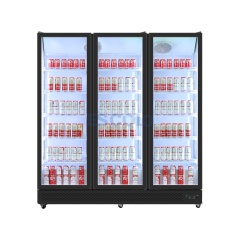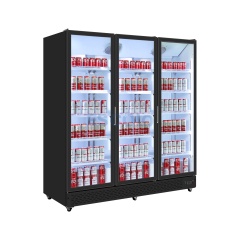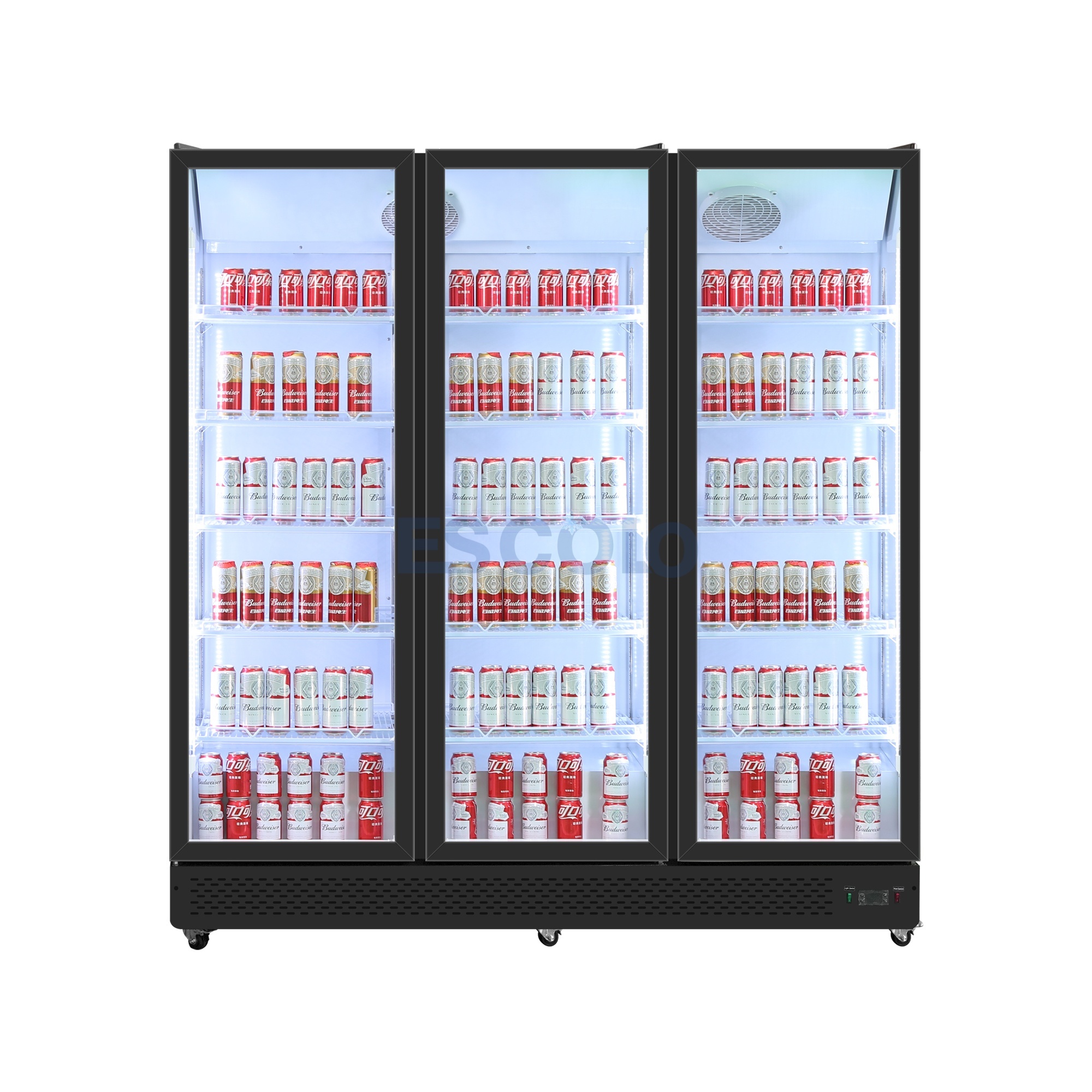
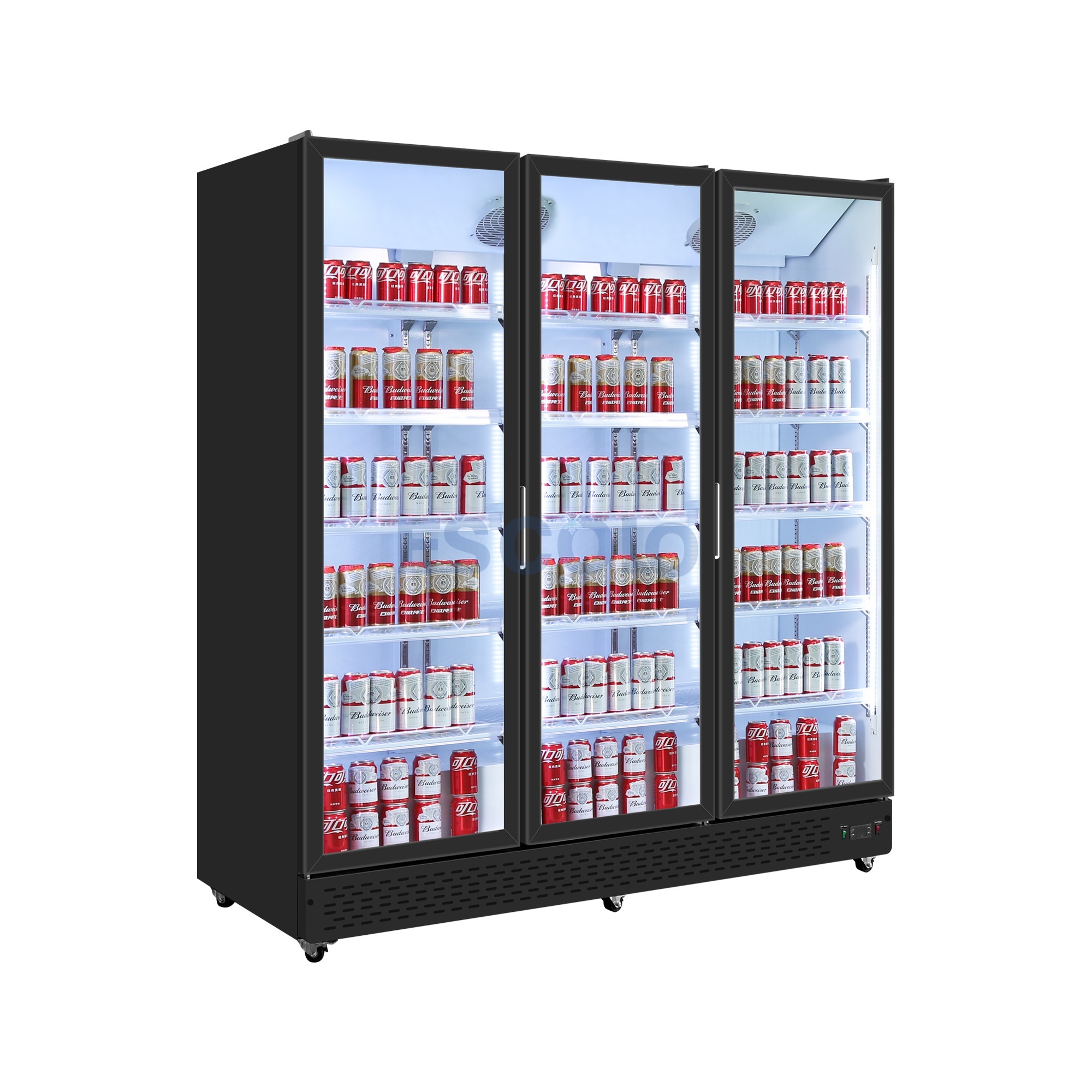
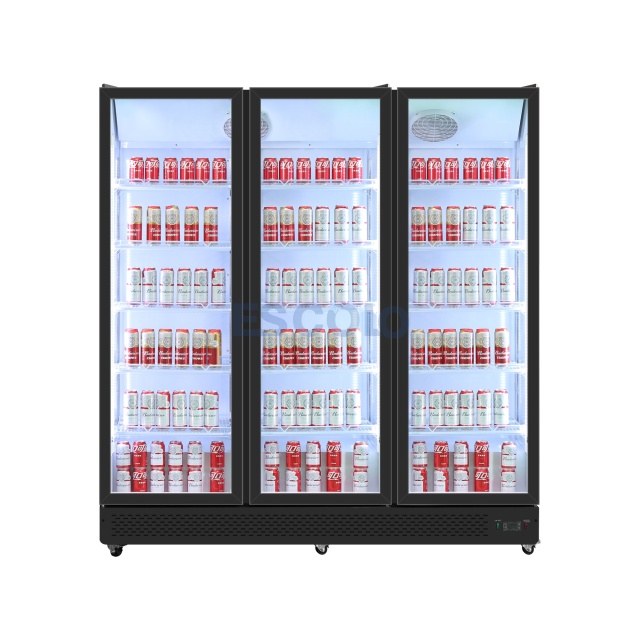
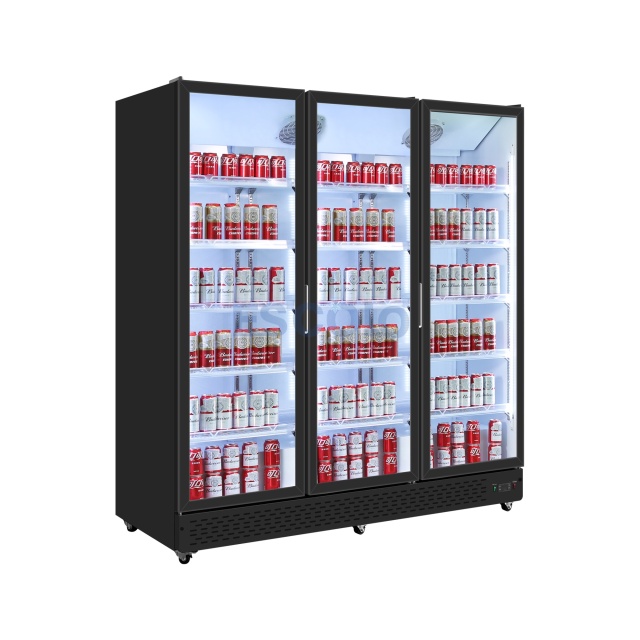
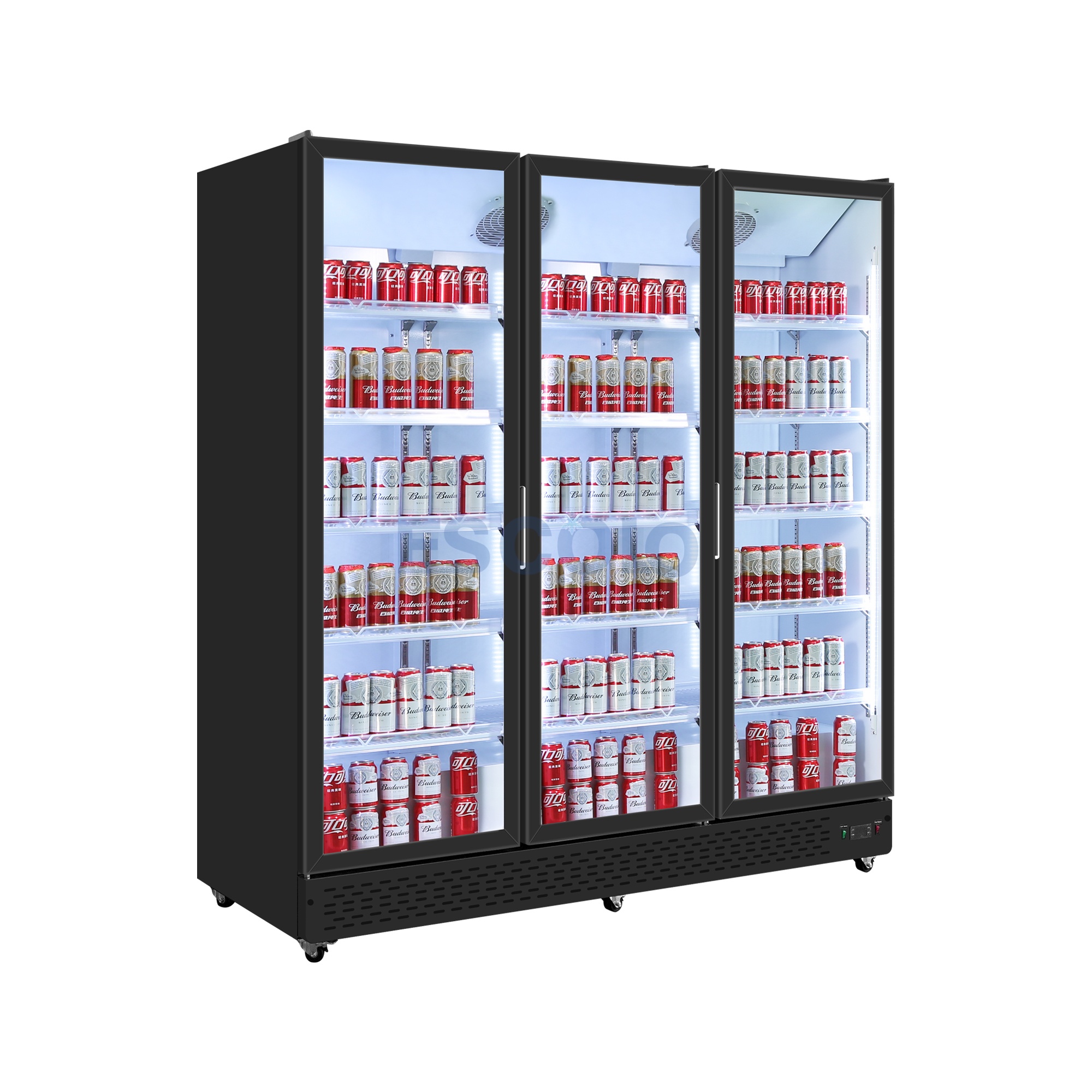

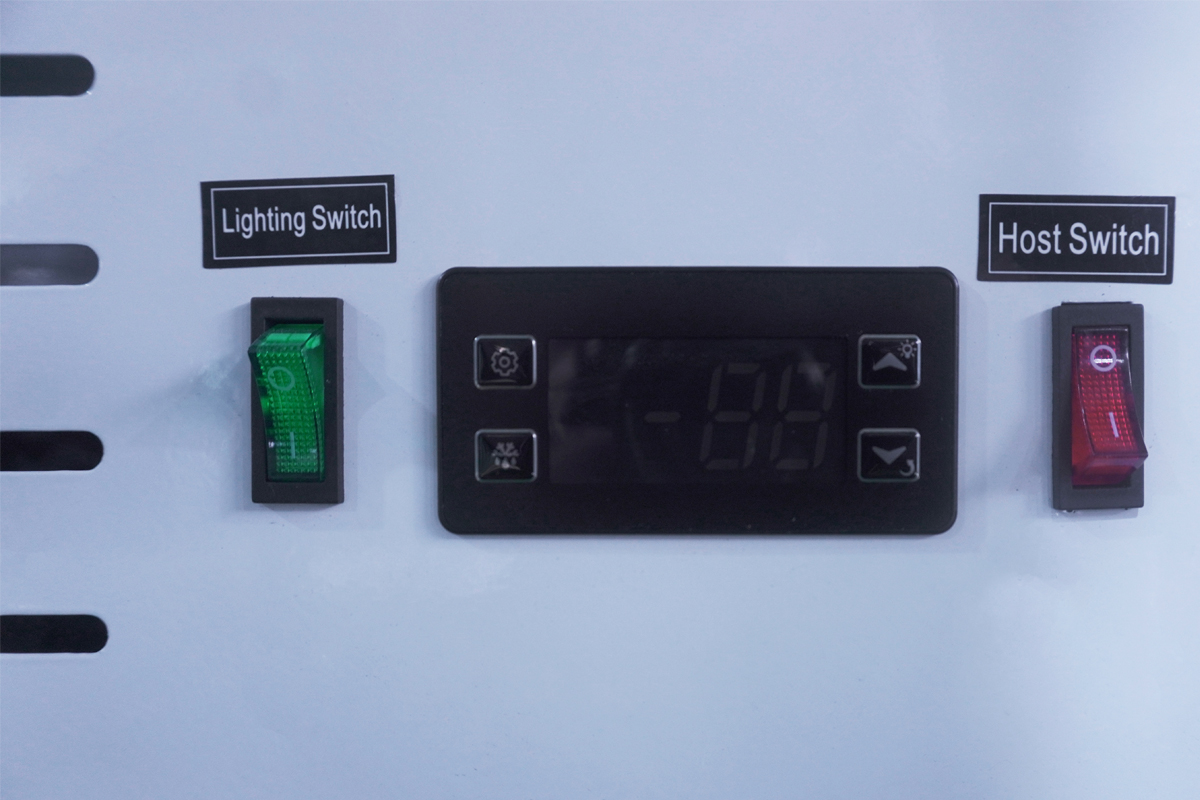
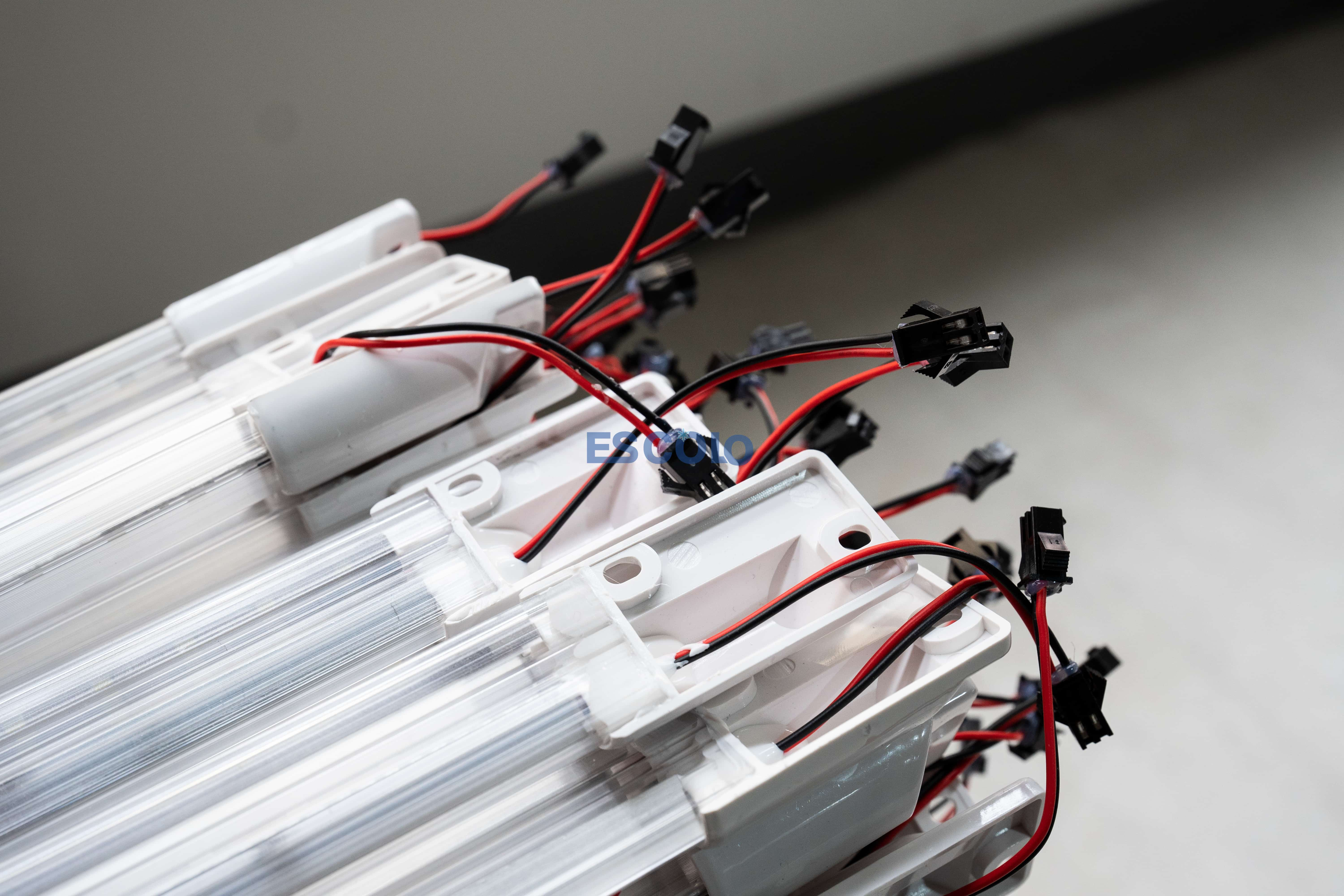
The ALG1680-3M-TJ is a 1190 L large triple door commercial chiller that puts a full chilled set behind glass in a single 1680 mm footprint. Three full-height doors run across a cabinet 590 mm deep and 1995 mm high, with a holding band of 0 °C to +10 °C — the working range for canned and bottled drinks, dairy, packaged desserts, chilled ready meals and grab-and-go food. Two fans circulate air through all three sections rather than one, a full stack of PVC shelves with price-tag strips sits behind each door, and vertical LED lighting runs the height of the cabinet. The controls are deliberately plain: a Hongke digital controller for the set point, one switch for the light and a separate switch for power. Stores buy this cabinet when a row of narrow single-door coolers no longer keeps up with the volume moving through the aisle. It stands on castors, so it can be rolled into position during a fit-out and pulled clear for cleaning behind and beneath.
| Model | ALG1680-3M-TJ |
|---|---|
| Unit size (mm) | 1680 × 590 × 1995 |
| Package size (mm) | 1730 × 630 × 1905 |
| Capacity | 1190 L |
| Doors | 3 |
| Fan quantity | 2 |
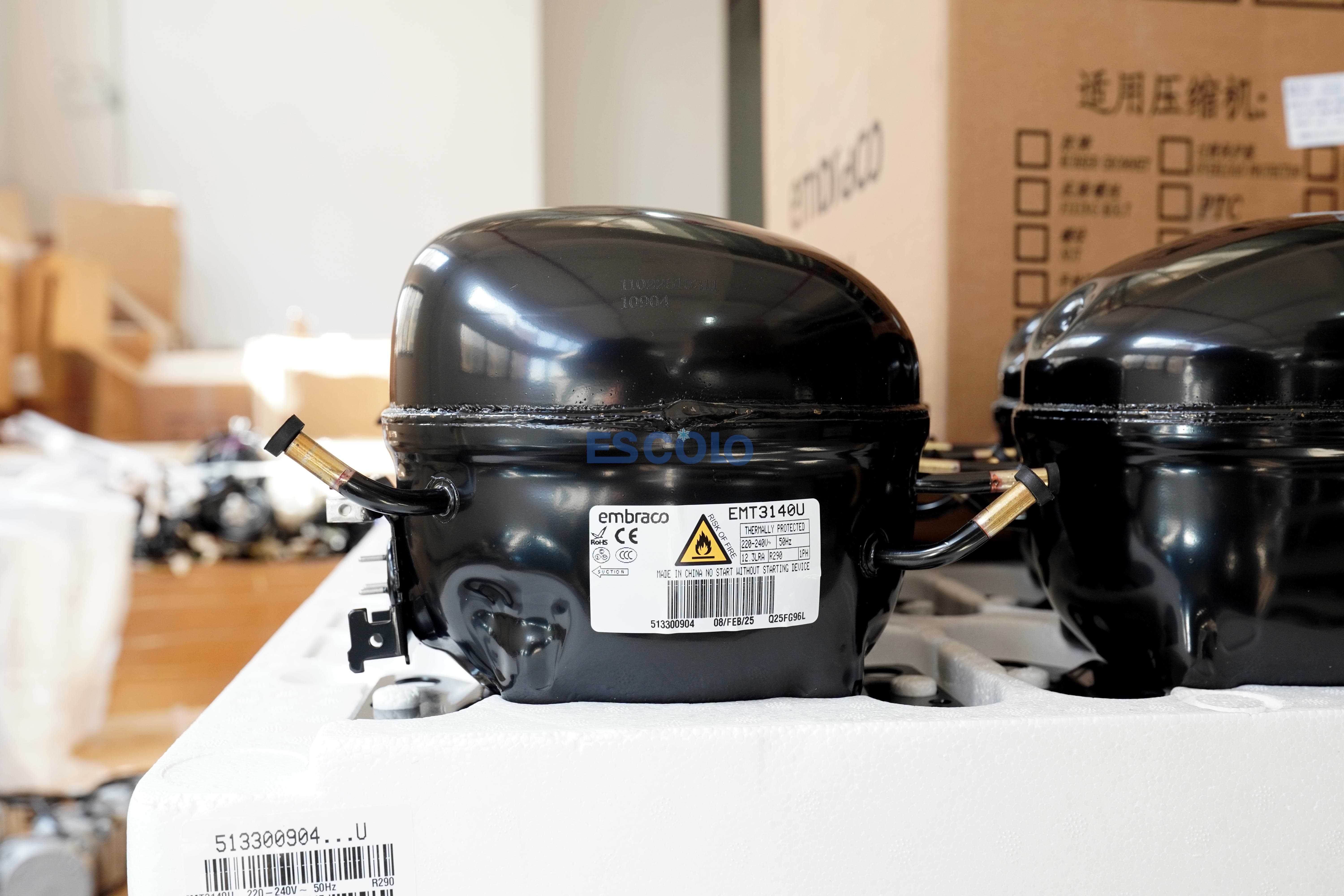
| Gas | Wanbao FNK120M (R290) |
| Temperature | 0 °C to +10 °C |
| Voltage | 220 V / 50 Hz |
| Shelving | PVC shelves with price tag, 5 per door |
| Exterior and interior | Painted steel |
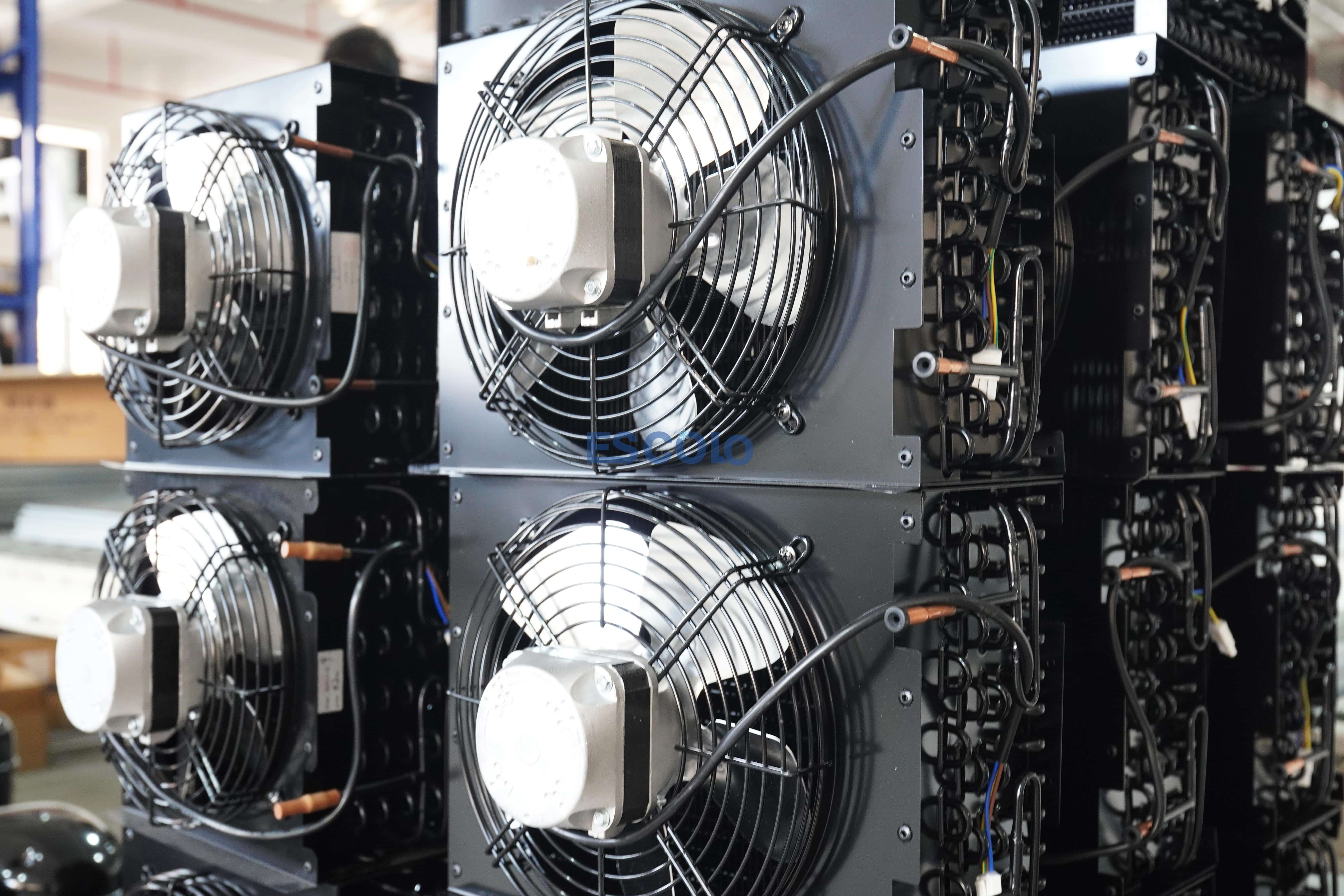
| Condenser | Web-type painted steel |
| Evaporator | Fin type, aluminium pipe |
| 20GP / 40HQ (unit) | 20 |
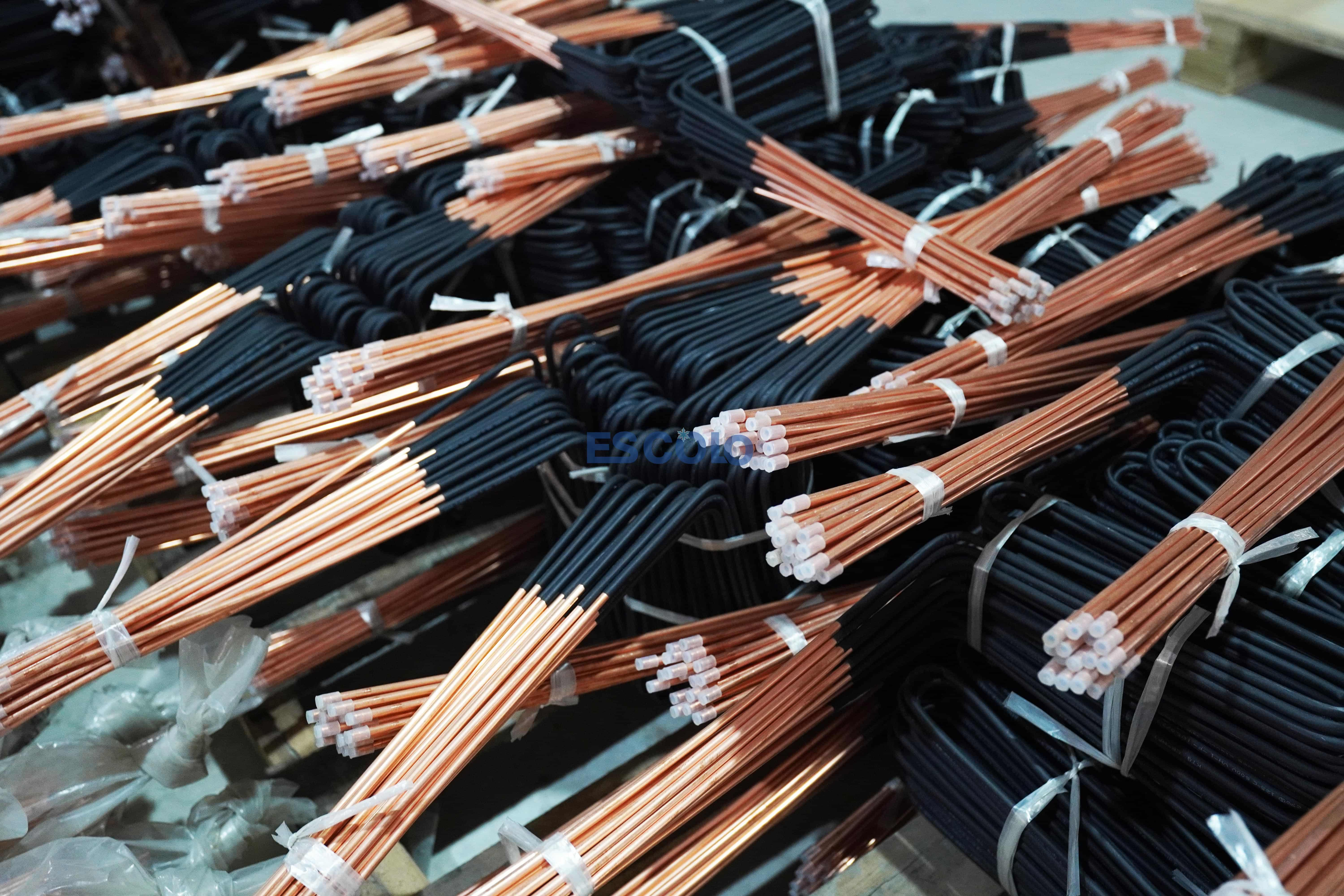
Commercial refrigeration earns its keep in month four, not week one. This cabinet is put together for a commercial shift that does not stop: staff open the doors to restock between rushes, shoppers open them again for a closer look, and the store expects the same holding temperature at nine in the evening as at nine in the morning. The refrigeration circuit uses a branded compressor and copper tubing, the cabinet is built as a single steel shell rather than a set of bolted panels, and the shelves are PVC so they can be lifted out and washed without rusting along the edge. Stores specify it as a high traffic commercial display cooler because that is the job it is sized for — a wide, fast-moving chilled set in a position where people pass constantly. The same build is supplied to importers and to chain fit-outs, which means a cabinet specified for one store can be repeated across a rollout without redrawing the aisle each time.
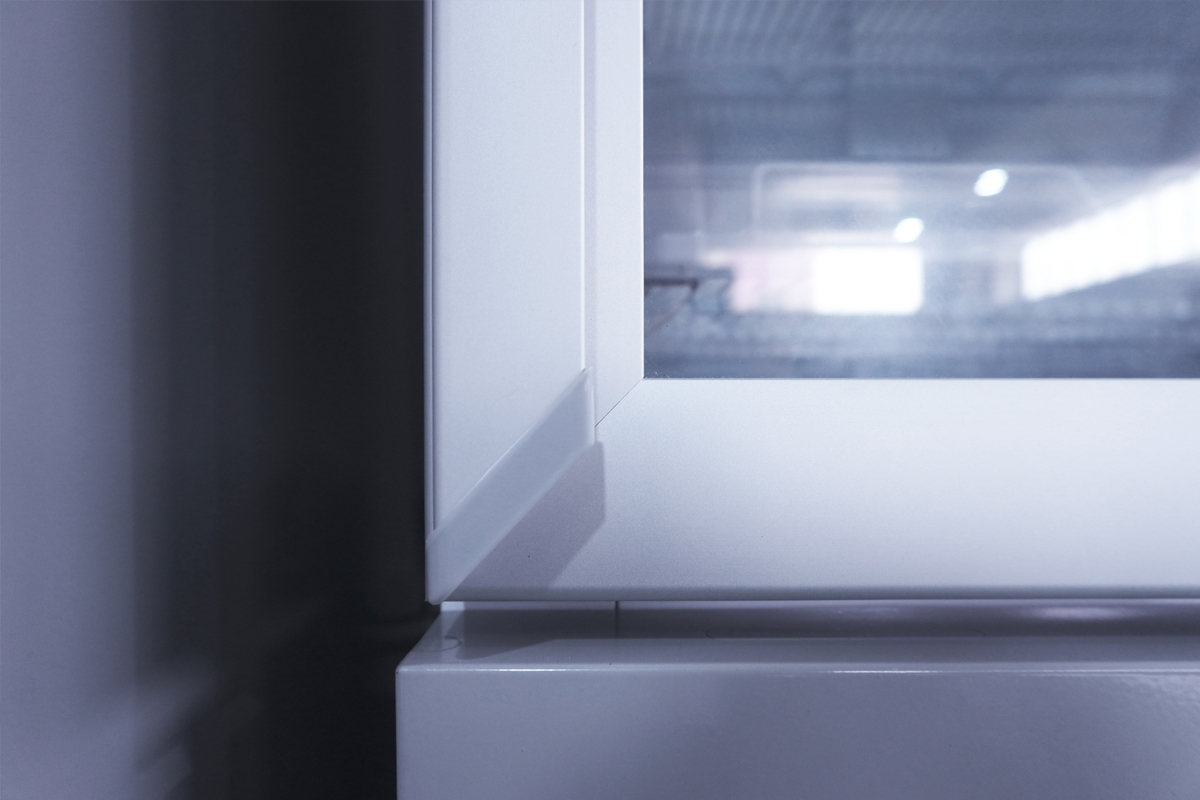
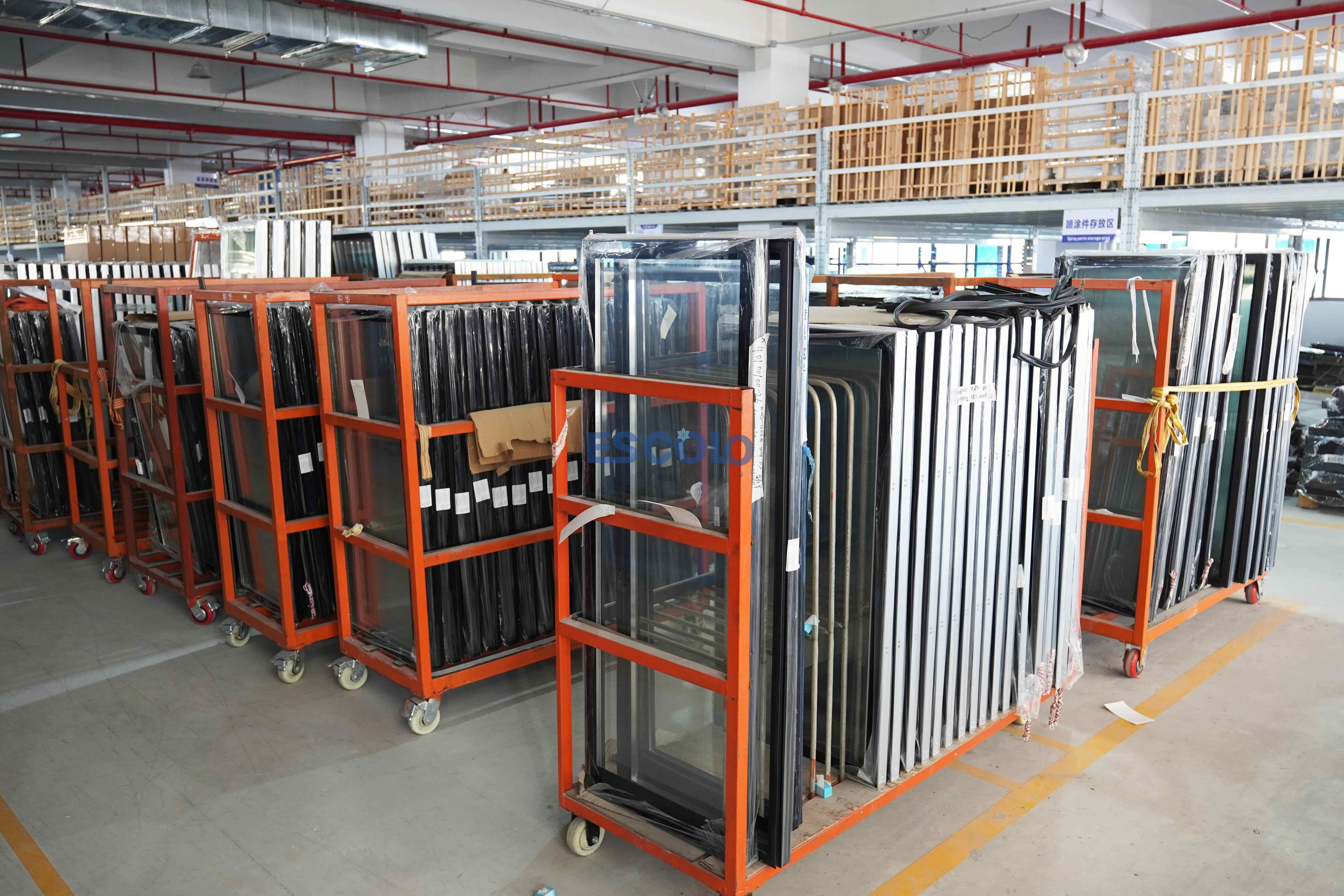
The doors are where a display cabinet is judged, because the doors are what the shopper actually sees. Each one is framed in moulded PVC with a PVC handle formed into the frame — no painted metal edge to rust where the glass meets the frame, nothing metal to work loose in a hand that opens it two hundred times a day, and a surface that wipes down with the glass during cleaning. The glass runs from the top rail to the base, so there is no solid panel hiding the top shelf, and the panes are hollow double-glazed units: the sealed air gap between the two sheets insulates the display and slows condensation on the outer face. Three separate doors matter as much as the glass itself, because staff can open the section they are restocking and leave the other two closed, which keeps cold air where it belongs during a busy changeover. The frame is finished in black, so the cabinet reads as part of a fitted commercial run rather than a utility box at the end of an aisle. On condensation, be precise about what you are buying: this model is specified with a full glass door without a heater. The hollow pane copes with normal air-conditioned interiors, but in a coastal store, a genuinely humid climate or a space where doors are opened constantly, ask your sales contact about a heated-door build before you specify — it is a decision to settle at specification stage, not something to find out in the first wet season. Condensation that builds up on the glass hides the drinks inside and quietly costs sales, so the glass is heated to keep the display crystal clear for shoppers.
Inside and out, the cabinet is built from painted steel. The finish is there for two reasons: it protects the steel in a room that is mopped and washed daily, and it keeps the cabinet looking like commercial equipment rather than a utility box parked at the end of an aisle. The panels wipe down with a damp cloth and a mild detergent. Keep scourers, solvent-based cleaners and anything abrasive away from the coated surfaces, because a scratched panel is where rust begins, and a chipped edge — a door frame corner knocked during delivery, for example — should be touched up promptly rather than left through a whole season. The shelves are PVC rather than coated steel, so they can be lifted out, washed at a sink and put back without the edges rusting. Treat the painted body as the structural shell it is: it does not need polishing, it needs to stay intact and clean.
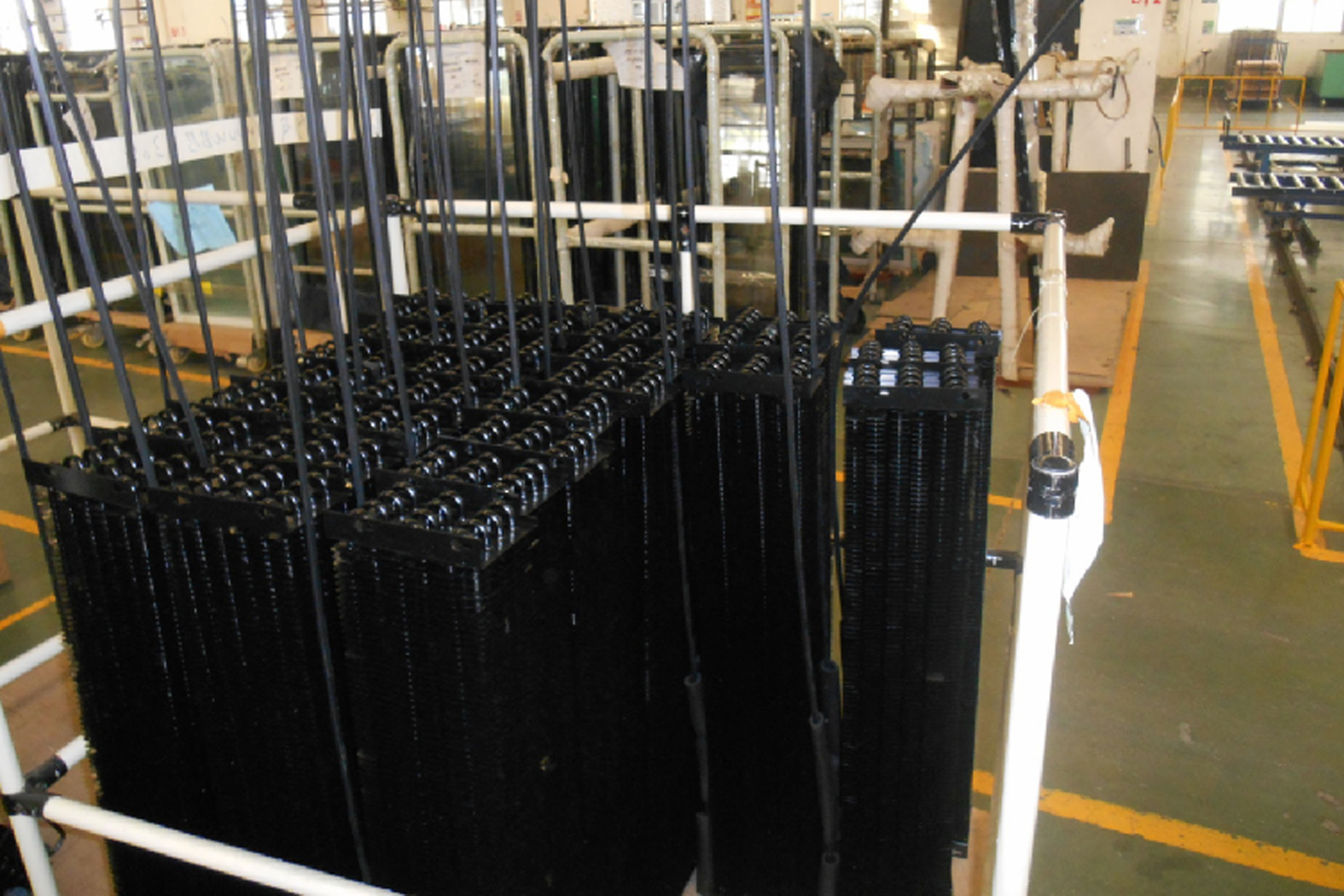
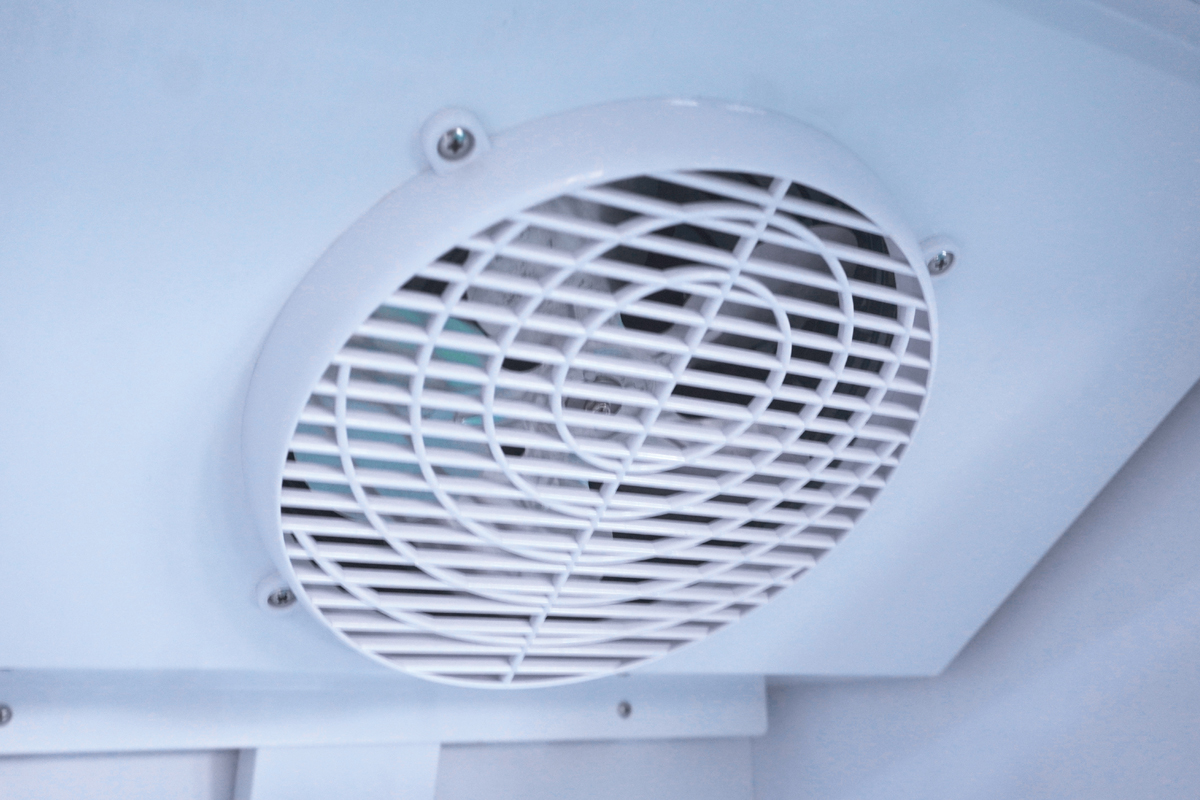
Uneven cooling is the failure a store notices last and pays for first. In a wide cabinet, the end furthest from the cooling coil is where temperature drifts, and that is usually where the slowest-moving stock sits. The two-fan layout exists to close that gap: the band you choose for the middle of the cabinet is the band the outer doors hold.
A fogged door turns a display cabinet into a closed box, and a shopper who cannot identify a product from two metres away keeps walking. The hollow double glazing slows condensation on the outer pane, and closing each door fully after a restock does as much as the glass itself.
Every manual defrost costs staff time — stock out of the section, wait for the coil to clear, stock back in, usually in the middle of trade. With defrost on a cycle and melt water evaporating from the base tray, that job never appears on the rota.
Display space runs out at the worst possible moment, usually the week a promotion lands. One 1680 mm cabinet carries the volume that would otherwise need several narrow coolers, and it presents that volume as one continuous display instead of a row of separate boxes with frames between them.
Finally, a temperature set by guesswork is not a setting at all. A digital readout and an adjustable set point make holding temperature something the store decides deliberately — and something it can repeat in the next store it fits out.
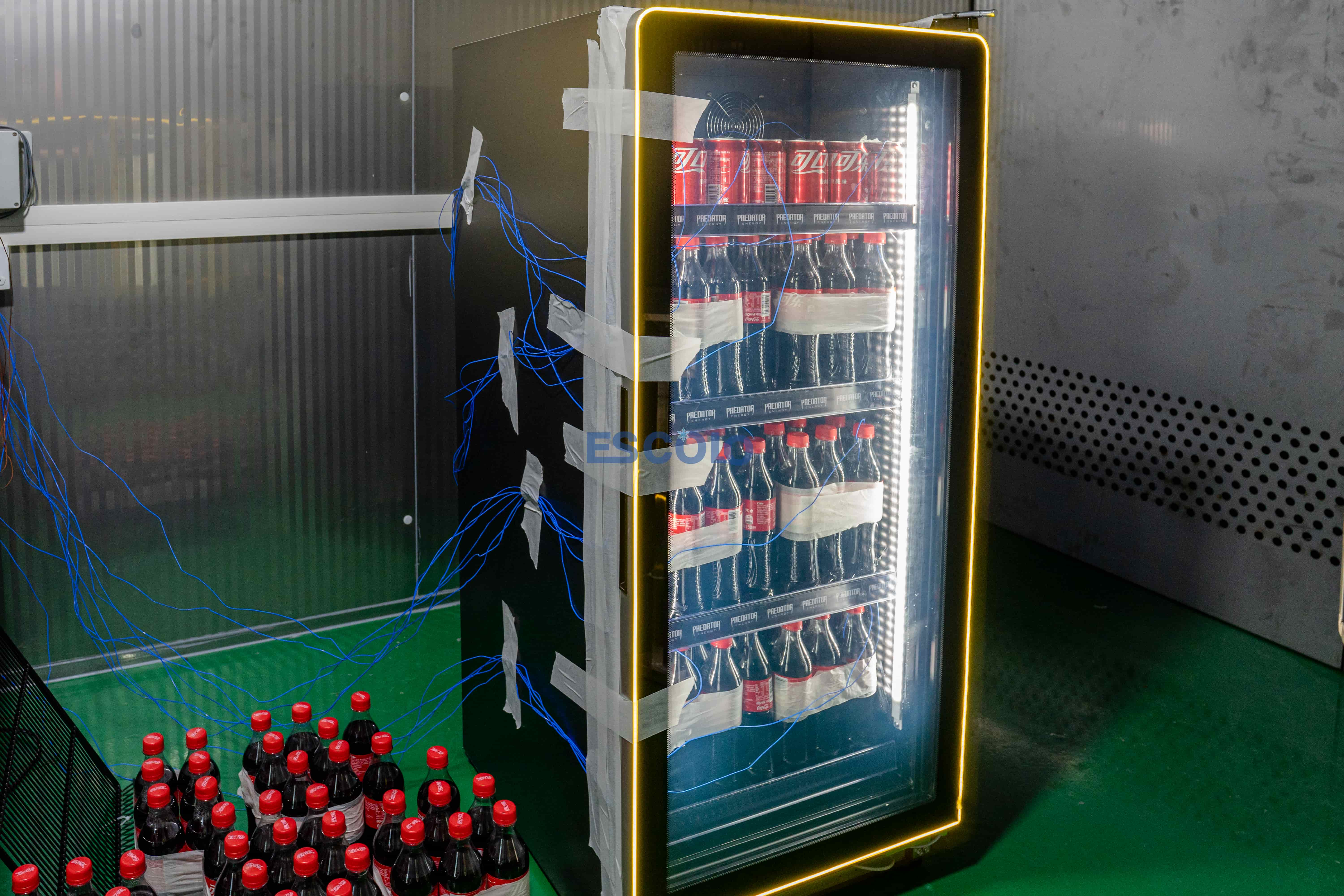
Every design passes through our own laboratory before it reaches the production line. Cooling performance, energy draw, running noise and door-seal integrity are measured there against international references such as CE, UL and SASO, and the results are recorded before a model is released for manufacture. The same discipline continues on the line: each unit is run and checked against the acceptance criteria for its model, and it is only packed once it passes. Which certificates travel with a particular cabinet depends on the model and on the market it is going to — a European distribution chain and a Middle Eastern distributor do not ask for the same paperwork, and no supplier should tell you otherwise. Tell your sales contact what your customs authority or your own commercial customer requires, and we will confirm what can be issued with this order instead of leaving you to assume it.
The hollow glass doors are equipped with built-in heating elements that prevent condensation from forming on the panes. Your beverages stay clearly visible at all times, which significantly improves merchandising effectiveness and helps drive impulse purchases.
Many traditional commercial beverage coolers suffer from uneven airflow, causing temperature fluctuations that can affect beverage freshness and consistency. This glass display refrigerator features a fan cooling system combined with a fin-type evaporator, ensuring uniform air circulation and stable cooling performance across all shelves, even during peak usage hours.
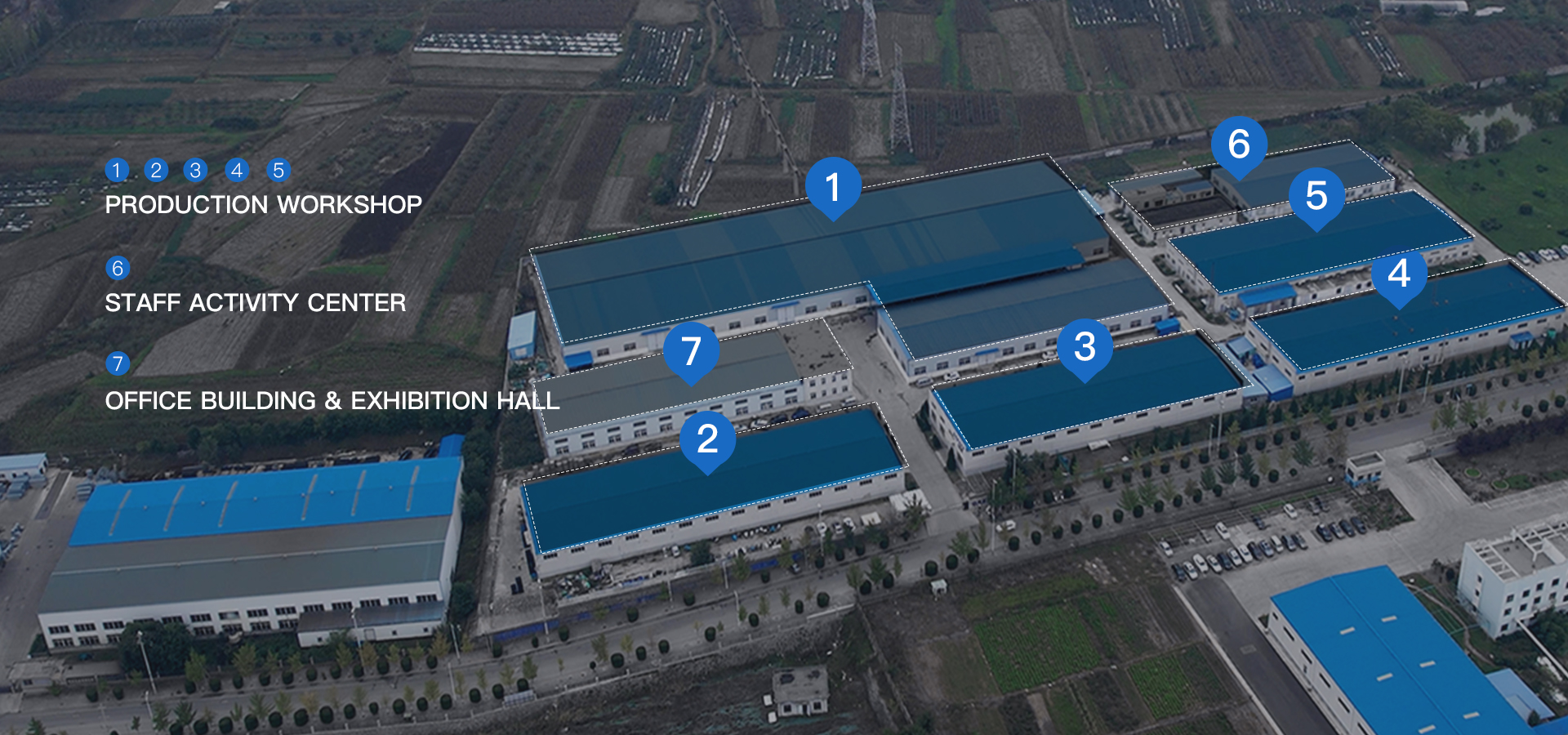
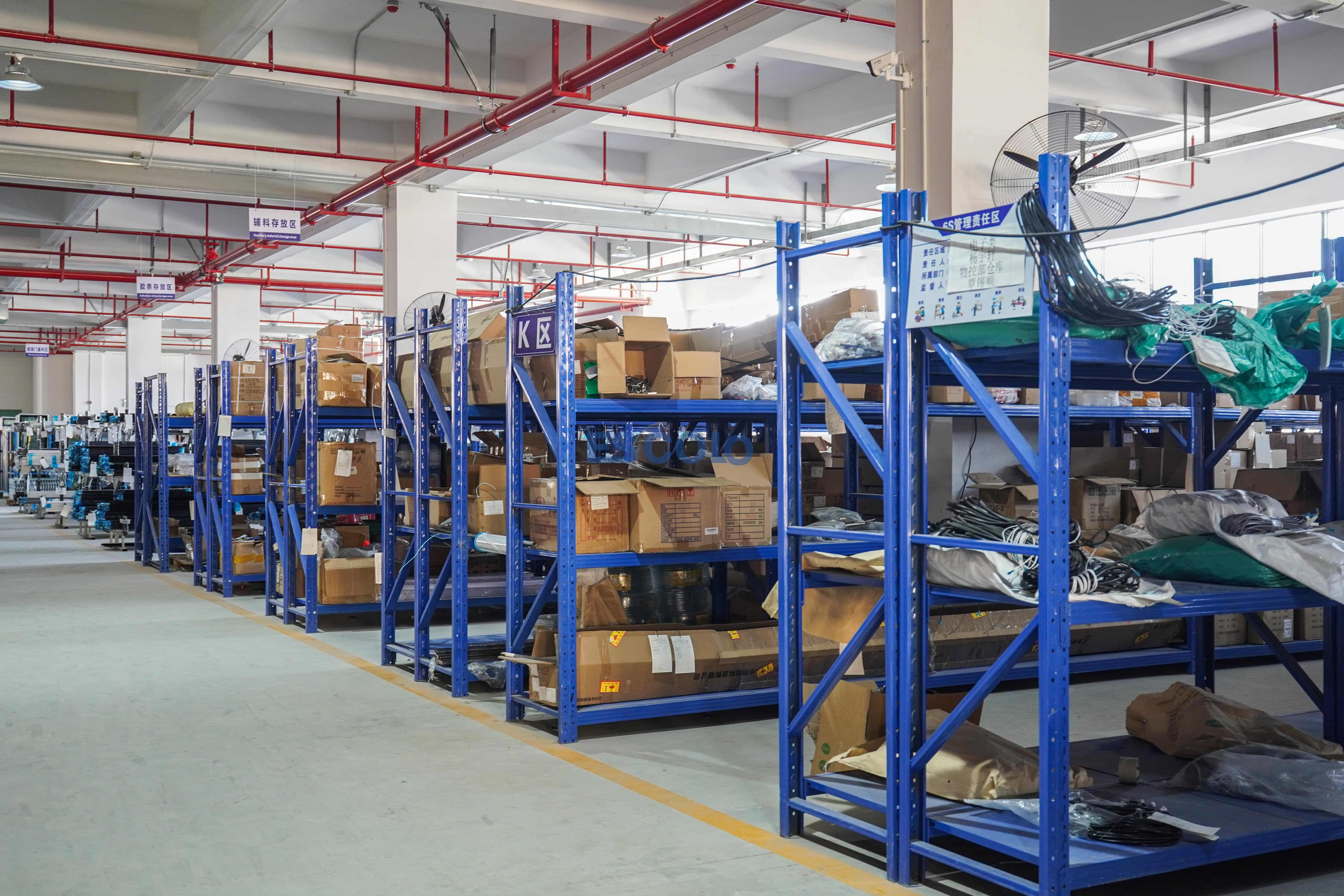
ESCOLO has manufactured commercial refrigeration equipment in Foshan, Guangdong since 2010, and the team now numbers more than 800 people. Fifteen-plus years in the trade, a network of 3,000+ qualified partner factories and an annual output of 200,000+ units let us run container-scale programmes and repeat orders for supermarket, convenience and foodservice buyers. OEM and ODM work is standard: size, colour, function and your own branding are set to the specification you send. Factory audit, pre-shipment inspection, consolidated shipping and after-sales support are handled in-house.
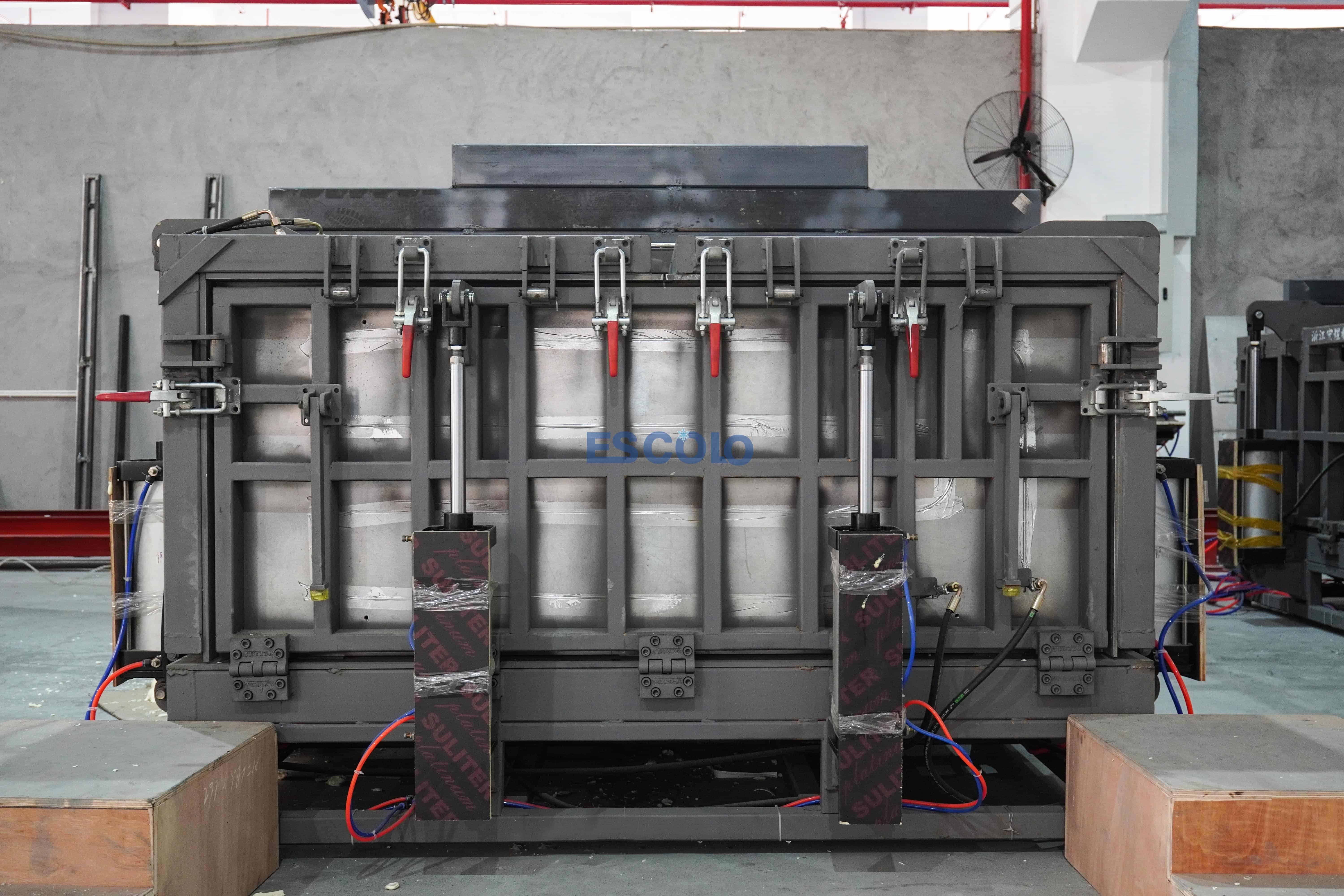
It holds 1190 L across three doors and runs anywhere between 0 °C and +10 °C, which covers canned and bottled drinks, bottled water, dairy, packaged desserts, chilled ready meals and grab-and-go sandwiches. Set it towards the lower end of the band for dairy and prepared food, and towards the middle for drinks. A large triple door commercial chiller like this one is normally run at a single band for the whole cabinet, with shelf zoning doing the rest of the work rather than a different temperature per door.
The cabinet measures 1680 × 590 × 1995 mm and ships in a 1730 × 630 × 1905 mm package, so check the final position and the route in — a stockroom door and a goods lift are the two places a wide cabinet usually gets stuck. Allow clearance behind and above for the condenser to reject heat, keep the front grille unobstructed, and plan the space so a door can be opened without staff stepping backwards into the aisle.
The doors are hollow double-glazed panels, and the sealed gap between the two panes slows condensation on the outer face. This model is specified with a full glass door without a heater, which performs well in most air-conditioned commercial interiors. In a coastal store, a genuinely humid climate or a space where the doors never stop opening, ask your sales contact about a heated-door build — it is worth settling at specification stage rather than after the container lands.
Yes. The shelves are PVC and lift out of their supports, so heights can be reset whenever the range changes — deeper gaps for 1.5 L bottles, tighter spacing for cans and small packs. The price-tag strip runs along the front of each shelf, so labels move with the shelf instead of being taped on. Leave a hand's width between the product and the back panel when you reset heights, so the air path behind the shelves still works.
If drinks turn over quickly and the aisle is narrow, yes. A 1680 mm three-door cabinet works as a high traffic commercial display cooler because a shopper can take in the whole chilled set at a glance and open only the section they need. Check the footprint and the delivery route first, and keep the front grille clear once it is in position — a cabinet that cannot breathe at the front will run harder than it needs to.
this product covers the three-door 1190 L configuration. As a commercial display chiller supplier we build upright coolers across a range of door counts and capacities, so if a store needs a narrower cabinet, a taller one, or a different temperature band for the same aisle, tell your sales contact the footprint and the band you need and they will point you to the closest model rather than forcing this one into the space.