


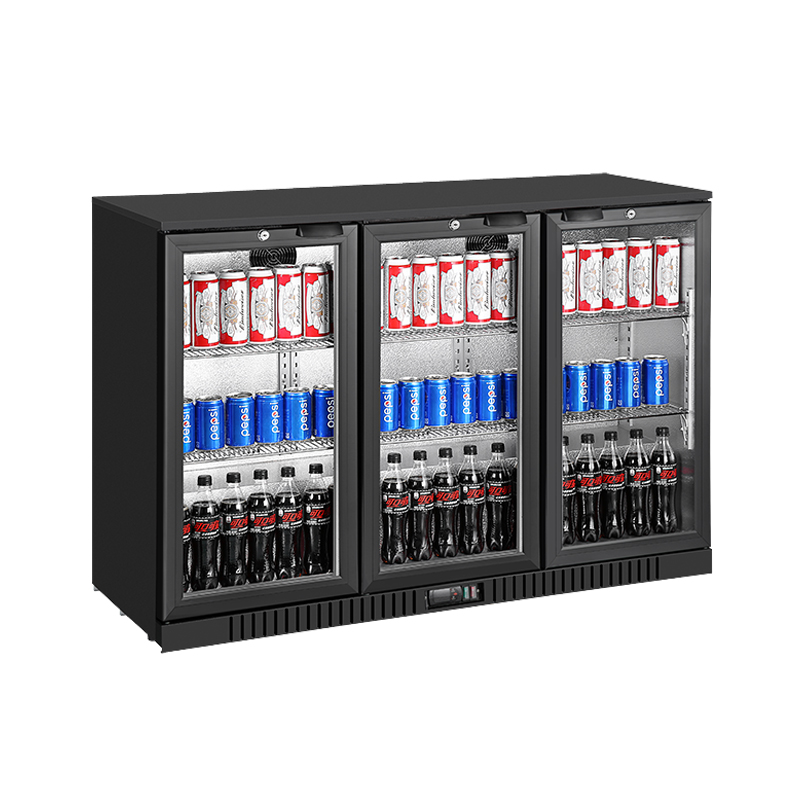
The 3 door commercial beer cooler is built for the working side of a bar: 1350 mm wide, 536 mm deep and 840 mm high, so it sits at counter height along a back bar, at the end of a bottle-shop run or on the chilled aisle of a convenience store. Three glass doors open onto two chrome shelf levels each, which keeps the whole selection — lagers, stouts, ciders, mixers — visible without a bartender or a customer pulling a door open and letting the cold air out.
Beer is what the cabinet is designed around, but it holds anything you serve chilled. It runs from 0 to +10 °C, which covers canned and bottled beer, soft drinks, tonic and bottled water. It is a chilled display, not a freezer. The outer cabinet is pre-painted steel and the interior is embossed aluminium or stainless steel, so a shift's worth of spills wipes out with a cloth.
ESCOLO builds this cabinet as a commercial beer fridge manufacturer supplying bars, restaurants, supermarkets and convenience stores alongside its upright glass door coolers and freezers. The same design is offered in 1-, 2- and 3-door versions with hinged or sliding doors, so one specification can cover a single pub or a multi-site rollout.
| Door configuration | Door type | Width × depth × height (mm) | Loading (20GP/40HQ) |
| 1 door | Hinged | 595 × 536 × 840 | 75/225 |
| 2 doors | Hinged | 900 × 536 × 840 | 48/144 |
| 2 doors | Sliding | 900 × 536 × 840 | 48/144 |
| 3 doors | Hinged | 1350 × 536 × 840 | 32/98 |
| 3 doors | Sliding | 1350 × 536 × 840 | 32/98 |
A glass door beer display fridge for bar service has a harder job than a storage fridge. The doors open every few minutes, warm air spills in, and the next customer still expects a cold bottle. Fan cooling keeps the air moving so the cabinet climbs back to temperature as a whole rather than shelf by shelf, and the glass front means most customers pick their drink without opening a door at all.
The working range is 0 to +10 °C. Towards the bottom of that range you get the sharpest pour from lager and cider; towards the top it suits mixed stock — soft drinks, mixers, bottled water, and darker beers that lose their aroma when served close to freezing. For a venue pouring several styles at very different temperatures, the answer is a second cabinet rather than one compromise setting.
Serving temperature and carbonation travel together. A cabinet that swings between warm and cold makes beer foam at the tap, so once a setting suits your range, leave it there and change it only for a new product line or a change of season.
One thing worth saying plainly: this is a chiller, not a freezer. It brings beer down to serving temperature and holds it there; it will not freeze stock or store ice.
| Item | Detail |
|---|---|
| Minimum order quantity | 1 container (glass door freezer and merchandiser line) |
| Manufacturer | ESCOLO, commercial beer fridge manufacturer |
| Warranty and after-sales | After-Sales Support & Warranty |
| Voltage and plug | Confirmed against your market before production |
| Cabinet marking | Ask your sales contact about branding options |
| Packing | Confirmed with your order |
| Payment and shipping terms | Confirmed with your sales contact |
| Pre-shipment inspection | Arranged with your sales contact |
| Specification sheet | Request the current data sheet from your sales contact |
The 3 door commercial beer cooler is a single-temperature cabinet, so the honest answer to a mixed beer list is that all three doors share one set point. There is no per-door thermostat: the Elitech controller sets one temperature between 0 and +10 °C for the whole cabinet, and fan cooling then holds the shelves within a close band of each other. That is good for consistency, but it means the cabinet cannot run lager at the bottom of the range and stout at the top at the same time.
Plan the range before you set the controller. Write down every beer you intend to display and the temperature you want to serve it at; group the list into styles that sit comfortably at the lower end of the range, such as lager, cider and wheat beer, and those that drink better nearer the top, such as ale, stout and darker malt styles. If the two groups overlap within a few degrees, one setting will cover the list. If they sit at opposite ends of the 0 to +10 °C band, split the range between two cabinets rather than compromising both.
For a mixed list that stays in one cabinet, choose the set point around the biggest-selling or most temperature-sensitive style and treat the others as tolerant stock. Set the controller, leave it for a full pull-down, then check a sample bottle with a probe thermometer rather than trusting the display alone. Taste the first pour from a bottle that has held at that setting for a day; foam, sharpness and aroma tell you more about whether the setting suits that beer than the air temperature does.
Use the doors to separate stock by turnover and handling, not by temperature. Put fast-moving lines behind the door staff open most, keep slower or premium bottles in a door that stays closed, and keep the shelf layout the same from shift to shift so no one has to hunt. Because the cabinet is fan-cooled, loading matters: leave the rear grilles clear and avoid packing bottles tight against the back, or the air will short-circuit and some shelves will run warmer than the controller suggests.
A glass door beer display fridge for bar service also depends on door discipline. Most customers choose through the glass, so the cabinet only loses its hold when staff prop a door open during restocking or leave it ajar at close. If your list includes several styles that genuinely need different serving temperatures, accept that one cabinet is a compromise and plan a second unit — a smaller back-bar cooler for the colder lines, for example — instead of trying to force a single cabinet to do two jobs.
ESCOLO has manufactured commercial refrigeration equipment in Foshan, Guangdong since 2010, and the team now numbers more than 800 people. Fifteen-plus years in the trade, a network of 3,000+ qualified partner factories and an annual output of 200,000+ units let us run container-scale programmes and repeat orders for supermarket, convenience and foodservice buyers. OEM and ODM work is standard: size, colour, function and your own branding are set to the specification you send. Factory audit, pre-shipment inspection, consolidated shipping and after-sales support are handled in-house.
Canned and bottled beer, cider and stout are the main brief, and the same shelves take soft drinks, tonic, mixers and bottled water. It holds between 0 and +10 °C, so treat it as a chilled display rather than a freezer — frozen food, ice cream and bagged ice do not belong in it.
Yes. The cabinet runs a Donper compressor with R600a refrigerant and fan cooling to move the cold air through the shelves. The compressor is the part that decides how a bar cooler behaves in a hot room, which is why a branded unit is specified rather than a generic one.
Two shelf levels sit behind each door, so every door is split into a top and bottom position rather than one deep cavity. That split is easiest to run as a merchandising decision: give one door to tall bottles, one to standard bottles and one to cans and mixers, then set the two levels in each door around the tallest product in that zone. In a bar, the lower level usually carries the label-forward row the customer reads through the glass while the upper level holds the next row for quick restocking. If you plan to stack multi-packs, confirm the per-shelf weight rating with ESCOLO before loading, and ask whether spare shelf sets can ship with the cabinet if you expect to change the line-up by season.
No. The cabinet runs at one temperature across all three sections, set from the front panel. If a venue needs lager close to 0 °C and darker ales around 8 °C, the practical answer is two cabinets rather than one split setting.
It measures 1350 mm wide, 536 mm deep and 840 mm high, with the same 536 mm depth running through the 1-, 2- and 3-door versions. Measure the bar run and the doorway the cabinet has to come through before you order, because the depth is usually the number that decides whether it fits.