Introduction: A rear sliding door lets bakery staff restock a chilled cake case from the work aisle behind the counter instead of stepping into the customer's view.
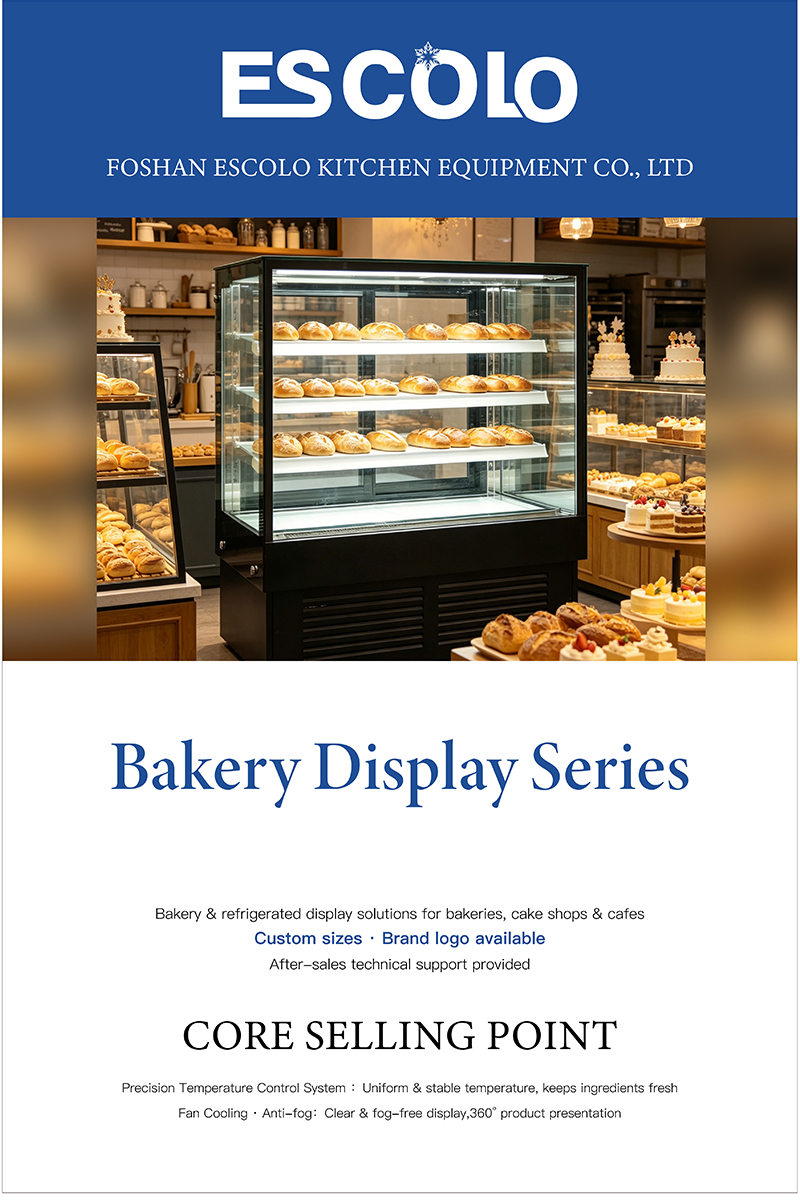
Walk into most small bakeries or cafés at eight in the morning and you will see the same scene: a staff member standing in front of the cake case with both arms full of trays while customers wait to see what is inside. The cooling is rarely the problem. The path the person has to walk is. A case with a back sliding door splits the cabinet into two working sides, one for customers and one for staff, and that split changes how restocking, cleaning, and peak-hour service actually feel. A commercial bakery display refrigerator built around this idea, such as ESCOLO's cake showcase model, pairs a back sliding door and a front curved glass panel with two standard internal shelves (three-layer customization is optional) and a 2°C to +8°C showcase range.
In a front-loading case, every refill is a small interruption to selling. The staff member stands inside the customer zone, opens the front, reaches over the display, and blocks the glass while trays are swapped. A rear sliding door removes that step entirely. The panel slides along the back of the cabinet, so the person loading stands in the work aisle and the restocking path shrinks from a loop around the counter to one step sideways. That difference matters most in shops where a single person is watching the register, the coffee machine, and the cake case at the same time.
With the door at the back, trays enter from the staff side and the front curved glass stays closed. Nothing is passed through the customer-facing panel, so the display keeps its shape while it is being refilled. A worker can slide the panel open, set a tray down on one of the two standard shelves, ease older pieces forward, and close the panel again without ever standing in front of a customer. On heavy days, the optional third shelf earns its keep: more stock stays inside the cabinet, so the number of trips per hour drops and each trip is shorter.
Bakery traffic has a shape. Mornings and holiday weekends push a lot of people through the counter in a short window, and the cake case gets emptied and refilled several times before noon. Rear loading lets one person top up the front rows while another serves, because the person restocking never enters the queue area. The gain is operational rather than promotional: it keeps two jobs from competing for the same square meter of floor. During a holiday rush, that separation is often what keeps the counter tidier and the line moving, even when the cabinet itself is unchanged.
The front curved glass is what makes the cabinet worth looking at, and it is also why staff cannot simply reach in from the customer side. Every piece of stock has to be placed from behind. That means each shelf needs to be arranged before the door slides shut: labels facing out, gaps closed, taller pieces positioned so they do not hide the row behind them. The curve also catches light from the room, so where the case sits relative to windows and ceiling fixtures changes how much reflection a customer sees from the aisle. Cleaning follows the same logic. The customer-facing glass is the surface people notice, so wiping it belongs to service, not only to closing. Fingerprints, dust, and light condensation around the frame all read as "stale" to a shopper deciding whether to buy a slice of cake. The World Health Organization's five keys to safer food guidance puts clean surfaces and careful handling at the center of safe food service, and a rear-loading cabinet supports those habits naturally by keeping the glass closed while trays move in and out.
Because staff load from the back, the shelf edge nearest the door is the easiest to reach, and the front edge of each shelf is a longer stretch. Plan the layout around that. Fast-moving items belong near the rear edge of a shelf where they can be topped up in one motion, while decorative or slow-selling pieces can sit toward the front, where they are seen often but touched less. The trade-off is visibility: anything tall placed at the front of a shelf hides the row behind it, so front glass stays informative only when shelf heights step down toward the customer. Cleaning habits change too. A rear door gives the cabinet two faces instead of one. The display interior and front glass are still wiped daily, but the sliding panel, its track, and the floor strip behind the cabinet collect crumbs and dust out of customer sight, which is exactly why they get skipped. A short closing routine covers it: wipe the glass, wipe the track, sweep the aisle behind. The 2°C to +8°C range keeps the case running cold all day, so every minute the rear panel stays open lets chilled air out and room air in; working quickly and closing the panel between loads keeps the cabinet closer to its set range. Service clearance around the compressor side matters as well, and commercial equipment planning references such as ASHRAE's ventilation standards are the usual starting point for how much breathing room that requires.
Rear access is a workflow feature, not a decorative panel. A rear sliding door separates the person loading from the person buying, which makes restocking easier to schedule around service and keeps the front curved glass doing its job as a display surface. Staff still cross the sales floor for other tasks, and the door supports hygiene routines rather than replacing them, since cold holding and clean surfaces remain daily responsibilities. Store operators comparing cabinets can use the ESCOLO commercial bakery display refrigerator listing as a reference for the visible facts: rear sliding door position, front curved glass, two standard shelves with optional three-layer customization, and a 2°C to +8°C range.
A:It moves the whole loading action behind the cabinet. Instead of opening the front and reaching over the display, staff slide the rear panel and place trays on the shelves from the work aisle, so the customer-facing glass stays closed and the sales floor is not blocked. Refills become a step sideways rather than a walk around the counter.
A:The front glass is the only view a shopper has of the cakes, so anything that blocks, smears, or crowds it costs attention at the exact moment someone is deciding what to buy. Loading from behind keeps the glass clear during refills, and it also means shelf heights and piece placement have to be planned so the rows behind stay visible.
A:Work from the rear edge outward. Keep fast-selling items within easy reach of the door, place decorative or slow-moving pieces toward the front where they are seen but handled less, and step shelf heights down toward the customer so nothing blocks the row behind. Two standard shelves are enough for many shops, with a third layer added when stock depth needs to grow.
Five keys to safer food manual
Commercial Bakery Display Refrigerator with Premium Cake Showcase Design